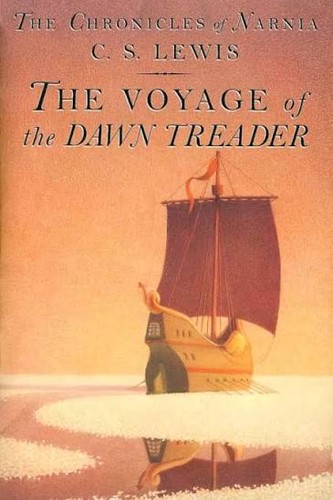

Themes
- children's fantasy
- classic
- sea voyage
- islands and dragons
- redemption arc
- Christian allegory
- read-aloud
Read it if
- you dream of a voyage into the unknown where every horizon hides a new island and a new puzzle
- you love characters who start out as obnoxious know-it-alls and end up as someone you'd want on your crew
- you want a classic to read aloud that comes with a dragon, a sea serpent and a mouse with a rapier
Skip it if
- you want one big plot with one villain to beat, because here every island is its own short story
- a finale with no battle, just silence, light and a sea of lilies, sounds boring to you
- a Christian allegory spelled out almost openly at the end pulls you right out of the story
Why this rating
🧠 For connoisseurs
6/10- Eustace. The best redemption arc in the series, and yes, I'm counting Edmund's in The Lion, the Witch and the Wardrobe. Lewis opens with pure satire – a boy who likes beetles only when they're dead and pinned to a card, and who keeps a diary where he wins every argument after the fact – then turns him into a dragon sobbing alone in a valley. The scene where he scratches off one layer of skin after another until Aslan has to do it for him reads like a picture of conversion to an adult, and like something that hurts and heals at the same time to a kid.
- Lucy and the Magician's Book. The strongest chapter in the book, and Lucy finally gets a flaw of her own: a beauty spell with a picture of a jealous Susan, a friend overheard on a train and a story she isn't allowed to read twice. Lewis writes about vanity and gossip here without preaching, and Aslan's line that nobody is ever told what would have happened lands perfectly.
- The Dark Island. A place where dreams come true – the kind that make you scared to fall asleep again. Lewis never describes a single nightmare, and that's exactly why it works: every reader fills in their own.
- Island after island. The plot is a string of episodes threaded on a voyage. Every stop has its own problem and its own fix, and the big goal, finding seven lost lords, gets crossed off along the way. Between islands the tension drops to zero and restarts at the next shoreline.
- Aslan as the emergency exit. A passing lion breaks up the fight over the gold-making pool, an albatross leads the ship out of the Darkness, and a golden lion's head on the cabin wall settles who sails on and who turns back. The heroes rarely get out of trouble on their own steam.
- A bland Caspian and jabs from another era. The king is mostly nice and good-looking, until the finale, when he throws a tantrum like a sulky teenager. The narrator mocks Eustace's progressive parents and his school with no corporal punishment, and the Calormenes get one sentence about dark faces, wealth, fine manners and cruelty before the book moves on.
💖 For comfort readers
7/10- A dragon, a sea serpent and slave traders. There's enough adventure here for three books: a slave market, a storm that snaps the mast, a dragon's cave full of gold, a sea serpent coiling around the ship, invisible enemies and an island of nightmares. Every chapter brings a new shore and a new kind of trouble.
- Reepicheep. A two-foot mouse with a rapier who challenges anyone who insults his tail, charges his knight to certain death in chess and spends his nights comforting a dragon with stories about the Wheel of Fortune. Without him, half the islands would be just pit stops.
- Humor. Eustace's diary, where the storm lasts a day longer because nobody else can count, the Dufflepuds cheering every word their Chief says and planting boiled potatoes, a governor who hides behind paperwork when the king walks in. The jokes are simple, but they land.
- Atmosphere. A ship with a purple sail, a sun that grows bigger every morning, water you drink like light and a sea of white lilies. Near the end everything goes quiet and bright, like a dream you don't want to wake up from.
- The brakes in the finale. After the Dark Island the action slows into contemplation: talks with a star, white birds, lilies and goodbyes. If you were waiting for a battle at the end of the world, you get a lamb and fish on a campfire.
The book's four layers
Plot and pacing
The idea is simple and gorgeous: a ship sails east until the world runs out. Each island is its own story with its own mood – politics on the Lone Islands, dread in the dragon's valley, comedy with the Dufflepuds, horror in the Darkness – but nothing ties them together except the map and the list of lords. Tension rises and falls with every landfall, and Aslan pulls the heroes out of the worst spots.
Characters and relationships
Eustace is one of the best-written characters in children's fiction, from the very first sentence, where the narrator says he almost deserved his name, to the dragon crying in the valley. Reepicheep is Don Quixote and d'Artagnan in one small furry body, and Lucy gets the best chapter in the book. Caspian, Edmund and Drinian, on the other hand, are likable but flat, and the villains each fit into a single scene.
Writing style and atmosphere
The chatty narrator stops to explain port and starboard in brackets, then turns around and describes light, silence and the smell of lilies so well you can taste the salt. The Last Sea, with its underwater city, a girl herding fish and the wave at the end of the world, holds some of the most beautiful pages in children's literature. What grates: the digs at Eustace's progressive parents and school, and a moral spelled out too plainly at the end.
Entertainment and value
For a kid, it's a summer at sea with monsters and magic; for an adult, a story about how you can change, but only if you let someone help you. It leaves plenty to talk about: greed, vanity, eavesdropping, courage and saying goodbye to childhood. It grips less than The Lion, the Witch and the Wardrobe, but it stays with you longer.
The book in brief, spoiler-free
Edmund, Lucy and their insufferable cousin Eustace fall through a painting straight into the sea and sail east with King Caspian, island by island, toward the end of the world. Stranger and more adventurous than The Lion, the Witch and the Wardrobe, with a beautifully written transformation and a plot that's a list of stops instead of one big scheme.
Want the plot step by step?SummaryThemes it explores
C.S. Lewis writes a road trip on water, where every stop tests someone's weak spot. Eustace loses to greed and selfishness, Caspian to gold fever and royal pride, Lucy to vanity and the urge to know what people say about her, and the whole crew to fear in the Darkness. The heart of it is Eustace: a boy who arrives in Narnia as a smug know-it-all, turns into a dragon and gets his human shape back only when he lets Aslan tear the skin off him. Adults will recognize baptism and conversion in that scene, and in the finale – a lamb on the shore, fish roasting over a fire and Aslan saying he has another name in our world – a Christian allegory served almost openly. Kids will read it as an adventure with a lion who is good but not tame. Running alongside is a story about longing: Reepicheep sails east with no thought of treasure or glory, he just wants to see what's past the edge of the world, and the water of the Last Sea tastes like light. A few things are worth knowing before you read it with a child. The Calormenes show up only as slave buyers, summed up by the narrator in one sentence about dark faces, wealth, elaborate manners and cruelty. Susan isn't in this book at all: she has gone to America with their parents, and in Lucy's enchanted vision she appears as a sister jealous of Lucy's looks.
The main threads: the voyage east (seven lost lords and a mouse who wants to reach Aslan's country); Eustace's transformation (from a diary full of grievances through a dragon's cave to a boy you'd hardly recognize); freedom (a ban on the slave trade and a governor who defends it with statistics); temptation (the gold-making pool, the beauty spell, eavesdropping on friends and the Stone Knife that put three lords to sleep); fear (the Dark Island, where dreams come true, and the light that leads the ship out); honor (Reepicheep, who never retreats, and Caspian, who has to learn that a king can't run off after adventure); and the end of the world (sweet water, lilies, a wave that stands still and a goodbye to Narnia).
Questions and answers
Do I need to read The Magician's Nephew first?
No – The Magician's Nephew tells a different story long before this one, and nothing here depends on it. What does help is knowing The Lion, the Witch and the Wardrobe and especially Prince Caspian: this book picks up Caspian three years into his reign, mentions the usurper Miraz and Trumpkin the regent, brings back Reepicheep, famous since the second battle of Beruna, Lucy's diamond bottle of cordial and the Stone Knife the White Witch once used. You can start here and follow the adventure fine, because Eustace is a total newcomer and you learn Narnia alongside him, but you'll miss the joy of the reunions.
What's the Chronicles of Narnia reading order?
I recommend reading in Narnian chronological order, which is also the numbering on current HarperCollins editions: 1. The Magician's Nephew, 2. The Lion, the Witch and the Wardrobe, 3. The Horse and His Boy, 4. Prince Caspian, 5. The Voyage of the Dawn Treader, 6. The Silver Chair, 7. The Last Battle. Full disclosure: that's not the order Lewis published them in – The Lion, the Witch and the Wardrobe came out first, in 1950, and Dawn Treader was the third one published, right after Prince Caspian. Either order works for this book. Next up is The Silver Chair, where Eustace gets another adventure.
How many pages is The Voyage of the Dawn Treader?
About 250 – the US HarperTrophy paperback runs 248 pages, though it depends on the edition. It's 16 chapters, nearly every one with a new island or a new adventure, so it works great at one chapter a night.
Is The Voyage of the Dawn Treader appropriate for 9 year olds?
Yes, I recommend it from 9, like the whole series. There's no romance and no swearing, but it's scarier than The Lion, the Witch and the Wardrobe: a slave market, a sailor washed overboard and lost in the storm, a dying dragon, a golden body at the bottom of a pool and Aslan tearing off Eustace's dragon skin with his claws. The Dark Island, where nightmares come true, is the creepiest part – Lewis never describes a single one, but a sensitive kid will supply their own. The narrator keeps easing the tension with jokes and quick relief. The ending, with the lamb and Aslan's other name, points straight at religion, which some families will love and others won't.
Is The Voyage of the Dawn Treader YA or a children's book?
It's a children's classic, middle grade by today's labels, not YA – Lucy and Edmund are kids and so is Eustace. Spice is 1/10 on my scale, meaning none at all: the closest thing to romance is a quick joke about a duke who hoped Caspian would marry his daughter. Plenty of teens and adults still reread it, mostly for Eustace and the Last Sea.
Who is The Voyage of the Dawn Treader for?
For kids around 9 to 12 who already know Lucy and Edmund and want to sail further with them, and for parents looking for a classic to read aloud a chapter at a time. Comfort readers get a dragon, a sea serpent, a mouse with a rapier and a sea that turns sweet; connoisseurs get one of the best character transformations in children's fiction and the Magician's Book chapter, along with a plot made of loosely linked episodes. If you loved The Sea of Monsters, you'll find the same island-hopping fun here, just in its mid-20th-century version.
What about you? Have you read this book?
Reader ratings
Your rating might be totally different from mine. A lot depends on when you pick it up.
Your rating on a 1-10 scale
No login needed. One vote per browser – you can change it later.
Disagree? Rate the book above or message me on Instagram or TikTok.
What to read next
 The Silver Chair
C.S. Lewis
The next book in chronological order, where Eustace gets another adventure in Narnia.
★ 7/10🧠 6💖 7🌶️ 19+
Read the review
 The Lion, the Witch and the Wardrobe
C.S. Lewis
The book where Edmund takes the road he admits to Eustace here – and the first Narnia book Lewis published.
★ 7/10🧠 5💖 8🌶️ 19+
Read the review
 The Horse and His Boy
C.S. Lewis
Same series.
★ 7/10🧠 6💖 7🌶️ 19+
Read the review