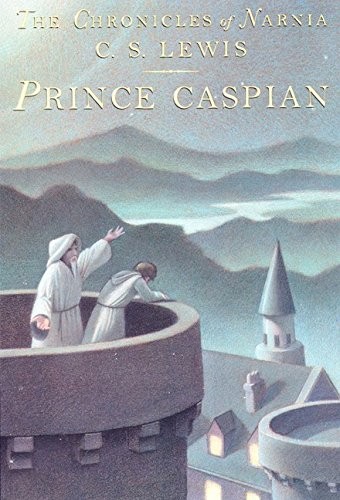

Tropes in this book
- Found family
Themes
- middle grade fantasy
- return to Narnia
- rightful heir vs. usurper
- talking animals
- faith and doubt
- read-aloud pick
Read it if
- your kid just finished The Lion, the Witch and the Wardrobe and wants back into Narnia, even if it's in ruins now
- you like stories about a rightful heir who flees a usurper uncle and builds an army out of outcasts
- you want to meet a mouse about a foot tall with a rapier at his side and more honor than the entire Telmarine army
Skip it if
- you need nonstop action from page one, because a big chunk of the book is a dwarf telling a story and a long hike through the woods
- you expect the title character to be the hero, not a nice boy whose war gets won by other people
- a Christian allegory and a Roman wine god in the same chapter just don't add up for you
Why this rating
🧠 For connoisseurs
5/10- Lucy and the lion nobody else sees. The strongest thread in the series so far. Lucy spots Aslan above the gorge, gets outvoted, and then has to wake four older, exhausted companions in the middle of the night and lead them after an animal they can't see. Edmund backs her because he remembers being the brother who didn't believe her once – a lovely callback to The Lion, the Witch and the Wardrobe. Later Susan admits she believed deep down and just wouldn't let herself, and when Lucy asks what would have happened if she'd gone alone, Aslan tells her plainly that nobody ever gets to know that.
- Nikabrik and the black magic. A bitter dwarf who'll trust anyone willing to help drive out the Telmarines, even the White Witch, is the most interesting antagonist Narnia has had so far. Lewis gives him arguments instead of shifty eyes: years in hiding, losses in every skirmish, dwarfs sent on the worst raids. The council the boys overhear through a door inside Aslan's How, with a hag and a werewolf waiting in the half-dark, is the scariest scene in the book, and Caspian, who mourns Nikabrik afterward, gets more character in that moment than in all his other chapters.
- Intrigue in the tent. Lords Glozelle and Sopespian talk Miraz out of the duel so skillfully that his wounded pride makes him accept it, and then they cash in on his stumble. It's a short, cynical scene of court politics that wouldn't look out of place in a novel for adults.
- The title character on the sidelines. Caspian gets a terrific start: his nurse's forbidden stories, astronomy lessons on top of a tower, a midnight escape with a magic horn. Then he turns into a nice boy whose war is planned by Peter, whose duel is fought by Peter and whose battle is decided by trees. He's at his best near the very end, when he admits to Aslan that he doesn't feel ready to be king.
- A story inside a story. Four chapters of Caspian's backstory come from Trumpkin over breakfast in the ruins, so we learn what the war is about secondhand while the Pevensies sit around eating fish. After that they row, get lost, retreat under arrow fire and trudge through the gorge all over again. Structurally, it's a clear step down from The Lion, the Witch and the Wardrobe.
- An ending that solves itself. The war gets wrapped up by awakened trees and Bacchus's parade, which turns a classroom into a forest glade and, rumor has it, a gang of nasty schoolboys into piglets. It looks great, but everything Peter's duel set up simply resolves on its own. Some of the narrator's jabs grate, too: a class of dumpy girls with fat legs played for laughs, and Edmund announcing that girls can never keep a map in their heads.
💖 For comfort readers
6/10- Back to the ruins. An island, a wild orchard, a gold chess knight with one ruby eye and sixteen steps down to a treasure chamber where Peter's sword, Susan's bow and Lucy's cordial are still hanging. Working out that this is Cair Paravel right alongside the Pevensies is a fantastic opening for anyone who remembers The Lion, the Witch and the Wardrobe.
- Reepicheep. A swashbuckling mouse with whiskers made for twirling and a sense of honor that has him offering to duel anyone who laughs at him, giants included. The scene where a freshly healed Reepicheep spins around three times looking for his tail, while his soldiers threaten to cut off their own, is the funniest bit in the book.
- Trumpkin. A skeptical dwarf who believes in neither the horn nor Aslan but goes wherever he's sent. He loses a sword fight to Edmund and an archery contest to Susan, gets nicknamed DLF – Dear Little Friend – and ends up tossed in the air by Aslan like a kitten. Warm, funny and easy to love from his first scene.
- The duel and the battle. A challenge written in grand old-fashioned legalese, a paw-sucking bear serving as marshal of the lists, Peter versus Miraz with a timeout to bandage a wrist, and mice stabbing Telmarine soldiers in the feet. Younger readers finally get the excitement they've been waiting for all book long.
- Long hikes. Before Aslan roars, there's a lot of walking: the island, the boat, the woods, the gorge, a retreat under arrows and the gorge again. A kid used to faster books may get restless somewhere in the middle.
The book's four layers
Plot and pacing
The premise is great: coming back to a country where centuries have passed and you've turned into a legend. The construction limps, though. First the Pevensies listen to Caspian's story for four chapters, then they wander around lost, and the war is settled by trees and Bacchus. The best moments – the night march behind an invisible Lion and the council in Aslan's How – grow out of the characters' own choices; most of the rest just happens near them.
Characters and relationships
Lucy gets her most serious role in the series, Edmund has grown up and stands by her, and Susan gets a real, human doubt instead of only playing the cautious one. Trumpkin, Trufflehunter, Nikabrik and Reepicheep are as vivid as the best animal fables. Caspian, despite the title, stays a pleasant sketch, and Miraz is the evil uncle with exactly one emotion: anger.
Writing style and atmosphere
The storyteller narrator is in fine form: the ruins of Cair Paravel, trees dancing in the moonlight and Aslan's roar waking rivers and towns make for gorgeous pages, and a feast where the trees eat fine gravel sprinkled with silver sand for dessert is pure charm. What grates are the cracks about dull schoolgirls and piggish boys, plus Bacchus and his crew dropped into a Christian allegory without a word of explanation.
Entertainment and value
For a kid who loved The Lion, the Witch and the Wardrobe, it's a must-read return trip with Reepicheep and Trumpkin thrown in, and it leaves faith, doubt and buried history to talk about afterward. An adult will notice that for a good stretch there's more walking than happening. Without the wardrobe book behind it, this one holds up noticeably worse than its predecessor.
The book in brief, spoiler-free
A year after the wardrobe, the four Pevensies get yanked off a railway platform and land in a Narnia where centuries have passed, the animals and trees have gone silent, and a young prince is on the run from the uncle who stole his crown. It's smarter and more political than The Lion, the Witch and the Wardrobe, with the series' best take on faith and doubt – but for long stretches the heroes are either listening to a dwarf's story or lost in the woods.
Want the plot step by step?SummaryThemes it explores
Faith without proof is the real subject of this book. Lucy sees Aslan and the others don't, and she has to choose between staying with her siblings and following him on her own. Lewis makes no secret that he's thinking about trust in God, but he gets there through a feeling every kid knows – the sting of nobody believing you – and through Susan's shame at having believed all along without wanting to admit it. The second axis is memory: the Telmarines silenced the animals and trees, banned the stories of Old Narnia and raised their people to fear the woods and the sea, while the truth survives with a nurse, the half-dwarf Doctor Cornelius and a badger who doesn't change. The third is power: a usurper who murdered his brother, two lords who goad him into a duel, and Nikabrik, ready to reach for black magic if it means winning. Near the end, Aslan tells Peter and Susan they're too old to come back to Narnia. Here it reads like the ache of growing up, but it's worth knowing that Susan's fate comes back in the final book, and that's the part of the series readers argue about most. Alongside the Christian allegory, Lewis brings in Bacchus and Silenus from classical myth, and he traces the Telmarines back to pirates who killed the people of an island – two threads a parent may want to talk through with a kid.
The main threads: return after centuries (the ruins of Cair Paravel, a wild orchard and a treasure chamber full of gifts from ages past); forbidden history (a nurse sent away for her stories, astronomy lessons on the tower and the truth about the Telmarines); the prince's escape (the birth of Miraz's son, a midnight ride with the horn and a badger's cave); Old Narnia in hiding (bears, dwarf smiths, a centaur, fauns and Reepicheep's company of mice); Queen Susan's horn (the call that pulls the Pevensies off a railway platform); faith and doubt (Lucy, the vote above the gorge and the night march behind the Lion); the lure of black magic (Nikabrik, a hag and a werewolf at the heart of Aslan's How); the duel and the betrayal (Peter, Miraz and two scheming lords); and a door in the air (the Telmarines go back where their ancestors came from, and the Pevensies return to the station).
Questions and answers
Do I need to read The Magician's Nephew or The Lion, the Witch and the Wardrobe first?
You can skip The Magician's Nephew for this one – nothing in Prince Caspian depends on it. The Lion, the Witch and the Wardrobe is a different story: the very first sentence points back to the wardrobe adventure, and the whole opening works because you recognize Cair Paravel in the ruins along with the Pevensies. Without that book, the gold chess knight, Susan's horn and the cracked Stone Table inside Aslan's How mean nothing. The Horse and His Boy, which comes right before Prince Caspian in chronological order, is nice to have but not required here.
What order should I read The Chronicles of Narnia in?
I recommend reading them in the order things happen inside Narnia: The Magician's Nephew, The Lion, the Witch and the Wardrobe, The Horse and His Boy, Prince Caspian, The Voyage of the Dawn Treader, The Silver Chair and The Last Battle. US editions use that same numbering, which makes Prince Caspian book 4. Publication order looks different – The Lion, the Witch and the Wardrobe came out first, in 1950, and Prince Caspian was the second book published. Either way, read it after the wardrobe book. Next up chronologically is The Voyage of the Dawn Treader.
How many pages is Prince Caspian?
About 240 – the HarperTrophy paperback runs 240 pages, though it depends on the edition. There are 15 chapters, which works out to just over two weeks of bedtime reading if you stick to a chapter per evening.
Is Prince Caspian appropriate for 9 year olds?
Yes – 9 works, same as for The Lion, the Witch and the Wardrobe, though there's noticeably more fighting this time. No romance, no swearing. A few scenes are worth having an adult nearby for: in a dark chamber Trumpkin cuts off a hag's head, a treacherous lord stabs Miraz while he's down, and Reepicheep is carried off the battlefield on a stretcher, barely alive. Each lasts a few sentences, and the narrator heads right back to jokes and feasting. Bacchus's crowd drinks wine, which is easy to comment on while reading aloud. A 12-year-old will get through it without trouble, though the cozy storyteller voice may feel young to them.
Is Prince Caspian YA or middle grade? Is there any romance?
It's a children's book – middle grade, really – and I'm reviewing it as a crossover for younger readers, not pretending it's YA. Spice is 1/10 on my scale, which here means zero: no crushes, no kisses, not even a meaningful glance. The heroes are schoolkids (Lucy is just about to start boarding school), and the grown-up layer lives in the themes, not the content.
Who is Prince Caspian for?
Kids around 9 to 12 who've finished The Lion, the Witch and the Wardrobe and want more Narnia, and parents looking for something to read aloud. Comfort readers get the ruins of Cair Paravel, Reepicheep, Trumpkin and a duel for the throne; connoisseurs get the series' most grown-up take on faith and doubt and a bitter, believable Nikabrik, along with a clearly uneven structure. Parents should know the Christian allegory sits right on the surface, a wine god from mythology romps alongside it, and the line about Peter and Susan being too old for Narnia opens a debate fans of the series are still having. How to feel about it makes a good conversation with your kid.
What about you? Have you read this book?
Reader ratings
Your rating might be totally different from mine. A lot depends on when you pick it up.
Your rating on a 1-10 scale
No login needed. One vote per browser – you can change it later.
Disagree? Rate the book above or message me on Instagram or TikTok.
What to read next
 The Voyage of the Dawn Treader
C.S. Lewis
The next book in chronological order, where Edmund and Lucy get the return trip to Narnia that this ending promises them.
★ 7/10🧠 6💖 7🌶️ 19+
Read the review
 The Silver Chair
C.S. Lewis
Same series.
★ 7/10🧠 6💖 7🌶️ 19+
Read the review
 The Lion, the Witch and the Wardrobe
C.S. Lewis
The book you really need first – without it, the ruins of Cair Paravel, Susan's horn and the Stone Table lose half their punch.
★ 7/10🧠 5💖 8🌶️ 19+
Read the review