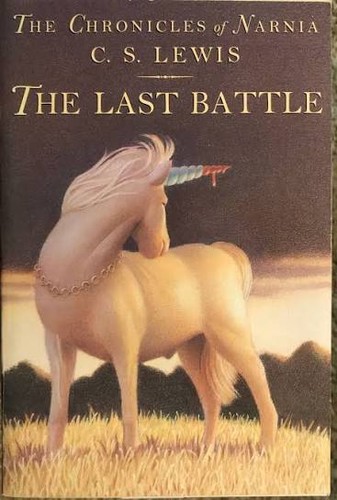

Themes
- children's fantasy
- classic
- series finale
- false prophet
- faith and doubt
- end of the world
- Christian allegory
Read it if
- you've read the earlier books and want to see how Lewis closes the Narnia you've known since its very first day
- you like stories about a liar in power whose every lie sounds just a little like the truth
- you want a classic that opens a real conversation with a kid about death, faith and who to trust
Skip it if
- you know Narnia from just one book, because without the rest of the series the finale loses half its punch
- the way old books portray foreigners bothers you, and the Calormenes come off worse here than anywhere else in the series
- you're hoping for an adventure that ends with a victory and a trip home
Why this rating
🧠 For connoisseurs
6/10- The ape and his propaganda. Shift is one of the best-written villains in children's literature. He convinces the donkey that thinking isn't his strong suit, declares himself a Man rather than an ape, calls slavery well-paid work and redefines freedom as doing what he says. His smartest move comes at a midnight meeting: once the donkey has vanished, Shift himself announces that an impostor in a lion skin is roaming the woods, and with one lie wrapped around a truth he takes away Tirian's only proof.
- The Dwarfs. Griffle and his band are the most interesting idea in the book. Fooled once, they refuse to believe anyone ever again – not the ape, not the king, not Aslan. They shoot down the horses galloping in to help, and at the end they sit in a circle in a sunny meadow, swearing they're stuck in a dark, smelly stable. Cynicism that mistakes itself for common sense, drawn with cold precision.
- Emeth. A young Calormene walks into the stable because he wants to see his god's face, even if it kills him. His conversation with Aslan is the most surprising page of the whole series: the Lion accepts every good deed done in Tash's name as service to himself. Lewis, who spent six books keeping Calormen on the dark side, complicates that picture himself.
- Tirian. A king who kills two unarmed men in a rage, then calls himself a murderer and walks back to give himself up for judgment. He's terrified that Aslan will turn out to be someone other than the Aslan he believed in, and he holds the line to the end anyway. The most grown-up hero in the series.
- The Calormenes. The narrator introduces them as dark-skinned, bearded men who smell of garlic and onions, with the whites of their eyes flashing in brown faces. The Dwarfs call them by a racial slur, and once Tirian scrubs off his brown disguise, he says he finally feels like a real man again. Emeth balances this a little, but he doesn't erase it. Better to talk it through with your kid than pretend it isn't on the page.
- Susan on the other side of the door. One of the siblings doesn't make it into the real Narnia because, as the others report in about three sentences, all she cares about now is nylons, lipstick and invitations. She wasn't on the train or on the platform, so she's left behind in our world without her parents or her brothers and sister, and the book doesn't spend a single line on that. Critics have argued for decades that the scene punishes a girl for growing up; Lucy frames it more as immaturity, but the verdict still lands without a trial.
- A parade instead of a finale. Once the heroes are through the Door, they have no more choices to make. What's left is a vision of the end of the world, a lecture on shadows and the real world with Plato in the background, and reunions with characters from earlier books, while Aslan settles the fate of the whole crowd in two sentences.
💖 For comfort readers
5/10- The night raid. A disguise made from a juice that stains your skin brown, a sentry taken down with a fake friendly handshake, and Jill slipping into the stable on her own and leading the false Aslan out by the halter. One of the best adventure chapters in the whole series.
- Tirian and Jewel. The king and the unicorn ford a river together, surrender together and say goodbye before the last night. Their friendship carries the emotion of the entire book, and the mice feeding the tied-up king wine from a cup the size of an eggshell will melt anyone.
- The reunion. If you've read the whole series, the finale brings everyone back: Reepicheep, Mr. Tumnus, the Beavers, Caspian, Bree and Hwin, Fledge. It'll get to anyone who grew up with these characters.
- Dark from the opening chapters. A dryad dies in front of the king, Dwarfs shoot down horses, a bear, dogs and a centaur die, and Narnia loses the war. Lewis offers no victory as consolation, and the consolation on the last page unsettles plenty of kids more than the battle itself.
- Theology instead of adventure. The last chapters are an apocalypse, a judgment of every creature and a meditation on what's real and what's only a reflection. If you came to Narnia for the adventures, you may feel the book stops talking to you right at the end.
The book's four layers
Plot and pacing
The first two-thirds are the best-built plot in the series: the lie grows, changes shape and stays one step ahead of the heroes every time, and a stable nobody wants to walk into keeps the tension high for three chapters. Once the heroes pass through the Door, the story becomes a vision of the end of the world and a journey deeper into paradise – beautiful, but with nothing left at stake. An ending that reveals a railway accident in a single line is going to split readers.
Characters and relationships
Tirian, Jewel, Shift, Ginger, Griffle and Emeth are the best cast Narnia ever had. Eustace and Jill are paler than in The Silver Chair, though Jill gets her moments in the night woods and at the stable, while Peter, Edmund, Lucy, Digory and Polly show up like guests of honor at graduation. Susan gets three sentences and a verdict.
Writing style and atmosphere
Lewis writes his best prose of the series here: a forest gone silent, with no fauns' flutes and no Dwarf hammers underground, stars falling like silver rain, dragons crunching up trees like rhubarb and a sun squeezed like an orange. The chatty narrator still talks to the reader, but in this book he goes quiet more often than he comforts. What grates is the portrayal of the Calormenes and the old-fashioned remarks about what's proper for girls.
Entertainment and value
A book to talk about, not just read and shelve: lies that pass for the truth, faith and cynicism, whether it's okay to cry for a world that has ended. At the same time, you'll have to explain the Calormenes and Susan to your kid, and the ending can be rough on younger readers. Essential as the close of the series, weaker as an adventure than the books before it.
The book in brief, spoiler-free
In Narnia's last days, an old ape dresses a donkey in a lion skin and announces that Aslan is back, and young King Tirian ends up almost alone against a lie the whole country has swallowed. The darkest book in the series: a sharp story about propaganda and losing faith, and also the one where you can see most clearly when Lewis was writing and which prejudices he brought with him.
Want the plot step by step?SummaryThemes it explores
C.S. Lewis closes Narnia with a story about a lie wrapped around a truth. Shift doesn't invent a new religion – he dresses up the old words, repeating that Aslan is “not a tame lion” and using it to justify logging, slavery and fear. The scariest part, though, is what's left once the fraud is exposed: the Dwarfs, fooled once, refuse to believe in anything and would rather sit in an imaginary darkness than risk being disappointed again. It's the most openly Christian book in the series – a false prophet, an apocalypse with falling stars, a judgment at the Door and Lucy's remark about a stable in our world that once held something bigger than the whole world – and also the least predictable one, because Aslan accepts the good deeds Emeth did in Tash's name, and Digory explains the real Narnia through Plato. On top of all that sits the question of death, which the book answers with comfort, even though it leaves many readers uneasy.
The main threads: the false Aslan (a donkey in a lion skin, an ape in a scarlet jacket and orders issued in the name of someone nobody is allowed to see); propaganda (Tash and Aslan merged into “Tashlan,” slavery called wages and midnight meetings by the bonfire); faith and doubt (Tirian, who fears Aslan won't be who he believed, and the Dwarfs, who choose cynicism); loyalty (Tirian and Jewel, the mice feeding the bound king and the dogs who are the first to rally to him in battle); Calormen and outsiders (a country shown as a cruel invader and described by skin color, and yet Emeth, the noblest man in the book); the end of the world (Father Time, falling stars, dragons and the sea swallowing Narnia); and the real Narnia (a country deeper than the old one, where the inside is bigger than the outside).
Questions and answers
Do I need to read The Magician's Nephew first?
Yes – and really all six books before this one. The Last Battle is the finale that ties the whole series together: Eustace and Jill are the pair from The Silver Chair, Calormen and Tash come from The Horse and His Boy, and the garden in the last chapter is full of characters from every book. I recommend chronological order, following Narnia's own history: The Magician's Nephew, The Lion, the Witch and the Wardrobe, The Horse and His Boy, Prince Caspian, The Voyage of the Dawn Treader, The Silver Chair and The Last Battle, which is also how HarperCollins numbers the books today. Publication order is different (The Lion, the Witch and the Wardrobe came out first, in 1950), but The Last Battle (1956) closes the series either way. Read at the end of the chronology, it gives you one extra gift: Digory and Polly, who watched Narnia being born in The Magician's Nephew, are there to watch it end.
How many pages is The Last Battle?
211 pages in the US HarperCollins paperback, though it depends on the edition. It has 16 chapters, so if you read one aloud every night, you'll finish in about two weeks.
What age is The Last Battle appropriate for?
9+, like the rest of the series, but parents should know up front: this is the saddest of the seven books, and by the end, characters your kid has known since the early books are gone. There's no romance, no real swearing and nothing gory, but death is everywhere: a dryad drops dead in front of the king, Tirian and the unicorn kill two unarmed Calormenes, Dwarfs shoot down horses, the bird-headed demon Tash carries off a commander, and in the end the whole world of Narnia dies. The hardest part is the ending: it turns out the heroes and the Pevensies' parents were killed in a railway accident, and the book presents that as a happy ending. A nine-year-old can read it with a parent nearby, especially a kid who has recently lost someone – it's a great starting point for a conversation, just not a book to read alone.
How spicy is The Last Battle?
1/10 on my spice scale, which means none. There's no romance at all, not even a crush – the closest it gets is Jill falling a little bit in love with a unicorn.
Is The Last Battle YA or a kids' book?
It's a children's classic – middle grade, by today's shelving. The heroes are schoolkids and a young king, and the narrator talks straight to a young reader. Teens and adults come back to it for the allegory, the theology and the arguments about Susan, but it isn't YA, and I'm rating it for what it is.
Who is The Last Battle for?
Kids roughly 9 to 13 who've read the earlier books and want to know how Narnia ends, and parents looking for a book that opens a conversation about manipulation, faith and death. Connoisseurs get a brilliantly written propagandist ape, the Dwarfs and Emeth, but also Calormenes defined by their skin color and Susan dismissed in three sentences. Comfort readers get a thrilling night raid and a reunion of every hero in the series, along with a dark mood and a finale where thoughts about the afterlife take the place of adventure.
What about you? Have you read this book?
Reader ratings
Your rating might be totally different from mine. A lot depends on when you pick it up.
Your rating on a 1-10 scale
No login needed. One vote per browser – you can change it later.
Disagree? Rate the book above or message me on Instagram or TikTok.
What to read next
 The Voyage of the Dawn Treader
C.S. Lewis
Same series.
★ 7/10🧠 6💖 7🌶️ 19+
Read the review
 The Silver Chair
C.S. Lewis
Same series.
★ 7/10🧠 6💖 7🌶️ 19+
Read the review
 The Magician's Nephew
C.S. Lewis
Same series.
★ 7/10🧠 6💖 7🌶️ 19+
Read the review