 Compiled by T.O. Lyceum
Tropes in this book
- Zero to hero
Themes
- children's fantasy
- classic
- desert escape
- talking horses
- zero to hero
- long-lost prince
- read-aloud
In brief
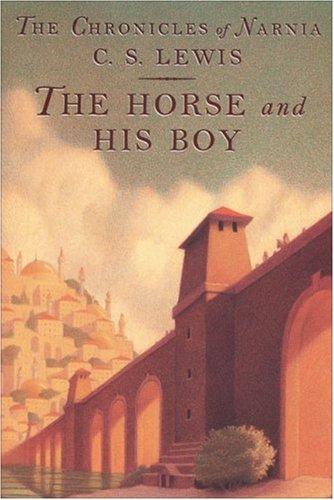
The Horse and His Boy by C.S. Lewis is book 3 of The Chronicles of Narnia in chronological reading order (the order current US editions use), though it was the fifth to be published, and it's the only book in the series whose main characters aren't children from our world. It's set in the Golden Age, when Peter, Susan, Edmund and Lucy rule Narnia, but most of it takes place far from Narnia, in Calormen, a vast empire to the south. Shasta, a boy raised by a harsh fisherman, overhears a visiting lord haggling over his price, and that night discovers that the guest's horse can talk.
Bree, a Narnian warhorse stolen as a foal, suggests they run away to the North together. Along the way they're joined by Aravis, a Calormene noblewoman fleeing a marriage to a much older courtier, and her talking mare, Hwin. To reach Narnia, the four have to get through the Tisroc's capital and across the desert, and in Tashbaan Shasta is mistaken for someone else entirely and stumbles onto plans that will decide the fate of two kingdoms.
Read this book? Rate it
Reader ratings
Your rating on a 1-10 scale
No login needed. One vote per browser – you can change it later.
Spoilers ahead. The plot breakdown gives away the ending. If you don't want to know it, stop at the description above.
Plot breakdown
- 1
A boy for sale
In Narnia's Golden Age, when Peter is High King and rules alongside his brother and two sisters, a poor fisherman named Arsheesh lives by a small inlet in the far south of Calormen with a boy called Shasta, who calls him father. The fisherman beats him for the slightest reason, and Shasta has always longed for whatever lies north of the hill behind their hut, even though nobody ever goes that way. One evening Anradin Tarkaan, a Calormene lord with a beard dyed crimson, turns up and wants to buy the boy. Listening through a crack in the wall, Shasta overhears the haggling (the guest offers fifteen crescents, the fisherman demands seventy) and learns that he isn't Arsheesh's son: the fisherman found him as a baby in a boat washed ashore, next to a man who had died of hunger. The Tarkaan's dappled horse turns out to be a talking horse from Narnia, stolen as a foal. He warns that Anradin is a bad master and proposes they run away together: a horse without a rider would be caught as a stray, and a boy on foot won't get far. Shasta, who has only ever ridden a donkey, calls the horse Bree, because his full name is impossible to pronounce. They set off north that night, and the horse leaves hoofprints in the sand pointing south.
- 2
Two runaways and two horses
For weeks they travel up the coast. Bree teaches Shasta to ride without reins, using only his knees, and in the saddlebags they find about forty crescents, which the horse declares spoils of war. One moonlit night they sense another rider nearby, and then a lion roars out of the dark. Fleeing, the two horses race neck and neck and plunge into a long inlet of the sea. On the far side it comes out that the mare, Hwin, can talk too, and the armored rider is a girl, Aravis Tarkheena. Aravis tells her story in the grand Calormene style. She's the daughter of Kidrash Tarkaan, lord of the province of Calavar; her stepmother hates her and talked her father into promising her to Ahoshta Tarkaan, a sixty-year-old hunchback who has climbed the ranks through flattery. Aravis rode into the woods intending to stab herself in the heart with her brother's dagger, but Hwin spoke, stopped her and told her about Narnia, where no girl is forced to marry. Aravis pretended to be delighted with the engagement, got her father's leave to spend three days in the woods for a rite in honor of Zardeenah, drugged her maid, and in Azim Balda sent off, through the imperial post, a forged letter from Ahoshta saying he had already married her. She remarks coolly that the maid was probably whipped, and that this is fine, since the girl spied for her stepmother. Shasta and Aravis can't stand each other from the start, but the horses talk them into traveling together. They agree that if they get separated in the capital, they'll meet at the Tombs of the Ancient Kings on the edge of the desert.
- 3
Prince Corin
Disguised as peasants, with the horses rolled in mud and their tails hacked unevenly short, they enter Tashbaan, the Tisroc's capital, which stands on an island between two branches of a river. At the gate a soldier punches Shasta in the face for talking back. On one street a procession of Narnian envoys goes by, and its leader, King Edmund, grabs Shasta by the shoulder, taking him for Corin, the prince of Archenland, who disappeared the night before. Shasta can't explain himself without giving away Aravis and the horses, so he's marched off to the Narnians' lodgings. Queen Susan welcomes him, and the faun Mr. Tumnus decides the boy has sunstroke. Lying on a sofa with an iced sherbet, Shasta listens in on a council. Susan doesn't want to marry Prince Rabadash, the Tisroc's son, who was courteous in Narnia but has shown himself in Tashbaan to be a cruel tyrant, and Edmund fears that once she refuses, they'll all become prisoners and the queen will end up the prince's wife, or his slave. Sallowpad the Raven describes the route across the desert: from the Tombs toward the double peak of Mount Pire, to a hidden gorge and a river that leads to Archenland. Tumnus comes up with a ruse: invite Rabadash to a banquet aboard their galleon, spend the whole day carrying supplies onto the ship and slip away under cover of night. After a lavish dinner Shasta falls asleep, and he's woken by the real Corin climbing in through the window with a black eye and a missing front tooth: he thrashed a boy who insulted Susan, got the city guards drunk on wine and spent the night on a roof. The two boys are as alike as two peas in a pod and feel at once that they're friends. Corin shows Shasta the way out over a roof and along a wall, and as they say goodbye he tells him to go to his father, King Lune.
- 4
A night among the Tombs
Shasta gets out of the city and runs to the Tombs of the Ancient Kings, stone buildings shaped like giant beehives. Nobody is waiting for him, and at sunset the horns of Tashbaan announce that the gates are closing. Terrified of ghouls, the boy spends the night on the sand curled up against a large, dignified cat that has appeared out of nowhere. In the night he's woken by howling jackals, then by a huge animal that drives them off with a roar and turns out, once again, to be the cat. In the morning Shasta scratches an arrow in the sand pointing toward Mount Pire, steals oranges, a melon, figs and pomegranates from a garden by the river, goes for a swim and waits all day. Shortly before sunset he sees Bree and Hwin, groomed and saddled, led by a stranger, a richly dressed servant. Aravis isn't with them, so Shasta hides behind a tomb, suspecting a trap.
- 5
The secret council
When Edmund carried Shasta off, Aravis was left in the street with the horses and gave herself away to a childhood friend, Lasaraleen, a newly married Tarkheena being carried past in a litter. She jumped inside and demanded to be hidden. Lasaraleen, giggly and mostly interested in dresses and parties, can't understand why anyone wouldn't want to marry Ahoshta, who has just become grand vizier, but she agrees to help: she'll send the horses to the Tombs with one of her servants, and she'll lead Aravis out at night through the gardens of the Tisroc's palace to a little gate in the wall by the river. The next evening the girls get lost in the old palace and hide behind a sofa when the Tisroc approaches. Into the room come the Tisroc, Rabadash and Ahoshta. Rabadash is furious that the Narnians have escaped by ship, kicks the vizier for every quotation from the poets and demands war. The Tisroc doesn't want to attack Narnia openly, since it's said to be protected by a demon in the shape of a lion, so his son proposes a raid: with two hundred horsemen he'll cross the desert, take Anvard, King Lune's castle, in peacetime, dash through Narnia to Cair Paravel while the High King is away and seize Susan when her ship arrives home. The Tisroc agrees, but warns that if it fails, he'll disown his son. Once Rabadash has gone, he admits to the vizier that he has eighteen other sons, and that eldest sons have a way of becoming dangerous to Tisrocs. Aravis threatens the terrified Lasaraleen that she'll start screaming unless she's taken to the gate, rows across the river in a small boat and reaches the Tombs. She sends the servant away, and Shasta comes out of hiding.
- 6
The race across the desert
Knowing Rabadash's plan, the four set off at once, steering by Mount Pire. They ride all night and through a blazing day, alternating between trot and walk; the hot sand burns Shasta's bare feet, and Tashbaan stubbornly refuses to drop off the horizon. After moonrise they find the gorge, which leads them to a stream, a waterfall and a grassy valley, where they all fall asleep from exhaustion. They wake late in the morning, and Bree insists on breakfast even though Hwin wants to press on; the narrator observes that slavery has robbed him of the ability to push himself. After fording the river Winding Arrow they're in Archenland, and behind them they see a cloud of dust: Rabadash's cavalry has already arrived. In the middle of a wild gallop a lion catches up with them. Bree runs flat out, and the lion goes after Hwin and Aravis. Shasta jumps off his horse and, with no weapon at all, runs back to help them, shouts at the lion as if it were a dog, and the animal turns and walks away. Not before it has raked Aravis's back with its claws, though. The runaways burst through a gate into a round enclosure of green turf, the home of the Hermit of the Southern March. The old man says Rabadash has already found the ford and tells Shasta to run on immediately and warn King Lune.
- 7
The voice in the fog
The Hermit dresses Aravis's wounds: ten scratches, not very deep, like the marks of a whip. He tells her he has lived a hundred and nine winters and has never come across any such thing as luck. Bree, ashamed that he ran while the boy turned back, wants to go back to slavery, but the Hermit explains that he has lost nothing except his vanity. Shasta, meanwhile, runs through the forest and stumbles on King Lune's hunting party, and the king takes him for Corin. He warns them about Rabadash, is given a horse and rides with the hunters toward Anvard, but falls behind in the fog. At a fork in the road he hides and hears Rabadash order his men to take the castle within the hour and kill everyone inside. Shasta takes the other road, and during the night, weeping over his bad luck, he senses a huge invisible being walking beside him. The voice asks him to tell it his troubles and then explains that there was only one lion on the whole journey. It was the one that drove Shasta to Aravis, it was the cat at the Tombs, it chased off the jackals, it gave the horses the strength to stay ahead of Rabadash, and long ago it pushed the boat with the baby to shore. It also wounded Aravis, but it won't say why, because it tells each person only their own story. Asked who it is, it answers “Myself” three times. At dawn Shasta sees a shining Lion, taller than a horse, walking beside him and falls at his feet. The Lion vanishes, and a spring wells up in his pawprint. Shasta realizes that he crossed the pass in the night and is now in Narnia. The forest animals receive his news with interest and do nothing about it, until a Red Dwarf named Duffle gets a swift stag off to Cair Paravel with the message and then, together with his brothers Rogin and Bricklethumb, feeds Shasta porridge, then eggs with bacon and mushrooms. The boy sleeps through the rest of the day and the whole night.
- 8
The siege of Anvard
In the morning the Narnian army halts by the dwarfs' cottage, with King Edmund, Queen Lucy and Corin, who sailed back to Cair Paravel and heard about the attack from Chervus the Stag. Edmund tells Shasta he doesn't think him a traitor, but advises him to stop eavesdropping. Corin gets into a fight with the dwarf Thornbut, who was supposed to keep him out of the battle; the dwarf sprains his ankle, and the prince talks Shasta into putting on Thornbut's gear and riding with him at the back of the column. Beyond the pass the Narnians sweep down on the Calormenes, who are battering the gate of Anvard with a ram. Back at the hermitage, the Hermit watches the battle in his magic pool and describes it to Aravis and the horses: the great cats panic the enemy's horses, the giants fight on the right wing, the castle garrison sallies out with King Lune, and among those who fall is Anradin, Bree's old master. Shasta loses his sword almost at once, tumbles off his pony and comes through the battle nearly unhurt. Rabadash, whose coat of mail has been torn open by a nail in a giant's boot, leaps from a ledge on the castle wall with a war cry about the thunderbolt of Tash and ends up hanging from a hook like a piece of laundry. King Lune refuses him single combat, since he attacked in peacetime, and has him tied up. Then he hugs Shasta, stands him next to Corin and asks his court whether anyone still has any doubts.
- 9
Cor, Aravis and the donkey
At the hermitage Bree keeps putting off the journey, because he wants to wait for his tail to grow back, and explains to Aravis in a know-it-all tone that Aslan can't really be a lion. At that very moment Aslan leaps down from the wall and tickles his ear with a whisker. Hwin is the first to approach the Lion and tells him she would rather be eaten by him than fed by anyone else. Aslan explains to Aravis that the scratches on her back matched the stripes the whip left on the back of the maid she drugged. Soon afterward Prince Cor of Archenland arrives with a herald and a trumpeter: it's Shasta. He is Corin's lost twin. A centaur prophesied that this boy would one day save Archenland from its greatest danger, so the treacherous former chancellor, Lord Bar, who was in the Tisroc's pay, kidnapped the baby. With King Lune in pursuit, Bar set him adrift in a boat with a single knight, who starved himself to keep the child alive. Aravis apologizes to Cor for how she treated him and accepts the king's invitation to live at his court, and Bree rolls in the ferns one last time before entering the castle. At Anvard, Rabadash refuses mercy, threatens and insults everyone despite Aslan's warnings, so the Lion turns him into a donkey. He'll get his human shape back before the altar of Tash in Tashbaan at the Autumn Feast, but if he ever goes more than ten miles from the temple, he'll turn into a donkey again, this time for good. As Tisroc, he will therefore be the most peaceful ruler in Calormen's history, known behind his back as Rabadash the Ridiculous. At the evening feast Lucy tells the story of the wardrobe, and King Lune announces that Cor, older than his brother by twenty minutes, will inherit the crown, which delights Corin. The brothers argue and fight for years, Corin earns the name Corin Thunder-Fist, and Cor and Aravis, who also quarrel a great deal, eventually marry and become King and Queen of Archenland. Their son, Ram the Great, becomes the most famous of its kings. Bree and Hwin live long, happy lives in Narnia and often visit their friends at Anvard.
Themes and message
- Freedom and slavery
- Shasta, Aravis and two stolen horses run away from a country where people, too, are bought and sold.
- Pride and humility
- Bree, Aravis and Rabadash all have to learn that they aren't as great as they thought, each in their own way.
- Courage
- A boy with no weapon turns back toward a lion, and before his first battle he knows it's now or never.
- Origins and identity
- A foundling from a boat, a boy who looks just like a prince, and the question of who you are when you don't know your parents.
- Providence
- One lion behind all the lions of the journey, and a voice that tells each person only their own story.
- Reluctant friendship
- Two kids who can't stand each other and two horses who make it across the desert together.
This is a summary of “The Horse and His Boy” by C.S. Lewis and its main events. It's not a review, but an overview of the novel's plot and themes.
Is this book for you?You'll find the rating and verdict in the review.
Read the review