 Compiled by T.O. Lyceum
Themes
- middle grade fantasy
- children's classic
- portal fantasy
- siblings
- betrayal and forgiveness
- Christian allegory
- read-aloud
In brief
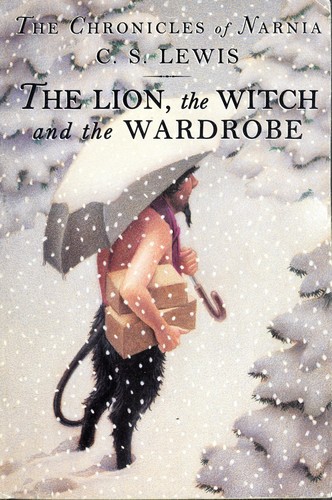
The Lion, the Witch and the Wardrobe is the first Narnia book C.S. Lewis published and the second in the chronological reading order of The Chronicles of Narnia. During the war, four siblings – Peter, Susan, Edmund and Lucy – are sent away from London to the countryside, to the Professor's enormous old house, to be safe from the air raids. On a rainy day the youngest, Lucy, climbs into a wardrobe full of fur coats and, instead of the back panel, finds a snowy forest, a lamppost and a faun carrying an umbrella.
The country is called Narnia, and it's ruled by the White Witch, who makes it always winter and never Christmas. The older siblings don't believe Lucy, and Edmund, who ends up in Narnia on his own, lets the Witch buy him with a box of enchanted Turkish Delight and the promise of a crown. When all four of them make it through the wardrobe, it turns out an old prophecy about two Sons of Adam and two Daughters of Eve is about them, and word is spreading through the woods that Aslan, the great Lion, is on the move.
Read this book? Rate it
Reader ratings
Your rating on a 1-10 scale
No login needed. One vote per browser – you can change it later.
Spoilers ahead. The plot breakdown gives away the ending. If you don't want to know it, stop at the description above.
Plot breakdown
- 1
The wardrobe in the empty room
During the war, Peter, Susan, Edmund and Lucy are sent from London to the countryside, to the big old house of a Professor who lives there with his housekeeper, Mrs. Macready. On their first morning it's pouring, so the kids explore the house and find an empty room with nothing in it but a wardrobe with a mirror in the door. Lucy, the youngest, looks inside, pushes past the fur coats and, instead of the back of the wardrobe, finds a forest at night, snow and a lamppost. There she meets Mr. Tumnus, a faun with an umbrella and an armful of parcels, who invites her back to his cave for soft-boiled eggs, sardines on toast and a sugar-topped cake, and then plays his flute for her. Finally he bursts into tears and confesses that he works for the White Witch, who makes it always winter and never Christmas in Narnia, and that he was supposed to lull Lucy to sleep and hand her over to the Witch. He can't bring himself to do it, walks her back to the lamppost and asks only to keep her handkerchief. Lucy comes home convinced she's been gone for hours, but for her siblings barely a moment has passed. The wardrobe has an ordinary wooden back, and nobody believes her.
- 2
Edmund and the Queen
Over the next few days Edmund is the one who teases Lucy the most. On a rainy afternoon, during a game of hide-and-seek, Lucy hides in the wardrobe, and Edmund follows her in to make fun of her and ends up in Narnia alone. A sledge pulled by two white reindeer stops beside him, and a tall lady in a crown, with a face as white as snow, introduces herself as the Queen of Narnia. With a drop from a little bottle she conjures him a hot drink and a box of Turkish Delight, and while Edmund stuffs himself with sweets, he lets slip that he has a brother and two sisters. The Queen promises to make him a prince and later a king if he brings all four of them to her house between two hills, and tells him to keep it secret. Afterward Edmund runs into Lucy and learns from her that his new acquaintance is the White Witch. Back home, when Lucy triumphantly tells the older two that Edmund was in Narnia too, he puts on a superior face and announces that he was only playing along.
- 3
The Professor's logic
Peter and Susan worry that something is wrong with Lucy and go to the Professor. Instead of reassuring them, he asks how they know their sister isn't telling the truth: there are only three possibilities – she's lying, she's mad or she's telling the truth – and another world might well have its own time. A few days later, dodging Mrs. Macready and a group of visitors touring the house, all four hide in the wardrobe and come out in the snowy forest. Peter apologizes to Lucy, the kids put on fur coats from the wardrobe, and Edmund gives himself away by knowing the way to the lamppost. Mr. Tumnus's cave has been wrecked, and a notice is pinned to the carpet: the faun has been arrested for high treason against the Queen and for fraternizing with humans, signed by the captain of the Secret Police. Lucy refuses to go home when the faun is in trouble because of her, so the kids follow a robin that clearly wants to lead them somewhere. Edmund whispers to Peter that nobody knows whose side the bird is on, or how they'll get home.
- 4
At the Beavers'
Mr. Beaver is waiting in the woods. To prove he's a friend, he shows them Lucy's handkerchief, which Mr. Tumnus managed to pass to him before his arrest, and whispers the news that Aslan is on the move. At the sound of that name each child feels something different, and Edmund feels dread. In the little house on the dam, Mrs. Beaver serves freshly caught trout, buttered potatoes and a marmalade roll. Mr. Beaver tells them that Mr. Tumnus has been taken to the Witch's house, which is full of creatures turned to stone, that Aslan is the great Lion, son of the Emperor-beyond-the-Sea, and that the children are to meet him at the Stone Table. He also explains that the Witch has no real human blood in her, and that an old prophecy says when two Sons of Adam and two Daughters of Eve sit on the four thrones at Cair Paravel, both her reign and her life will end. That's when Lucy notices Edmund is gone. Mr. Beaver has no doubt: the boy has gone to the Witch, because he has already met her and eaten her food. The Beavers and the three children pack provisions and leave at once.
- 5
The Witch's House
Edmund slipped out without his coat and struggles through the snowstorm, consoling himself that as king he'll build decent roads in Narnia and keep Peter in his place. By moonlight he reaches the castle between the two hills. The courtyard is full of statues, and on a stone lion he takes for Aslan turned to stone, Edmund pencils in a mustache and glasses. He's let in by the wolf Maugrim, chief of the Secret Police. By the door of the great hall stands a small stone faun. The Witch is furious that Edmund came alone, but when she hears about Aslan and the Stone Table, she orders her sledge readied without bells and sends Maugrim to the Beavers' house to kill anyone he finds there. Instead of Turkish Delight, Edmund gets a hunk of dry bread and a tin bowl of water.
- 6
Winter ends
The Beavers and the children walk through the night along a narrow path by the river and sleep a few hours in a secret hiding place. In the morning they hear sleigh bells, but it's Father Christmas, whom the winter had kept out of Narnia until now. Mrs. Beaver gets a new sewing machine, Mr. Beaver a finished and mended dam, Peter a sword and a shield with a red lion, Susan a bow that never misses and a horn that always brings help when it's blown, and Lucy a bottle of healing cordial made from the juice of a fire-flower, plus a dagger; the girls aren't meant to fight in the battle. Meanwhile the Witch stops at a party of squirrels, satyrs, a dwarf and a fox feasting on gifts from Father Christmas and turns them all to stone. Edmund begs for mercy, gets slapped across the face and, at last, feels sorry for someone other than himself. Then the thaw begins, the sledge sinks in the mud, and Edmund has to walk on with his hands tied, driven by the dwarf's whip. The dwarf says what the Witch doesn't want to hear: this isn't a thaw, it's spring, and it's Aslan's doing.
- 7
The Stone Table
At sunset the children and the Beavers reach the Stone Table, where Aslan waits beside a yellow silk pavilion, surrounded by dryads, naiads, centaurs and a unicorn. Peter admits that his anger at his brother helped push Edmund the wrong way, and Aslan shows him the distant castle of Cair Paravel, where Peter is to be High King. Suddenly Susan's horn sounds: Maugrim has chased her up a tree. Peter kills the wolf with his sword, and Aslan knights him as Sir Peter Wolf's-Bane and sends a party after the second wolf. In a dark valley the Witch has Edmund tied to a tree and sharpens a knife, but before she can use it, centaurs, unicorns and birds charge in and rescue the boy. The Witch and the dwarf save themselves by turning into a boulder and a stump. In the morning Aslan has a long talk with Edmund, and Edmund apologizes to his siblings. Then the Witch arrives and invokes the Deep Magic: every traitor belongs to her, and if she doesn't get his blood, Narnia will perish in fire and water. Aslan speaks with her alone and then announces that she has renounced her claim on Edmund's life.
- 8
The night at the Stone Table
The camp moves to the Fords of Beruna. Aslan teaches Peter how to fight the coming battle but won't promise to be there, and he's sad all evening. Susan and Lucy can't sleep, so they follow him through the woods at night with their hands buried in his mane, until Aslan tells them to stay hidden in the bushes. At the Stone Table the Witch is waiting with her whole army: ogres, wolves, hags and specters. Aslan doesn't resist. They tie him up, an ogre shears off his mane, they mock him as a big cat, muzzle him, beat him and lay him on the Table. The Witch tells him she'll kill him in Edmund's place, as they agreed, then kill the boy anyway and keep Narnia forever. The girls cover their eyes. When the army leaves, they cry over his body until dawn and take off the muzzle, while hundreds of field mice gnaw through the ropes. At sunrise there's a huge crack: the Table has split in two, and Aslan is standing behind them, alive, his mane grown back. He explains that the Witch knew only the magic from the dawn of time, but an older law says that when a willing victim who has committed no treachery is killed in a traitor's place, the Table will crack and Death itself will start working backward. After a wild romp on the hilltop, Aslan takes the sisters on his back and races across Narnia to the Witch's house.
- 9
Statues, battle and crowns
Aslan leaps the castle wall and breathes the statues back to life: the lion, a dwarf, dryads, centaurs and the giant Rumblebuffin, and upstairs Lucy finds Mr. Tumnus. The giant pounds the gate with his club, then tears down the gate towers with his bare hands, and afterward mistakes Lucy for her handkerchief and picks her up. The army of freed creatures follows the trail to the battlefield, where Peter is fighting the Witch and Edmund, who fought his way through three ogres and smashed her wand, lies badly wounded. Aslan springs on the Witch and she dies; her army flees or surrenders. Lucy saves Edmund and the other wounded with drops from her bottle, Aslan restores the creatures turned to stone, and Edmund is knighted; Susan insists their brother shouldn't know what Aslan paid for him, though Lucy still thinks he should. At Cair Paravel Aslan crowns all four, and during the feast he quietly slips away. The siblings reign long and justly, grow up and earn their titles: Peter the Magnificent, Susan the Gentle, Edmund the Just and Lucy the Valiant. Many years later, while hunting the White Stag, the kings and queens come upon a strange iron lamppost, push between branches that turn into fur coats and tumble out of the wardrobe as children, at the very moment they first went in. The Professor believes their story and tells them they'll return to Narnia one day, but not that way.
Themes and message
- Betrayal and forgiveness
- Edmund sells out his siblings for sweets and the promise of a crown, then gets a second chance.
- Sacrifice
- Aslan gives his life for a traitor, and at dawn the Stone Table cracks in two.
- Siblings
- Four kids who quarrel, doubt each other and finally stand together in battle.
- Truth and logic
- Lucy tells a truth nobody wants to hear, and the Professor teaches the older ones to think.
- Winter and spring
- An endless winter without Christmas melts away when the rightful king returns to Narnia.
- Growing up
- The kids who stepped into a wardrobe grow into kings and queens with titles to match.
This is a summary of “The Lion, the Witch and the Wardrobe” by C.S. Lewis and its main events. It's not a review, but an overview of the novel's plot and themes.
Is this book for you?You'll find the rating and verdict in the review.
Read the review