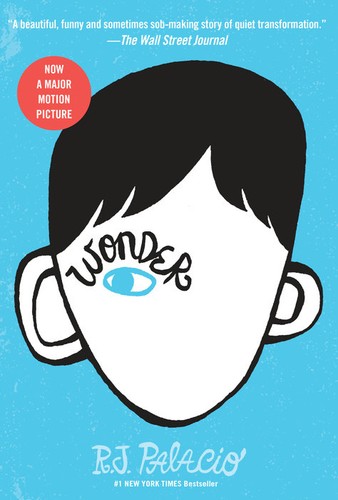

Tropes in this book
- High school
Themes
- middle grade
- first year at a new school
- multiple narrators
- facial difference
- bullying
- friendship and kindness
- heartwarming
Read it if
- you want a warm, smart book about school and friendship for a kid 10 and up, or one to read together with them
- you like stories told from several points of view, where the same scene looks a little different every time
- you want a book that takes rejection and bullying seriously without wallowing in cruelty
Skip it if
- you're after big plot twists, because from the first pages it's clear where this story is headed
- a finale served with a medal, a standing ovation and tissues at the ready makes you roll your eyes
- you need the school bully and his mom to be more than a cautionary tale about bad manners
Why this rating
🧠 For connoisseurs
8/10- Multiple narrators. The best idea in the book. Via's chapters – she adores her brother and is also secretly relieved that nobody at her new high school knows about him – and Miranda's, who invents a little brother with a facial difference at summer camp, turn a simple story into something much richer. Seeing Halloween or the school play from several sides says more than any long description could.
- Characters with rough edges. August is no monument to suffering: he can be mean to his mom, he yells at his sister, he jokes about himself and about doctors calling him a medical wonder. Jack is allowed to let him down and then fix it, and Via is allowed to feel jealous and ashamed. For a book aimed at ten-year-olds, that's a lot.
- Parents who get it wrong. Isabel and Nate argue about whether to send their son to school, apologize, and keep things from each other. The scene where Dad confesses what really happened to the astronaut helmet says more about a parent's love than a whole shelf of parenting books.
- Hard topics, no shock value. Rejection, bullying, illness and loss are named plainly, but without scare tactics or cheap melodrama. The book trusts young readers to draw their own conclusions from what they see.
- Frosting on top. The road from a rough September to June is fairly predictable, Julian and his mom are villains without a shred of nuance, and the finale – a medal, a standing ovation and a group photo everyone fights to get into – is clearly sweetened, even if it's done well.
💖 For comfort readers
7/10- Short chapters. More than 120 chapters, most of them very short, so it moves fast – including when you're reading it out loud at bedtime with a younger kid.
- Humor. Auggie's sense of humor is disarming: Darth Daisy, the fake love notes from the imaginary Beulah to Julian and his jokes about his own face are bright spots even in the hardest chapters.
- The feels. Saying goodbye to Daisy, Via's big night on stage and the last walk home with Mom get you right in the throat. I'll admit it – the dog chapter wrecked me.
- Kindness wins. You close it believing in people a little more. If you're looking for something uplifting, that's exactly what you get.
- Narrator hopping. Just when you're hooked on Auggie's story, he hands the mic to his sister, then to Summer, Jack and Justin, whose section is written all in lowercase with no quotation marks. Not everyone will enjoy the jumping around.
The book's four layers
Plot and pacing
A simple frame: first year at a new school, rejection, a friend who lets you down, making up, a war fought with notes in lockers, a threat from outside and a prize at the end. Everything is logical and evenly paced from September to June, and while there aren't many surprises, every stage of that year carries real weight. Via's storyline and the high school play give the plot a second wind.
Characters and relationships
August is wonderfully written: funny, stubborn, sometimes a pain, definitely not a saint. Via and Jack have their weak spots and their reasons, and Summer and Miranda get short but sharp chapters. The only letdown is Julian, who stays a one-note school villain to the very last page.
Writing style and atmosphere
The writing is easy to read, full of dialogue and Star Wars references, which fits a ten-year-old narrator perfectly. Each narrator sounds a little different, and Justin's lowercase section stands out clearly. Only the end-of-year speech points at the moral a bit too hard.
Entertainment and value
It's a pleasure to read and also an easy way to start talking with your kid about how we look at other people and what it means to be kind. Mr. Browne's precepts stay with you longer than most school assemblies, and the heavy topics are handled with care, without scaring anyone.
The book in brief, spoiler-free
Ten-year-old August Pullman was born with a rare facial difference, has had 27 surgeries and is about to walk into a real school for the first time – fifth grade at Beecher Prep, where he spends the whole year finding out who will see him as just a regular kid. A warm, smart, funny novel told in turns by Auggie, his sister and his friends, with a generous dusting of sugar on the finale.
Want the plot step by step?SummaryThemes it explores
R.J. Palacio writes about how we look at other people and how hard it is to see yourself through someone else's eyes. August has watched heads turn and heard the whispers his whole life, and Beecher Prep is the first year he can't hide at home or under an astronaut helmet. Palacio makes him neither a hero nor a victim: he's an ordinary ten-year-old the world won't let be ordinary, surrounded by people who are learning to behave decently – or failing to.
The main threads: difference and staring (Auggie's face and how kids, teachers, classmates' parents and total strangers react to it); kindness as a choice (Mr. Browne's precepts, starting with September's “choose kind,” and Mr. Tushman's graduation speech built around J.M. Barrie's idea of being a little kinder than is necessary); friendship and loyalty (Summer, who sits down with August because she wants to, and Jack, who lets him down and then pays a price for taking his side); siblings (Via, who has made room for her brother all her life and wants to be her own person in high school); bullying (the “Plague” game, notes in lockers, Auggie's face Photoshopped out of the class picture and a night in the woods with older boys); and loss (Grans, Daisy and Summer's dad, which the book talks about calmly and tenderly).
Questions and answers
What age is Wonder appropriate for?
10+ in my book. August is in fifth grade, there's no swearing and no romance beyond a couple of teenage kisses in Via's storyline, but there is bullying, a scuffle with older kids in the woods and the death of a much-loved family dog. Kids around 8 or 9 will do best reading it with an adult. And parents, read it yourselves too – the chapters about Via and the Pullman parents are as much for you as for your kid.
How spicy is Wonder?
1/10 on my spice scale, which here means basically zero. The closest it gets is Via kissing her boyfriend Justin on the front steps and fifth graders gossiping about who's dating whom. Nothing a ten-year-old can't handle.
Is Wonder part of a series?
No, Wonder is a standalone, so there's nothing you need to read before or after it. Palacio has written companion books set in Auggie's world – Auggie & Me (three stories told by other kids, including Julian), 365 Days of Wonder (a book of Mr. Browne's precepts), the picture book We're All Wonders and the graphic novel White Bird – but they're extras, not sequels. The novel was also adapted into a 2017 movie directed by Stephen Chbosky, starring Jacob Tremblay, Julia Roberts and Owen Wilson.
How many pages is Wonder?
About 300 – the 2012 US hardcover from Knopf runs 315 pages (some listings say 320), though it depends on the edition. It's split into eight parts and more than 120 mostly very short chapters, so it reads a lot faster than the page count suggests.
Is Wonder YA or adult?
Neither – it's middle grade. August is ten, the story covers his fifth-grade year, and it's shelved with children's books. Via's high school chapters give it real crossover appeal, though, and plenty of teens and adults read it (and cry) too.
Who is Wonder for?
Kids 10 and up and their parents, teachers looking for a book about empathy, and comfort readers (7/10) who want a good cry and a reason to believe in people. Connoisseurs (8/10) will love the multiple narrators and the beautifully written characters, and they'll easily forgive the predictable path and the sugar-coated ending.
What about you? Have you read this book?
Reader ratings
Your rating might be totally different from mine. A lot depends on when you pick it up.
Your rating on a 1-10 scale
No login needed. One vote per browser – you can change it later.
Disagree? Rate the book above or message me on Instagram or TikTok.
What to read next
 Harry Potter and the Prisoner of Azkaban
J.K. Rowling
Also: middle grade fantasy, school of magic.
★ 9/10🧠 8💖 9🌶️ 110+
Read the review
 Harry Potter and the Chamber of Secrets
J.K. Rowling
Also: middle grade fantasy, magic school.
★ 8/10🧠 6💖 9🌶️ 110+
Read the review
 Harry Potter and the Goblet of Fire
J.K. Rowling
Also: middle grade fantasy, friendship and first crushes.
★ 9/10🧠 8💖 9🌶️ 212+
Read the review