
Tropes in this book
- Academy and boarding school
- Mystery and crime
- Plot twists
Themes
- middle grade fantasy
- school of magic
- Triwizard Tournament
- mystery with a twist
- friendship and first crushes
- the series turns dark
Read it if
- you want a series that grows up with its readers and, in book four, raises the stakes from house points to life and death
- you love mysteries where the culprit stands right in front of you for hundreds of pages and you still don't see it
- you want dragons, an underwater rescue and a hedge maze in one book, with a Christmas ball in between
Skip it if
- you're buying a gift for a nine-year-old who just fell for Sorcerer's Stone, because this ending is too much for them
- you lose patience with doorstoppers that take their sweet time getting to school
- finales where the villains take turns explaining their plan instead of carrying it out make you roll your eyes
Why this rating
🧠 For connoisseurs
8/10- Best-hidden traitor in the series. Someone at Hogwarts is working for Voldemort, and Rowling leaves the clues lying around openly for hundreds of pages: a hip flask that never leaves somebody's hand, a name that pops up on the Marauder's Map where it has no business being, a book slipped to exactly the right kid at exactly the right moment. I still fell for it, right alongside Harry. When the truth finally comes out, you replay the whole school year in your head.
- The graveyard. One chapter changes the genre of the entire series. The worst moment takes a single sentence, and that's precisely why it hits so hard. The choice Harry makes there – to face it standing up, the way his father did, instead of cowering behind a headstone – is the strongest scene of the first four books.
- The world grows up. A Minister for Magic who'd rather not know, a reporter who invents whatever she doesn't know, house-elves working for nothing, and old trials in the Pensieve where respectable officials hand out life sentences while, as Sirius tells it, other people went to Azkaban without any trial at all. The series finally admits that the good side can do something rotten too.
- The Crouches. A father who sent his own son to Azkaban to protect his career, and a family secret that goes a lot deeper than that. Next to the one-note Slytherins, it's the first family tragedy in the series that genuinely makes sense.
- A plan with a hundred steps. Whoever is pulling the strings spends an entire year quietly steering Harry past dragons, through a lake and into a maze, all so he'll touch one particular object at the very end. If an old boot can be a Portkey, they could have slipped him pretty much anything back in September.
- Three lectures in a row. The finale wraps up the mystery like a 1930s detective novel with everyone gathered in the drawing room: three villain monologues back to back, each one explaining the plan in loving detail, the last one going over the whole thing again. The bad guys talk instead of acting, and that's exactly what trips them up.
💖 For comfort readers
9/10- Three tasks, three different books. The dragon is an action movie, the lake is a rescue story, the maze is straight-up horror. Every task has its own idea and its own stakes, and in between them the big question keeps getting louder: who put Harry in the tournament, and why?
- Humor. Dudley's tongue after the twins' toffee, Malfoy bouncing off the stone floor as a white ferret, Ron in frilly dress robes that look like a hand-me-down from a great-aunt, and Fred and George sprouting long white beards after trying to fool the Goblet. Rowling is funnier here than in the three previous books.
- The ball and first crushes. Harry asking Cho to the ball in one mashed-together word, Hermione showing up on Krum's arm looking so different that half the school doesn't recognize her, and Ron, who has only just worked out that she's a girl. The kids finally act like fourteen-year-olds.
- An ending that hurts. Keep tissues nearby for the last chapters: a conversation with grieving parents and Dumbledore's speech at the end-of-year feast. One small gesture with the tournament prize money lets you breathe again at the very end.
- A long runway. We only get to Hogwarts after the Quidditch World Cup, and the middle of the year spends plenty of time on Hermione's house-elf campaign, Rita Skeeter's articles and the hunt for ball dates. Action fans will be flipping ahead to the next task.
The book's four layers
Plot and pacing
The best twist in the series and an ending that changes the tone of the whole saga, but the road there is long. The Quidditch World Cup is a great prologue that runs like a novel of its own, and the middle of the year sprawls across S.P.E.W., the Yule Ball and newspaper gossip. The villains' plan is so convoluted that it takes three separate monologues to untangle.
Characters and relationships
Mad-Eye Moody is the best-written character of the first four books, Crouch senior is the first adult whose tragedy refuses to split into good guys and bad guys, and Cedric becomes, in just a handful of scenes, someone you truly care about. Ron and Harry's falling-out hurts because it feels real, and Hermione finally gets a life outside the library. The Malfoys are still painted in one color, except Lucius is getting a lot less careful about which side he's on.
Writing style and atmosphere
Rowling can do everything at once here: make you laugh at breakfast, scare you in the woods after the match and freeze you solid in a graveyard, where the horror comes from silence rather than gore. Toward the end the jokes disappear and grief moves in – the best writing in the series so far.
Entertainment and value
More than 700 pages of adventure with something the earlier books never had: a loss that can't be undone. It's a great opening for a conversation with a kid about death, prejudice and the fact that people in power don't always want to hear the truth. You'll want book five the minute you close this one.
The book in brief, spoiler-free
The Goblet of Fire picks three of-age champions for a deadly tournament – then spits out a fourth name: fourteen-year-old Harry, who never entered. The best-built book in the series so far, and the one where Hogwarts stops being a safe place.
Want the plot step by step?SummaryThemes it explores
In book four, J.K. Rowling stops protecting her readers. The story opens with a tournament, fame and a ball, and it ends somewhere much darker, with a loss nobody at Hogwarts is ready for. The first big theme is death: sudden, unfair and permanent, along with the guilt of the one who walks away alive. The second is power and truth. The Minister for Magic would rather not believe bad news than risk his job, a reporter makes up quotes, and a respected official throws people into Azkaban without a trial and sends his own son there after a hearing that's little more than a formality. The third is prejudice: house-elves who have never known anything but service, half-giants feared for their blood alone, and Muggles and Muggle-borns who once again become entertainment for Death Eaters.
The main threads: the Triwizard Tournament (three deadly tasks, four champions and a name that ended up in the Goblet nobody knows how); the mystery (who at Hogwarts is working for Voldemort and why he wants Harry in the tournament so badly); friendship and jealousy (Ron, who can't stand living in his famous best friend's shadow, and an hour underwater when Ron is the one Harry has to get back); growing up (the Yule Ball, first crushes, jealousy over Krum and Cedric); fathers and sons (the Crouches, Voldemort's father buried in Little Hangleton and James Potter, whose courage Harry needs most at the worst possible moment); prejudice and equality (Hermione's S.P.E.W., Hagrid's secret about his family and pure blood as a ticket to power); and Voldemort's shadow (a scar that keeps burning, the Dark Mark in the sky after thirteen quiet years, and the question of who will believe Harry and who will pretend nothing is happening).
Questions and answers
Do I need to read Harry Potter and the Sorcerer's Stone first?
Yes – and Chamber of Secrets and Prisoner of Azkaban too. Read the series in publication order, starting with Sorcerer's Stone. Book four assumes you know who Wormtail is, why Sirius is in hiding, where Harry got the Marauder's Map and what Voldemort has to do with his parents. Skip that and the finale won't land the way it should.
Is Harry Potter and the Goblet of Fire appropriate for 10 year olds?
I raise the bar to 12+ here, even though I recommend the first three books from 10. Parents should know this is the first book in the series where a student dies in front of Harry, and the finale is a dark ritual with blood, a severed hand and torture told from Harry's point of view. There's also a murder in chapter one and Neville's parents, tortured until they lost their minds and no longer recognize their son. A 10-year-old who devoured the earlier books will probably manage, but read it together or at least talk afterward about death and the guilt that can stay with you after a loss. It's the point where the series stops being middle grade and turns into YA.
How spicy is Goblet of Fire?
2/10 on my spice scale. Crushes, a Christmas ball, jealousy and a few pecks on the cheek – that's the whole romance. Swearing is practically nonexistent.
How many pages is Harry Potter and the Goblet of Fire?
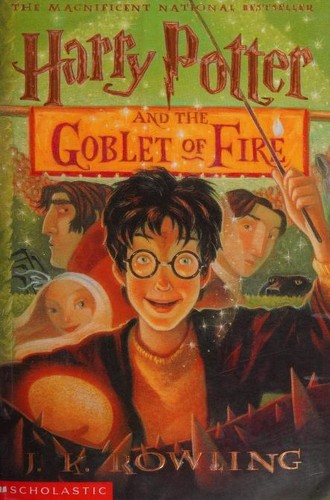
The US Scholastic paperback with the Mary GrandPré cover has 734 pages of story (752 counting the front matter), same as the 2000 hardcover, though it depends on the edition. That's 37 chapters and a big jump in length from the first three books.
Is Goblet of Fire middle grade or YA?
It's right on the border. The series is shelved as middle grade and Harry is only 14, but this is the book where the tone darkens for good: real death, torture and adults who lie. Treat it as middle grade growing into YA, which is exactly why I bump the age rating up here.
Who is Goblet of Fire for?
Readers who grew up with Harry and are ready for a story without a happy ending, plus adults coming back to the series. Comfort readers get dragons, a lake, a maze, a ball and the most humor in the series so far. Connoisseurs get the best-hidden twist of the first four books and a world where power, the press and prejudice start to matter. If a deadly tournament leaves you wanting more, older readers should try The Hunger Games next.
What about you? Have you read this book?
Reader ratings
Your rating might be totally different from mine. A lot depends on when you pick it up.
Your rating on a 1-10 scale
No login needed. One vote per browser – you can change it later.
Disagree? Rate the book above or message me on Instagram or TikTok.
What to read next
 Harry Potter and the Prisoner of Azkaban
J.K. Rowling
Harry's third year and the story of Sirius and Wormtail, without which book four makes a lot less sense.
★ 9/10🧠 8💖 9🌶️ 110+
Read the review
 Harry Potter and the Order of the Phoenix
J.K. Rowling
Same series.
★ 8/10🧠 7💖 8🌶️ 212+
Read the review
 Harry Potter and the Sorcerer's Stone
J.K. Rowling
Same series.
★ 8/10🧠 6💖 9🌶️ 110+
Read the review