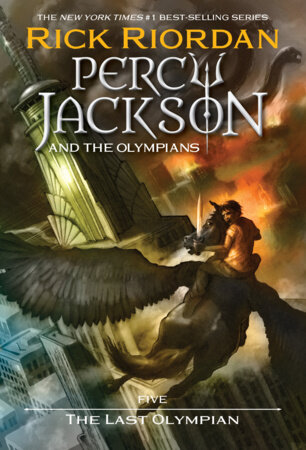

Tropes in this book
- Found family
- Friends to lovers
- Plot twists
Themes
- middle grade fantasy
- Greek mythology
- demigods
- battle of Manhattan
- series finale
- humor
Read it if
- you've read the first four books and need to see how the Great Prophecy plays out
- you love huge battles where statues come to life and river gods take bribes
- you want an adventure for a 10- to 12-year-old that doesn't pretend war costs nothing
Skip it if
- you're planning to start here, because without the four earlier books most of the emotion is lost
- you want an intricate plot rather than a war told skirmish by skirmish over bridges, parks and streets
- you have a sensitive nine-year-old at home who'll take the deaths of several well-loved characters hard
Why this rating
🧠 For connoisseurs
7/10- The prophecy has a false bottom. For four books everyone, me included, assumed they knew who the hero of the Great Prophecy was and what the cursed blade meant. Riordan resolves it differently than I expected, yet true to every line and to clues he planted back at the start of the series. I can't remember the last time I saw a finale this cleanly played in fantasy for this age group.
- The gods on trial. This time the other side has arguments. Hermes left his son alone with a sick mother, Zeus blasted the hotel where Hades's kids were living, Hades cursed the Oracle in revenge, and Kronos's army is largely made of unclaimed demigods whose godly parents forgot they exist. The book never lets the traitors off the hook, but it does make you ask who turned them into traitors.
- A spy reveal that stings. I won't say who's been reporting to Kronos. The answer hurts more than it satisfies, and it makes you rethink several earlier scenes. On top of that, the title turns out to mean something I didn't see coming.
- War in episodes. Most of the novel is the defense of Manhattan split into a string of fights: a bridge, a park, a street, the next monster, the next Titan. The ideas are spectacular, but the structure repeats itself, and the fearsome Hyperion goes down in a few pages and ends up as a tree in Central Park.
- The cavalry is always around the corner. Whenever the defenders are one step from defeat, someone rides in: centaurs, the Ares cabin, an army of the dead, Cyclopes. Information works the same way, since nearly every nap Percy takes ends in a prophetic dream that hands him exactly what he's missing. Convenient, but predictable.
💖 For comfort readers
9/10- Jokes in the middle of a war. Dionysus playing Pac-Man at somebody else's party, Cyclopes charging into battle yelling “Peanut butter!”, a flying sow brought down by a statue of Hermes and the Titan Prometheus showing up in a tuxedo. Even at the darkest moments, there's something to laugh at.
- New York as a battlefield. Statues climb off their pedestals, the stone lions outside the public library go after a monster, you reach Olympus by elevator in the Empire State Building, and the gods of the East River and the Hudson bicker like neighbors over a fence. The city plays one of the leading roles.
- Everyone gets a moment. Grover, Tyson, Thalia, Nico, Clarisse, Chiron and Mrs. O'Leary all get their big scenes, and after five books of bickering, Percy and Annabeth finally stop pretending.
- A finale with heart. The ending is moving without being crushing, it wraps up Percy's story, and it sends you off with a warm feeling.
- Heavier than before. Characters we've known for several books die, and one death is described fairly vividly. A younger reader may need a moment to process it.
The book's four layers
Plot and pacing
The war for Manhattan has clear stakes and a ticking clock: Typhon is heading for New York, and Percy is about to turn sixteen. Riordan smoothly weaves the battles together with trips into Luke's past, and the way the prophecy resolves ties the whole series together. The middle chapters suffer, though – skirmish follows skirmish, and help always arrives right on time.
Characters and relationships
Character-wise, this is the strongest book in the series. Luke goes from villain to tragic figure, Annabeth has to come to terms with an old attachment, and Nico, Clarisse and Silena get scenes that changed how I saw them. The Titans are weaker: Hyperion and Krios are background noise, and the genuinely interesting Prometheus disappears after a single conversation.
Writing style and atmosphere
Same mouthy Percy, who comments on everything up to and including the end of the world, and the same light style that slips the mythology in sideways. The humor balances the darkness well. The battle descriptions can get monotonous, though, and dreams and visions as the main way of delivering information start to grate.
Entertainment and value
A worthy ending to the series that entertains, moves you and makes you think. The choice Percy faces on Olympus and the request he makes of the gods are the perfect punchline to a whole story about kids the grown-ups forgot. After a finale like this, it's hard to say goodbye to these characters.
The book in brief, spoiler-free
Percy turns sixteen in a week, Kronos is marching on Olympus in the body of an old friend, and all of Manhattan has fallen asleep, so saving the world falls to a handful of teenage demigods. The series finale keeps the jokes coming, but Riordan makes everyone pay for the win with real losses.
Want the plot step by step?SummaryThemes it explores
Rick Riordan closes the series with a story about a war where kids fight on both sides. A large part of Kronos's army is made of demigods their godly parents never claimed, while Olympus is defended by teenagers from camp as the gods battle Typhon on the other side of the country. Under the battles sit questions about parents' responsibility, about whether you can forgive someone who betrayed you, and about what being a hero actually means. The last Olympian of the title is the quiet goddess of the hearth, who doesn't fight but makes sure there's still a home to come back to, and she turns out to matter more than the warriors.
The main threads: the Great Prophecy (Percy's sixteenth birthday and a single choice that decides the fate of Olympus); war and loss (the Battle of Manhattan and the friends who don't come back from it); family (Luke's mother waiting for her son with sandwiches, Sally and Paul in the street in the middle of the battle, gods who fail their own children); betrayal and redemption (a spy at camp, Luke possessed by Kronos and the question of whether anything good is left in a traitor); friendship (Percy, Annabeth and Grover on one last adventure together, with Thalia, Tyson, Nico and Clarisse at their side); hope (Pandora's jar, where only hope is left, and the decision of whom to trust it to); and growing up (the choice between immortality and an ordinary life).
Questions and answers
Do I need to read The Lightning Thief and the other books first?
Yes. The Last Olympian is the finale of a five-book story, and it pulls together threads from every earlier book: the Great Prophecy, Luke, Nico, the Labyrinth and a long list of old debts. Start with The Lightning Thief and read in order – The Sea of Monsters, The Titan's Curse, The Battle of the Labyrinth, then this one. Starting here, you'd get the battles and lose most of the feelings.
What comes after The Last Olympian?
This book closes the Great Prophecy and Percy's original arc. Camp Half-Blood's story continues in The Heroes of Olympus, which starts with The Lost Hero, and years later Riordan added books 6 and 7 about Percy himself, The Chalice of the Gods and Wrath of the Triple Goddess. If you're new to the world, read the original five first.
How many pages is The Last Olympian?
432 pages in the 2011 Disney-Hyperion paperback, though it depends on the edition (the 2009 hardcover runs 381). It's the longest book in the series, but the war keeps it moving fast.
Is The Last Olympian appropriate for 10 or 12 year olds?
I keep the whole series at 10+, but this is by far the most serious book. There's a war on, young demigods die, some of them Percy's friends, and at the end one character gives his life to defeat the enemy. Riordan writes it without gore and with plenty of humor, but if you're reading with a younger kid, it's worth talking about the losses afterward. Full disclosure: this is middle grade, not YA (the publisher pitches it at ages 10 to 14). YA ranked also reviews books for younger teens, and a finale this good belongs on the list.
How spicy is The Last Olympian?
2/10 on my spice scale, and that's generous. There are a few kisses and a lot of awkward blushing, and nothing beyond that. The romance is about two teens finally admitting they like each other.
Who is The Last Olympian for?
Anyone who has read the first four books – it's the mandatory finale. It hits hardest for readers around 10 to 14 who love adventure, mythology and heroes with a sense of humor, but adult comfort readers will have a great time too. Connoisseurs will enjoy how the prophecy resolves and the fact that the gods finally have to face their own neglect.
What about you? Have you read this book?
Reader ratings
Your rating might be totally different from mine. A lot depends on when you pick it up.
Your rating on a 1-10 scale
No login needed. One vote per browser – you can change it later.
Disagree? Rate the book above or message me on Instagram or TikTok.
What to read next
 The Battle of the Labyrinth
Rick Riordan
The previous book: the Labyrinth, Daedalus and the moment Kronos finally rises – you'll need it fresh for this finale.
★ 8/10🧠 6💖 9🌶️ 110+
Read the review
 The Lightning Thief
Rick Riordan
Back to the beginning: reread book 1 after the finale and you'll spot how early Riordan planted the prophecy clues.
★ 7/10🧠 5💖 8🌶️ 110+
Read the review
 The Titan's Curse
Rick Riordan
Same series.
★ 8/10🧠 6💖 8🌶️ 110+
Read the review