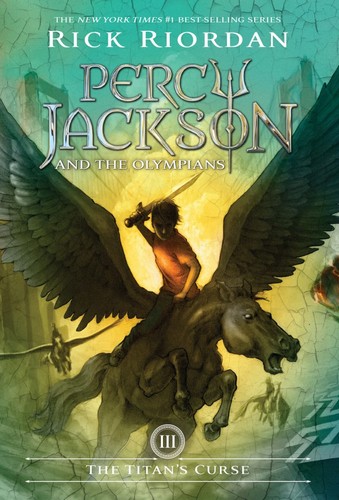

Tropes in this book
- Plot twists
Themes
- middle grade fantasy
- Greek mythology
- demigods
- Hunters of Artemis
- cross-country quest
- found family
- funny narrator
Read it if
- you like adventures where the myths dress up as the present day: the Nemean Lion stalks an aviation museum and the Old Man of the Sea naps on a pier in a bathrobe
- you enjoyed The Lightning Thief and want the series to grow up a little
- you want a book about friends who get in each other's faces and then risk their lives for each other anyway
Skip it if
- quests where every stop ends with a fresh monster make you break out in hives
- you'd rather the heroes get out of trouble on their own, without a god showing up right on cue
- you haven't read the first two books and starting a series in the middle drives you up the wall
Why this rating
🧠 For connoisseurs
6/10- A prophecy on a slow fuse. The Oracle's six lines get solved one at a time, and almost every one of them lands differently than the characters – and the reader – expect. The best of the bunch is the monster that's supposed to bring about the fall of Olympus: Riordan hides it in plain sight and disarms you with the way it looks.
- Zoe Nightshade. The Hunters' lieutenant talks like she stepped out of a dusty old volume and has nothing but contempt for boys, and the reasons for that contempt come out piece by piece. Her story adds a page to a famous myth that the myth itself conveniently left out, and it's the most interesting idea in the series so far.
- Stakes that actually hurt. This book doesn't pretend the quest is a field trip. The prophecy promises losses and delivers on that promise, and the goodbyes are written without melodrama, but they hit exactly where they should.
- A god out of the machine at every stop. A train courtesy of Apollo, a boar sent by Pan, statues that come to life, Dionysus saving everyone's skin over an Iris-message and, to top it off, Annabeth's dad in a biplane. At some point I stopped worrying about the heroes, because I knew someone from Olympus was about to pop out from around the corner.
- A train schedule of a plot. The structure from book one comes back unchanged: a city, a monster, an escape, the next state. The stops are inventive, but you can read the rhythm of the quest like a departures board.
💖 For comfort readers
8/10- The humor. Apollo in his haiku phase, Grover snacking on ping-pong balls with ketchup, a burrito food fight at the Hoover Dam snack bar and Dionysus stubbornly mangling every hero's name. I laughed more often than I did in book one.
- A new crew. Percy and Grover are joined by Thalia, who Percy bickers with like a real sister, the Hunters of Artemis and Bianca, with Nico and his game figurines hovering in the background. Every one of them has their own voice and their own reasons.
- Nonstop action. A military school, winter at camp, the museums in Washington, D.C., a junkyard of the gods, the Hoover Dam and San Francisco. The countdown to the winter solstice keeps ticking, and the monsters change like scenery outside a train window.
- The feels. Riordan makes you say goodbye to characters you've only just started to love, and he does it with a light, careful touch: your throat gets tight, but a ten-year-old won't be traumatized.
- Annabeth benched. The best character in book one spends most of this one held captive offscreen. Her fans are going to miss her.
The book's four layers
Plot and pacing
The prophecy works like a map with the squares covered up: every leg of the quest uncovers one line, and the biggest answers arrive in the showdown on Mount Tamalpais and in a short epilogue that sets up the rest of the series. What costs it is the sheer number of divine rescues, which let the tension leak out every so often.
Characters and relationships
Percy finally has people next to him who can keep up: explosive Thalia with her fears, proud Zoe with her painful past and Bianca, who has to choose between her brother and a life of her own. Even the gods, from Artemis to Dionysus and his Ariadne, get more than one trait each.
Writing style and atmosphere
A chatty, mouthy narrator and humor that keeps going even under the foot of a bronze giant. In a few serious scenes Riordan knows how to slow down and give his characters a moment of quiet. The mythology lectures still stop the action now and then, though.
Entertainment and value
For a ten- to twelve-year-old this is close to the perfect read: funny, fast and more moving than book one. Adults won't be bored either, and the epilogue makes you want to grab book four right away.
The book in brief, spoiler-free
Artemis has been kidnapped, Annabeth has vanished over a cliff, and the Oracle sends five questers west – none of them Percy, so the son of Poseidon tags along uninvited. Book three sticks to the tried-and-true road-trip formula, but the stakes go up, the crew gets bigger and the ending hits harder than The Lightning Thief.
Want the plot step by step?SummaryThemes it explores
In book three, Rick Riordan makes his heroes grow up faster than they'd like. Percy learns that the loyalty he's so proud of might be his weakest spot, Thalia faces the pull of power and has to decide who she wants to be before she turns sixteen, and Bianca has to choose between being the responsible big sister and having a life of her own. Running underneath is a story about parents who let their kids down in all kinds of ways – by being absent, by being cold or by being openly hostile – and about the ones who step up when it really counts.
The main threads: the quest (five questers, a few days until the winter solstice and a prophecy that promises losses); the Hunters of Artemis (forever-young girls who've sworn off love and look down on boys); friendship (Percy breaks the rules to save Annabeth and learns to work with Thalia after every fight); family (gods, Titans and mortal parents, from Percy's mom to Annabeth's dad in a biplane); temptation (a power that could topple Olympus sits within arm's reach, and someone has to say no to it); myths retold (a forgotten Hesperide who helped Hercules, and heroes who don't want to turn out like him); and mysteries (who the General is, what the monster Artemis is hunting is, and where the di Angelo siblings really came from).
Questions and answers
Do I need to read The Lightning Thief first?
Yes – and The Sea of Monsters too. The Titan's Curse is book 3, and it leans on the first two all the time: the Golden Fleece, Tyson, Thalia's return and Luke's ship all carry over from earlier books. You could follow the plot cold, but you'd lose half the payoff, so start at the beginning.
What's the Percy Jackson reading order?
Publication order: The Lightning Thief, The Sea of Monsters, The Titan's Curse, The Battle of the Labyrinth and The Last Olympian, which wraps up the main story. Years later, Riordan added new Percy books, starting with The Chalice of the Gods. The camp's story continues in a separate series, The Heroes of Olympus, which opens with The Lost Hero. The Titan's Curse ends with an epilogue that leads straight into book four, so have The Battle of the Labyrinth nearby.
How many pages is The Titan's Curse?
352 pages in the Disney-Hyperion paperback, though it depends on the edition. It's a quick read with short chapters, and most kids finish it in a few days.
Is The Titan's Curse appropriate for 10 year olds?
Yes, I rate it 10+, same as book one – it's a middle grade book, and YA ranked reviews books for younger teens too. Fights with monsters are played for laughs and there's no gore. This one is more serious, though: mercenaries shoot at the kids, not everyone comes home from the quest, and Thalia talks about her mother, who drank and died in a car crash. It's good to have an adult around to talk those scenes through.
How spicy is The Titan's Curse?
1/10 on my spice scale, which here means almost nothing. The romance amounts to one slow dance at a school dance and a few awkward feelings Percy can't quite name. No kissing scenes, no sex.
Is The Titan's Curse YA, and who is it for?
It's middle grade, not YA – written for roughly 10- to 14-year-olds who loved The Lightning Thief, and for adult comfort readers who want a good, funny adventure. Connoisseurs get more to chew on than in book one, because the prophecy resolves cleverly and Zoe and Thalia have real history behind them. They'll just have to swallow gods who keep pulling the heroes out of trouble.
What about you? Have you read this book?
Reader ratings
Your rating might be totally different from mine. A lot depends on when you pick it up.
Your rating on a 1-10 scale
No login needed. One vote per browser – you can change it later.
Disagree? Rate the book above or message me on Instagram or TikTok.
What to read next
 The Battle of the Labyrinth
Rick Riordan
Book four, which the epilogue of The Titan's Curse sets up directly.
★ 8/10🧠 6💖 9🌶️ 110+
Read the review
 The Sea of Monsters
Rick Riordan
Book two, with the Golden Fleece and Tyson – read it first, because this one picks up the threads it leaves hanging.
★ 7/10🧠 6💖 8🌶️ 110+
Read the review
 The Lightning Thief
Rick Riordan
Where it all begins, if The Titan's Curse landed in your hands by accident.
★ 7/10🧠 5💖 8🌶️ 110+
Read the review