
Themes
- contemporary YA
- psychiatric ward
- suicide attempt
- told as a 45-day diary
- dark humor narrator
- coming out
- heavy topics
Read it if
- you loved The Perks of Being a Wallflower and books where the narrator circles what hurts him for a long time before he says it
- you want a serious story about a mental health crisis that leaves room for laughter but never turns suffering into decoration
- you're looking for YA about figuring out your sexuality, with no free passes and no sugary ending
Skip it if
- suicide feels too close to home right now – then set this one aside and talk to someone you trust first
- you don't want to read explicit sexual scenes involving teenagers, especially ones where consent is doubtful at best
- you want action and a twist every chapter, not a diary in which the hero spends a long stretch brushing off his doctor with jokes
Why this rating
🧠 For connoisseurs
7/10- A narrator who lies. From page one, Jeff plays his doctor for a fool: one day the Sugar Plum Fairy from The Nutcracker has possessed him, the next he simply can't share a planet with Paris Hilton. I laughed along with him, and only later did I see how much that smoke screen was costing him.
- The truth in installments. The real reason for the attempt surfaces close to the end, and earlier scenes – making up the dialogue for old movies on a muted TV with Sadie, the nervous dodging every time anyone mentions Allie – suddenly get a second bottom. A careful reader may guess sooner and loses nothing by it.
- Therapy without miracles. The psychiatrist here is no guru, more a stubborn guy with a notepad who can be boring and out of his depth but doesn't give up. Jeff's breakthrough comes slowly, and that's exactly why I believed it.
- Sadie. The most unsettling and best-written character in the book: witty, perceptive and impossible to read right to the end. Her storyline says something that matters – the person who's best at pretending she has everything handled isn't necessarily safe.
- The Rankin storyline stays blurry. The hardest part of the book is left half-said. It rings true that Jeff can't name what happened to him, but the text doesn't help him enough – one line from the doctor saying it wasn't his fault is too little for a young reader.
- Patients as stops along the way. Alice, Bone and Juliet get strong entrances and then quietly drop out of the story. They read more like stations on Jeff's route than people with stories of their own.
💖 For comfort readers
5/10- Humor. Nicknames for the staff, late-night TV sessions with Sadie where the two of them voice the characters themselves, and a snowman named after a patient who just went home. There's plenty to laugh at despite the subject, and the jokes are never about the suffering itself.
- Short entries. 45 days, 45 short chapters. It's easy to read in small doses and easy to stop for a while when it gets too heavy.
- Amanda and the family. Jeff's little sister brings every scene she's in to life, and the conversation with his parents near the end gives you some relief after the darkest chapters.
- The weight. This is not a pick-me-up: suicide, abused kids in other patients' stories and difficult sexual scenes can flatten you.
- Not much happens. For a big part of the diary the action is the doctor's office, group sessions and a TV with the sound off. If you need a plot that keeps moving, you'll get restless.
The book's four layers
Plot and pacing
The structure is simple: 45 days, 45 entries, and the tension comes from what Jeff doesn't say. Every dodge gives something away about him, and two blows near the end shift the weight of the whole book. The finale is weaker: a four-hour talk with his parents ends in a group hug, which after everything that came before feels a little too smooth.
Characters and relationships
Jeff is wonderfully written: snarky, quick, scared and convinced, up to a point, that he's the only normal person on the ward. Sadie, Martha and Amanda stay with you long after you close the book. Some of the other patients are only sketches, though, and Rankin serves the plot more than he works as a person.
Writing style and atmosphere
The narrator's voice is the biggest strength here: sarcasm, tangents about astronauts and bears, asides straight to the reader. Ford can go from a joke to silence within one paragraph, like in the scene where Jeff cries in the shower over a children's rhyme. You can feel 2008 in it – TV, CDs, slurs tossed around without a second thought – but that was the world Jeff lived in.
Entertainment and value
A short, dense book that leaves you with questions. I laughed more often than I expected from a book with this title, and two of the later chapters knocked the wind out of me for a long while. It's not for every moment or every reader, but it's worth your time.
The book in brief, spoiler-free
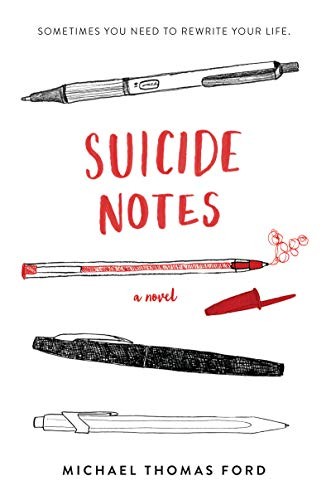
Fifteen-year-old Jeff wakes up on a psychiatric ward after a suicide attempt, gets 45 days of mandatory therapy and decides to get through them on sarcasm, as long as nobody makes him say why he did it. It's a diary from the ward where humor is the narrator's armor, never a way to make the subject smaller than it is.
Want the plot step by step?SummaryThemes it explores
Michael Thomas Ford writes about how hard it is to tell the truth – to a doctor, to your parents, to your best friend, and hardest of all to yourself. For half his stay Jeff is sure he ended up on the ward by mistake, and he turns every conversation into a sarcasm show. That irony is his armor, not a way to defuse the subject: the book shows a mental health crisis without romanticizing it and without miracle cures, and suicide here is neither mysterious nor beautiful. If this story touches something close to you, you can call or text 988, the Suicide & Crisis Lifeline in the US, any time.
The main threads: crisis and therapy (45 days of individual and group sessions in which Jeff's defenses give way slowly, piece by piece); truth and lies (made-up stories, jokes and dodges as a way to avoid talking about what hurts); identity (figuring out his sexuality in a world where homophobic slurs get thrown around like ordinary nicknames); friendship (Allie, who suddenly vanished from Jeff's life, and Sadie, with whom he has more in common than he wants to admit); family (parents who don't know how to talk about feelings and a little sister, Amanda, who says the things nobody wants to hear); boundaries and consent (a storyline in which Jeff takes a long time to put into words that someone crossed his); and loss and guilt (the ward doesn't give everyone a second chance, and the ones who stay have to find a way to live with that).
Questions and answers
Is Suicide Notes appropriate for 12 year olds?
No – I'd put it at 16+. Beyond the suicide attempt itself, one of the characters dies, other patients' stories include abused children, homophobic slurs come up often, and there are fairly explicit sexual scenes between teenagers, including some where consent is doubtful. If you're a teen reading this and the subject hits close to home, you can call or text 988, the Suicide & Crisis Lifeline in the US, any time.
How spicy is Suicide Notes?
6/10 on my spice scale, but don't read that number as romance heat. There's a kiss and a night in Sadie's room that Jeff runs away from, and then encounters with another boy on the ward that are described fairly directly and where consent is doubtful at best. Those scenes are there to show something Jeff can't name, not to be steamy.
Is Suicide Notes part of a series?
Yes, though it works fine on its own: Jeff's 45 days in the hospital wrap up in this book. Fifteen years after the original, Ford published a sequel, Every Star That Falls (2023), which picks up on the day Suicide Notes ends.
How many pages is Suicide Notes?
320 pages in the 2019 HarperTeen paperback, though it depends on the edition – the original 2008 hardcover is a little shorter. The book is a diary split into 45 short chapters, one for each day on the ward.
Is Suicide Notes YA or adult?
YA. Jeff is fifteen and the book was published by HarperTeen, but the subject and the sexual content make it a book for older teens, not middle schoolers. Adults who work with teenagers will get plenty out of it too.
Who is Suicide Notes for?
Readers who liked The Perks of Being a Wallflower or Thirteen Reasons Why and want a YA novel about a mental health crisis that's written with humor but never shrugs it off. Connoisseurs who enjoy a sharp-tongued narrator and a truth revealed in installments will get the most out of it. If you're after something light to unwind with, save this one for another time.
What about you? Have you read this book?
Reader ratings
Your rating might be totally different from mine. A lot depends on when you pick it up.
Your rating on a 1-10 scale
No login needed. One vote per browser – you can change it later.
Disagree? Rate the book above or message me on Instagram or TikTok.
What to read next
 Thirteen Reasons Why
Jay Asher
Teen suicide from a completely different angle – worth comparing to see how differently the subject can be written.
★ 6/10🧠 6💖 5🌶️ 215+
Read the review
 Looking for Alaska
John Green
Loss, guilt and questions without answers, with a narrator just as observant as Jeff.
★ 9/10🧠 9💖 7🌶️ 415+
Read the review
 The Perks of Being a Wallflower
Stephen Chbosky
Another teenage narrator who circles what hurts him for the whole book, and an ending that changes the meaning of the earlier pages.
★ 9/10🧠 8💖 5🌶️ 315+
Read the review