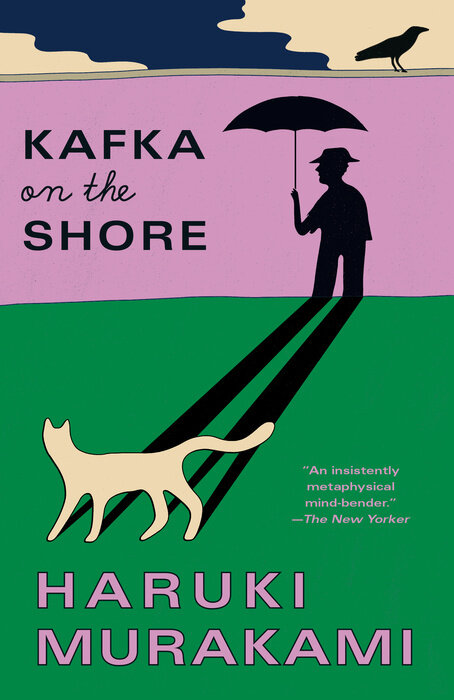

Themes
- magical realism
- adult fiction with a teen narrator
- runaway
- talking cats
- a library that keeps memories
- Greek tragedy curse
- 18+ content
Read it if
- you like books where fish fall from the sky, cats have opinions and nobody bothers to explain why
- you still think about The Perks of Being a Wallflower or Looking for Alaska and want to see how adult literary fiction handles growing up
- you prefer questions to answers and like taking a plot apart in your head for days after the last page
Skip it if
- you need an ending that tells you who did what and why, because half the mysteries here stay open
- sex scenes involving a 15-year-old and animal cruelty described in detail are a hard no for you
- you want a light YA read for the weekend, not 480 pages of metaphors, Schubert and Greek tragedy
Why this rating
🧠 For connoisseurs
8/10- Two roads that never meet. Kafka's chapters and Nakata's run side by side for hundreds of pages, and the two of them never once come face to face. Even so, every move one of them makes echoes in the other's life: the old man kills on the boy's behalf, and the boy wakes up covered in blood. It's an unusual idea, and Murakami carries it through with iron discipline.
- Nakata and Hoshino. An old man who talks about himself in the third person and doesn't know what memories are, and a truck driver who, at his side, discovers Beethoven and the fact that somebody might actually need him. Their conversations about eels, leeches and a stone are funny, and their parting hit me harder than plenty of books engineered to make you cry.
- Oshima. A librarian with hemophilia, born in a woman's body and living as a man, who flattens two inspectors who've come looking for discrimination in his library. Murakami writes him without kid gloves and without cheap sensationalism, and his rant about people with no imagination is one of the strongest passages in the book.
- Mythology on Shikoku. Oedipus, Cassandra, The Tale of Genji, Eichmann and a Chekhov's gun that has to go off. None of it is decoration: the book asks whether we're responsible for what we do in our dreams, and it refuses to hand you an easy answer.
- Mysteries with no solution. Who Johnnie Walker really was, what happened on Rice Bowl Hill, whether Miss Saeki is Kafka's mother, where the blood on his shirt came from. Murakami leaves all of it open on purpose, but after 480 pages of Chekhov-style promises I felt a little stood up.
- Women as instruments. Sakura, Miss Saeki and the philosophy student exist mostly to change something in a man's head or body. The book frames the scenes where a grown woman sleeps with a 15-year-old as dream and metaphor, but on the page it's still an adult and a child. That grated on me the whole way through.
💖 For comfort readers
5/10- Talking cats. Mimi, a Siamese who listens to Puccini and knows her car brands, the old tomcat Mr. Otsuka and Toro, a black cat from a sushi restaurant. The cat chapters are pure joy and the lightest part of the book.
- Hoshino. A truck driver in a Hawaiian shirt who gets so bored he starts telling a stone about his ex-girlfriends is a guy anyone would like. His asides rescue even the foggiest chapters.
- Length and pace. 480 pages in the US paperback, and a good chunk of them are conversations about Schubert, Greek tragedy and the nature of time. When something falls from the sky the plot sprints, and then for long stretches it slows to the speed of meditation.
- An ending with no period at the end. If you make it through the whole thing, you'll want to know who killed whom, who the mother is and what that white creature was. You won't find out, because the last scene is a boy falling asleep on a train.
- Scenes that won't let you relax. Cruelty to cats written out in detail, a dream about rape and sex between a 15-year-old and a woman in her fifties. This is not a bedtime book.
The book's four layers
Plot and pacing
Two parallel tracks, US Army intelligence reports from 1946 and a teacher's letter fit together into a precise structure, and the question of how an old man from Nakano connects to a runaway from the same neighborhood keeps you going to the end. I'm taking points off for a middle that bogs down in conversations about music and metaphor, and for an ending that leaves several key questions unanswered.
Characters and relationships
Nakata, Hoshino and Oshima are characters you remember for years, and each of them, from a different angle, is a story about loneliness and about what a person is missing. Kafka himself can be as unreadable as his boy named Crow, and the women are more often a mirror for the hero than people with lives of their own.
Writing style and atmosphere
Murakami writes in calm, simple sentences and still builds an atmosphere that gets under your skin: an empty reading room at dawn, a cabin with no electricity, a town with no names. Kafka narrates in the present tense, Nakata's chapters are told in the past, and in the most important scenes the narration slips into the second person. It's a deliberate game, and it works.
Entertainment and value
I read with growing involvement and kept putting the story together in my head long after I finished, which rarely happens to me. Points off for the length, for the sex scenes involving a 15-year-old that the author insists on treating as metaphor, and for a cat scene I'd rather not remember.
The book in brief, spoiler-free
Fifteen-year-old Kafka runs away from Tokyo and his father's curse and hides out in a small library in Takamatsu, while an old man who can't read but can talk to cats sets off down the same road without knowing the boy exists. The hero is fifteen, but this is Murakami for grown-ups, baggage and all.
Want the plot step by step?SummaryThemes it explores
Haruki Murakami writes about a boy trying to run away from himself and an old man with almost nothing left inside him to lose. Kafka flees his father's curse and finds out that the sandstorm he's running from is inside him. Nakata lost half his shadow and every one of his memories during the war, Miss Saeki has so many memories that she stopped living in the present, and Oshima and Hoshino each try, in their own way, to save the boy and the old man. Everything happens in ordinary places – a cheap hotel, a highway rest stop, a library with sofas – and every so often reality cracks open and you can see another world through the gap.
The main threads: the father's curse (a prophecy that Kafka will kill his father and sleep with his mother and his sister, carried over from Greek tragedy into modern Japan); memory (Miss Saeki's memories written down and burned, Nakata's empty head and the library as a place that keeps what people can't carry); the mother (a child abandoned at four and a grown woman asking for forgiveness); responsibility (whether we answer for what we do in our dreams, and whether you can kill with someone else's hands); friendship (Nakata and Hoshino, a pair thrown together by chance who come to need each other); being different (Oshima and his fight with people who have no imagination); and violence (war, murder, cruelty to animals and the question of where it comes from in people).
Questions and answers
Is Kafka on the Shore part of a series?
No. It's a standalone novel, and you can read it without knowing any of Murakami's other books. His other novels share its mood, but none of them continues this story.
Is Kafka on the Shore YA or adult?
Adult. It's literary fiction, published in the US by Knopf and in paperback by Vintage International, even though the narrator is fifteen. The hero's age is about the only YA thing in it: the sex, the violence and the way the book handles both are written for grown-up readers, and that's exactly how I rate it.
Is Kafka on the Shore appropriate for 12 year olds?
No. I rate it 18+, even though the hero is fifteen. The sex scenes involving him are written out plainly, there's graphic cruelty to animals, a murder and a dream about rape, and the characters wrestle with thoughts of death. If thoughts like that keep coming back to you after you finish, in the US you can call or text 988, the Suicide & Crisis Lifeline, any time.
How spicy is Kafka on the Shore?
7/10 on my spice scale, and the number alone doesn't tell the whole story. Most of the sex involves Kafka, who is fifteen: Miss Saeki, a woman in her fifties, comes to his bed the first time while she's asleep and takes him for someone else, there's a night of closeness with Sakura, and later a dream in which he forces himself on her. Hoshino also spends a night with a sex worker. Murakami frames it all as dream and metaphor, but the problems of age and consent are real, and there's nothing romantic about them.
How many pages is Kafka on the Shore?
480 in the Vintage International paperback of Philip Gabriel's translation, though it depends on the edition. The novel has 49 numbered chapters plus two extra sections titled The Boy Named Crow.
Who is Kafka on the Shore for?
Adults and older teens who've outgrown YA and want something stranger. Readers used to YA will recognize the runaway, the growing up and the first love, but there's no romance, no explanations and a mountain of metaphor. Connoisseurs will have plenty to pick apart; comfort readers may run out of steam before the ending.
What about you? Have you read this book?
Reader ratings
Your rating might be totally different from mine. A lot depends on when you pick it up.
Your rating on a 1-10 scale
No login needed. One vote per browser – you can change it later.
Disagree? Rate the book above or message me on Instagram or TikTok.
What to read next
 Norwegian Wood
Haruki Murakami
More Murakami for adults, this time with no talking cats: college in Tokyo, grief and two very different girls.
★ 8/10🧠 8💖 5🌶️ 818+
Read the review
 The Invisible Life of Addie LaRue
V.E. Schwab
Another book about memory and how much it matters that someone remembers us, only in a more romantic key.
★ 7/10🧠 7💖 5🌶️ 616+
Read the review
 South of the Border, West of the Sun
Haruki Murakami
Also by Haruki Murakami.
★ 7/10🧠 7💖 4🌶️ 718+
Read the review