

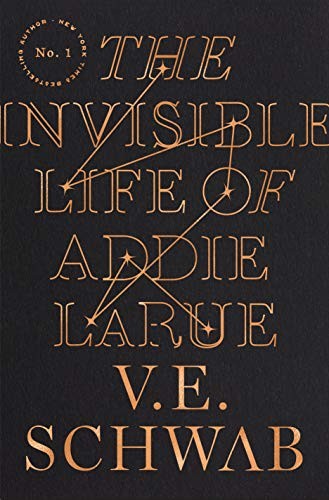

Tropes in this book
- Enemies to lovers
- Slow burn
Themes
- fantasy
- magical realism
- deal with the devil
- France 1714 and New York 2014
- melancholy vibes
- 16+ content
Read it if
- you like fantasy where the magic is quiet and the stakes are memory, loneliness and time
- you want a romance with a being not of this world, where an enemy spends two centuries slowly turning into a lover
- you have patience for a long, nonlinear story that jumps between eighteenth-century Paris and present-day New York
Skip it if
- you want fast action, because for nearly 450 pages most of the action happens inside the heroine's head
- repetition drives you up the wall, and Schwab keeps circling back to the same images and lines like a chorus
- you prefer endings tied up with a bow, with no question mark left hanging
Why this rating
🧠 For connoisseurs
7/10- An idea that never wears thin. A curse of being forgotten sounds like the premise for a short story, and Schwab squeezes three hundred years of consequences out of it. Addie can't rent a room, write a word or keep a single thing, and every night with someone she's close to ends with a stranger's stare in the morning. The rules hold together and keep revealing new loopholes, like the one where memories vanish but ideas stay.
- Two clocks. The chapters alternate between anniversaries of the deal and days in 2014, so the past keeps commenting on the present. The short art-catalog entries that open each part look like decoration, and they only reveal what they're really doing at the very end.
- Twists that hurt. The real terms of Henry's deal and what Luc confesses in Central Park make me rethink the whole book. The finale turns on a single phrase in Addie's own bargain, which is the perfect punchline for a book where Luc himself taught her that the power of a deal lives in its wording.
- Luc. A god of darkness whose eyes change color with his mood, seductive, cruel and pathetically lonely all at once. The three-hundred-year chess match between him and Addie is where Schwab is at her best.
- Pale Henry and paper friends. Henry is a sweet but fairly one-note guy with depression and a good heart, and Bea and Robbie exist mostly to forget Addie and comment on his life. Next to Luc he's chamomile tea next to absinthe.
- Too long, and too much of the same. That's a lot of pages for a plot that, in the New York half, boils down to one date after another. Déjà vu, the palimpsest, stone wearing away to dust and freckles like stars come back so many times that the chorus turns into a tic.
💖 For comfort readers
5/10- Romance with the devil. Addie and Luc are textbook enemies to lovers, just stretched across two centuries. If you like dark, jealous love interests with a glint in their eye, the scenes in Munich, Los Angeles and New Orleans will have you swooning.
- Atmosphere and travel. Voltaire's Paris, the Revolution, Venice, Chicago speakeasies and New York rooftops. It's a tour through the centuries with a guide who remembers every taste and smell.
- Bittersweet feels. A warm, moving story about finally being seen. The rooftop finale can close your throat.
- Pace. It warms up slowly, and plenty of chapters are mood pieces rather than events. If you need the plot to sprint, you may stall somewhere around page 150.
- Melancholy instead of a happy ending. This isn't a light love story. Loneliness, hunger, violence against women and depression carry their full weight here, and the ending leaves a sting rather than relief.
The book's four layers
Plot and pacing
It opens like a fairy tale and grows into a three-hundred-year saga in which every anniversary of the deal adds a new move to the game between Addie and Luc. The late twists, especially the truth about Henry's bargain and about who put him in Addie's path, are very good. The problem is length: the New York half has stretches where the characters simply go on one more date.
Characters and relationships
Addie is stubborn, resourceful and nobody's victim, and you can feel her three hundred years in every decision. Luc is a character I'll remember for a long time: a beautiful, cruel, lonely god whose moods you read in the color of his eyes. Henry looks pale next to them, and Bea, Robbie and Muriel are sketches more than people.
Writing style and atmosphere
Schwab writes in the present tense, lyrically and vividly, and her Paris, Venice and New Orleans have smells and noise. The art-catalog entries between the parts are a delight. The same style likes to loop back on itself, though, and the repeated phrases eventually start to grate.
Entertainment and value
It's a beautiful, wise book about memory, but not something you finish in one evening. Nearly 450 pages of melancholy take patience, and in the middle it was honestly too slow for me. The ending makes up for it: afterward I spent a long time thinking about what a person's trace in the world is worth.
The book in brief, spoiler-free
A French village girl runs from her own wedding in 1714 and strikes a bargain with the dark: freedom and a life without end, but everyone she meets forgets her the moment she's out of sight. Three hundred years later, in a secondhand bookstore in New York, someone remembers her.
Want the plot step by step?SummaryThemes it explores
V.E. Schwab writes about memory as the thing that makes us human: we exist in other people's eyes, in the things we leave behind and in the stories someone tells after we're gone. Addie gets what she asked for, freedom and time, and then spends three hundred years testing what they're worth when nobody remembers her. Henry gets everyone's love and discovers it's only a mirror in which each person sees what they want. Between them stands Luc, a god of promises for whom loving means owning.
The main threads: the deal and its price (a bargain made after dark, where a single sentence decides three centuries); the curse of being forgotten (no name, no home, no photos, no place in anyone's memory); art and ideas (Addie's freckled face and her melodies slipped into paintings, sculptures and songs as her only trace on the world); the game with the dark (Luc's yearly visits, which turn from war into romance and back into war); Henry and his storms (depression, addiction and the need to be good enough for everyone else); friendship (Bea and Robbie, who love Henry even when they don't quite see him); and story as salvation (the notebooks where Henry writes down Addie's life so it can outlast them both).
Questions and answers
Is The Invisible Life of Addie LaRue a series?
No, it's a standalone novel, so there's nothing to read first and no reading order to worry about. The ending leaves an open question about what comes next for Addie and Luc, but the main story is told all the way to the end.
How many pages is The Invisible Life of Addie LaRue?
The 2020 US hardcover from Tor Books has 448 pages, though it depends on the edition. It's divided into seven parts, each opening with a short catalog entry for a work of art, and the chapters jump back and forth between the centuries and 2014.
Is The Invisible Life of Addie LaRue appropriate for 12 year olds?
Not yet – my rating is 16+. There are short but explicit sex scenes, sex work out of desperation, an attempted rape, wartime violence, alcohol and drugs. Henry's depression and suicidal thoughts are a major thread, handled seriously and without graphic detail. If you or someone you know is struggling or thinking about suicide, call or text 988 (Suicide & Crisis Lifeline, US).
How spicy is The Invisible Life of Addie LaRue?
6/10 on my spice scale. There are several brief but fairly direct sex scenes, with lovers Addie meets across the centuries and with Luc, plus plenty of sensual tension. They're never the main event, though: the book cares far more about longing than about the bedroom.
Is The Invisible Life of Addie LaRue YA or adult?
It's adult fantasy, published by Tor, and Addie is 23 when she makes the deal before living three more centuries. It's hugely popular with older teens on BookTok, and I'd hand it to readers 16 and up.
Who is The Invisible Life of Addie LaRue for?
Readers who like fantasy that sits closer to literary fiction than to adventure: melancholy, atmospheric, with a romance and a solid dose of history. Connoisseurs (7/10) will be drawn in by the original premise and a terrific antagonist; comfort readers (5/10) get a romance with the devil and a trip through the centuries, as long as they survive the slow pace. Fans of fast, light romances may get bored.
What about you? Have you read this book?
Reader ratings
Your rating might be totally different from mine. A lot depends on when you pick it up.
Your rating on a 1-10 scale
No login needed. One vote per browser – you can change it later.
Disagree? Rate the book above or message me on Instagram or TikTok.
What to read next
 The Cruel Prince
Holly Black
An inhuman love interest, hostility that turns into feelings and bargains where every word is a trap.
★ 7/10🧠 7💖 7🌶️ 215+
Read the review
 Ignite Me
Tahereh Mafi
Also: enemies to lovers.
★ 5/10🧠 4💖 6🌶️ 616+
Read the review
 Carry On
Rainbow Rowell
Also: YA fantasy, magic school.
★ 7/10🧠 7💖 7🌶️ 214+
Read the review