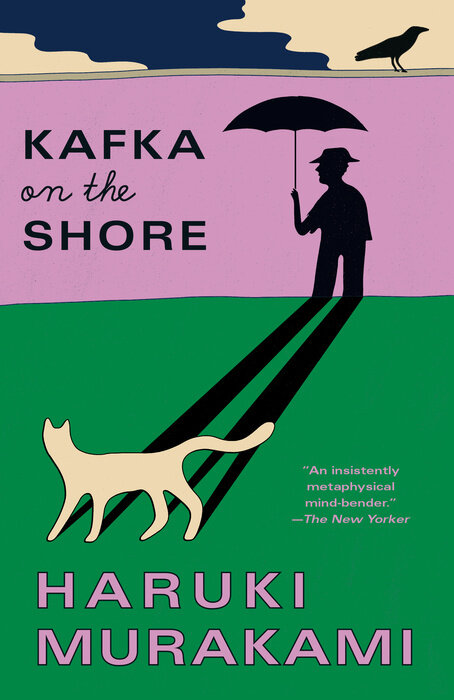
 Compiled by T.O. Lyceum
Themes
- magical realism
- adult fiction with a teen narrator
- runaway
- talking cats
- a library that keeps memories
- Greek tragedy curse
- 18+ content
In brief
Kafka on the Shore by Haruki Murakami is a novel about a boy who runs away from home in Tokyo's Nakano Ward on his fifteenth birthday to escape a prophecy his father made about him. Kafka Tamura (a name he picked for himself) takes money, a knife and an old photo of himself with his sister, boards a night bus and ends up on the island of Shikoku, in the city of Takamatsu, where a small private library takes him in. His only companion is the boy named Crow, a voice in his head that keeps telling him he has to become the toughest fifteen-year-old in the world.
Running alongside his story is that of Mr. Nakata, an old man from the same part of Tokyo. As a nine-year-old during the war, he lived through a mysterious incident in the mountains in which a whole group of schoolchildren lost consciousness at once, and he woke up with no memory and no ability to read. What he can do is talk to cats, and he earns a little money finding the neighbors' lost pets. While looking for a calico cat named Goma, he crosses paths with a cat catcher who insists on being called Johnnie Walker, and from that moment on the roads of the old man and the boy, who never meet, begin to converge in a dangerous way.
This is literary fiction for adults, where the everyday blends with magic: fish fall from the sky, a stone opens a passage into another world, and the spirit of a woman who is still alive comes every night to a room in the library to look at a painting of a boy by the sea.
Read this book? Rate it
Reader ratings
Your rating on a 1-10 scale
No login needed. One vote per browser – you can change it later.
Spoilers ahead. The plot breakdown gives away the ending. If you don't want to know it, stop at the description above.
Plot breakdown
- 1
Running away on his fifteenth birthday
Kafka Tamura lives in Nogata, in Tokyo's Nakano Ward, with his father, a famous sculptor he does his best to avoid. His mother left when he was four and took his adopted sister, six years older than him, with her. For years Kafka has been working out at the gym, he has the best grades in his class and he doesn't let anyone get close, and in his head he hears the boy named Crow. Just before his fifteenth birthday he takes money from his father's study, along with a gold lighter, a folding knife, a flashlight and a photo of himself with his sister at the beach, and then rides a night bus to Takamatsu. On the bus he meets Sakura, a young hairdresser who gives him her phone number. He checks into a cheap hotel recommended through the YMCA, works out at a sports club in the mornings and spends his days at the Komura Memorial Library, the former mansion of a wealthy family, where he reads The Thousand and One Nights and the novels of Natsume Soseki. There he meets the librarian, Oshima, and the woman who runs the library, Miss Saeki, and the first time he sees her, he thinks how wonderful it would be if she were his mother.
- 2
Rice Bowl Hill
Kafka's chapters alternate with US Army intelligence reports from 1946. They describe an event that took place on November 7, 1944, in Yamanashi Prefecture: on a mushroom-picking trip to a hill known as Rice Bowl Hill, sixteen schoolchildren suddenly lose consciousness, and their teacher, Setsuko Okamochi, is left alone among the children lying on the ground. After about two hours they all come to with no memory of what happened, all except one boy evacuated from Tokyo, Satoru Nakata. He lies unconscious in a military hospital for several weeks and wakes up with his mind wiped clean: he doesn't know his own name, his parents or how to read. In a 1972 letter to a psychiatry professor, the teacher confesses what she kept from the military: just before the children collapsed, the boy brought her some bloodstained cloths, and in her shock she beat him.
- 3
Blood on his shirt
On May 28, Kafka comes to late in the evening in the bushes behind a Shinto shrine. He can't remember the last four hours, his left shoulder hurts and his white T-shirt is soaked with someone else's blood. He calls Sakura, who takes him to the apartment of a friend she's staying with, listens to the story of his mother and sister, massages his shoulder and lets him spend the night, and their closeness that night throws him into turmoil. In the morning Kafka checks out of the hotel, leaves Sakura a letter and asks Oshima for help. The librarian, a Schubert lover with hemophilia, drives him in his green Mazda Miata to his brother's cabin in the mountains of Kochi Prefecture, a place with no electricity and no cell signal. There Kafka reads about the Eichmann trial, finds a note Oshima wrote in the margin about responsibility beginning with imagination, and learns not to fear the forest he's been told not to wander into. A few days later he becomes a library employee and moves into the room where Miss Saeki's lover once lived. When two inspectors accuse the library of discriminating against women, Oshima tells them that biologically he's a woman who lives as a man and likes men.
- 4
The man who talks to cats
Nakata, now past sixty, refers to himself in the third person, lives on a disability allowance and, for a few thousand yen, searches for missing cats, because he can talk to them. For thirty-seven years he worked as a carpenter in a furniture workshop, but he lost the job, and a cousin squandered his savings. An old tomcat, Mr. Otsuka, tells him his shadow is only half as dark as it should be. While searching for Goma, a cat belonging to the Koizumi family, Nakata meets Mimi, a Siamese and a Puccini fan, who warns him about a cat catcher in a tall hat. After several days of waiting in an empty lot, a huge black dog leads him to the house of a man dressed as the figure on a whiskey label, Johnnie Walker. Johnnie Walker shows him a freezer full of cats' heads, explains that he makes flutes out of cats' souls and demands that Nakata kill him, or else he'll keep killing cats, Goma and Mimi included. When he kills a tomcat named Kawamura right in front of Nakata, the old man grabs a knife and kills Johnnie Walker. He wakes up in the empty lot, clean, with no trace of blood on him and both cats at his side.
- 5
Fish, leeches and the curse
Nakata returns Goma to her family and goes to a police box to report that he has killed a man, but the young officer brushes him off as a confused old man. Nakata also warns him that fish will fall from the sky the next day, and sure enough, around two thousand sardines and horse mackerel rain down on a shopping arcade in Nogata. In a nearby house, the housekeeper finds the naked body of the sculptor Koichi Tamura, stabbed to death with a steak knife. From a newspaper Oshima shows him, Kafka learns that his father was killed on the very evening he himself came to covered in blood. That's when he confides the curse his father had been repeating to him for years: that he would kill his father and sleep with his mother, and with his sister too. Meanwhile Nakata hitchhikes west. At a highway rest area in Fujikawa, as he opens his umbrella, leeches rain down on a group of bikers who are beating up a young man. He gets a ride from there with Hoshino, a young driver who hauls furniture in his truck and wears a Chunichi Dragons cap and a Hawaiian shirt, and whom Nakata reminds of his late grandfather. In Kobe, Hoshino walks away from his job, and the two of them cross the great bridge to Shikoku.
- 6
The girl in the blue dress
Oshima tells Kafka Miss Saeki's story. As a girl she loved the eldest son of the Komura family; at nineteen she wrote and sang a song called “Kafka on the Shore” that sold more than a million copies, and her twenty-year-old boyfriend was beaten to death by striking students who mistook him for someone else. Miss Saeki disappeared for a quarter of a century and came back to Takamatsu after her mother died. At night, in Kafka's room, the spirit of a fifteen-year-old Miss Saeki in a pale blue dress appears and gazes at the painting of a boy on the beach, and Kafka falls in love with this girl. In the song's lyrics he recognizes the falling fish and the knife, and when Miss Saeki mentions that she once wrote a book about people struck by lightning, he remembers that his father was struck by lightning once too. He starts to suspect that Miss Saeki is his mother and asks whether she has children, but she answers neither yes nor no. One night the adult Miss Saeki comes into his room in her sleep, takes him for her lover from long ago, and they sleep together. Later she comes to him fully awake, takes him to the beach in the painting, and they're together again. The police trace Kafka to Takamatsu through his father's cell phone records, so Oshima drives him back to the mountains and tells him that Miss Saeki is dying.
- 7
The entrance stone
In Tokushima, Nakata sleeps for thirty-four hours, and when he wakes up he fixes Hoshino's aching lower back with one painful press. In Takamatsu he announces that they have to find the entrance stone, white and round, flat like a pancake. Searching the city library gets them nowhere, until one evening Hoshino is approached by an old man dressed as Colonel Sanders from the Kentucky Fried Chicken ads. This pimp, who claims to be a concept rather than a person, treats Hoshino to a night with a philosophy student who quotes Bergson and Hegel, and then leads him to a small shrine in a wooded grove where the stone is lying. On the day of a thunderstorm, Hoshino turns the stone over with every ounce of strength he has, Nakata announces that the entrance is open, and then he falls into another sleep that lasts for hours. In the meantime Hoshino discovers Beethoven's Archduke Trio in a little coffee shop. When the police start looking for an old man from Nakano and his companion, Colonel Sanders moves them into an apartment in Takamatsu. Hoshino rents a car and drives around the city for two days, until Nakata points to the gate of the Komura Memorial Library.
- 8
Burned memories
After a tour of the library, Nakata goes into Miss Saeki's office. She admits that long ago she opened the stone herself, so that nothing could break into the world she shared with her lover, and that since she was twenty her life has been nothing but remembering. Nakata confesses that he killed a man in Nakano in place of the man's fifteen-year-old son, who should have been the one there. Miss Saeki gives him three files with her life written down in them and asks him to burn them without reading them. Less than two hours later, Oshima finds her dead at her desk, with the ghost of a smile on her face. Nakata and Hoshino burn the files by a river, and the next day Nakata dies in his sleep in the apartment Colonel Sanders found for them. In the forest, the boy named Crow attacks the spirit of Johnnie Walker, who is stuck between life and death and won't stop laughing. Hoshino is left alone with the body and the stone, and Toro, a black cat he suddenly finds he can talk to, tells him he has to kill something that will try to get through the entrance. Toward dawn, a white, shapeless creature crawls out of the dead man's mouth. A knife, a cleaver and a hammer do nothing to it, so with the last of his strength Hoshino turns the stone over and closes the entrance, then finishes off the creature and takes the remains away to be burned.
- 9
The town deep in the forest
At the cabin, Kafka dreams that he has sex with Sakura against her will, and she tells him straight out that he is raping her. Horrified by what he is turning into, he walks deeper and deeper into the forest, abandons his compass, his paint and his backpack, and wonders whether to stay there forever. He meets two soldiers who vanished in that forest during maneuvers just before the war, and they lead him through the entrance to a town with no names, no books and no passing of time. A fifteen-year-old Miss Saeki who has no memories cooks for him. The adult Miss Saeki visits him too: she asks him to go back to his own world and to remember her, gives him the painting of the beach and asks him to forgive her for once abandoning someone she loved more than anything. Kafka forgives her, calls her Mother in his mind, and she gives him her blood to drink. The boy makes his way back through the forest with the soldiers before the entrance closes. Oshima's brother Sada, a surfer, drives him to Takamatsu, where Oshima tells him that Miss Saeki died of heart failure and hands him the painting. Kafka decides to go back to Tokyo, turn himself in to the police and finish junior high. From the station he calls Sakura and says goodbye, calling her his sister, and on the train he falls asleep, to wake up as part of a new world.
Themes and message
- Escape and the curse
- A fifteen-year-old runs from his father's prophecy, which echoes the fate of King Oedipus.
- Memory and forgetting
- Miss Saeki lives on her memories, Nakata has none at all, and the library keeps what people lose.
- The mother who left
- Why a mother walked away from her four-year-old child, and an attempt to forgive her.
- Violence and responsibility
- Whether we answer for what we do in our dreams or through someone else's hands.
- Friendship by chance
- A truck driver and an old man who can't read end up needing each other.
- Being different
- Oshima lives in a body he doesn't identify with and can't stand people who lack imagination.
- A world next door
- Talking cats, a rain of fish and a forest where time stands still.
This is a summary of “Kafka on the Shore” by Haruki Murakami and its main events. It's not a review, but an overview of the novel's plot and themes.
Is this book for you?You'll find the rating and verdict in the review.
Read the review