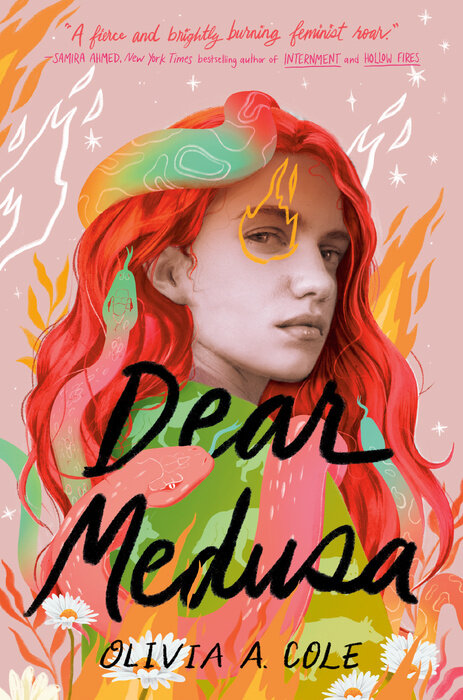

Tropes in this book
- High school
Themes
- novel in verse
- contemporary YA
- slut-shaming
- sexual violence
- female friendship
- Medusa myth
- track and field
Read it if
- you're looking for a book about slut-shaming and sexual violence told in the survivor's own voice, with nobody moralizing over her
- you love novels in verse and writing where a single metaphor says more than a page of dialogue
- you want a story about girls becoming friends and a quiet, tender crush on another girl
Skip it if
- you need a clear, driving plot, because most of this happens inside the heroine's head
- harassment and rape are too close and too painful for you right now – this one can wait
- you can't stand it when an adult expert delivers ready-made lectures to the characters (and to you)
Why this rating
🧠 For connoisseurs
7/10- Alicia's voice. The free verse here isn't decoration. Alicia thinks in images: wolves and rabbits, hair the color of a poison dart frog, an hourglass in a therapist's office, a friendship running out like sand. Those images carry everything she can't say out loud, and her inner monologue about shame and anger is sharper than what you get from most YA narrators.
- The myth, rewritten. Medusa as Poseidon's victim, punished by Athena, and not a monster waiting for some hero's sword – that's the key to the whole book. Alicia's letters to Medusa, Athena and Poseidon are the strongest pages, and the final letter closes the circle so well it gave me chills.
- Characters with a pulse. Deja, mouthing off in detention and open about being asexual; Blake, the perfect girl behind a mask; a mother who doesn't really see her daughter for half a year and then makes a scene at the eye doctor's. Plus the adults who help without any fanfare: Mr. West with the razor blade, Debbie in the storage room doorway. Nobody here is a prop.
- The notes. The mystery of the notes in blue ink keeps the tension up from start to finish and leads to a reveal that makes you see one of the characters in a completely different light.
- The lesson plan. Dr. Kareem talks like a workshop handout, and the girls in her group work through topic after topic: periods, hormones, racism, virginity, trans people. All of it is right, but in those scenes the characters turn into megaphones and the novel turns into a syllabus.
- A full-time wolf. The wolf metaphor comes back so often that by the end it has lost its teeth. The author even has Alicia ask why she keeps comparing women to rabbits, and that question never gets an answer.
💖 For comfort readers
4/10- Friendship and tenderness. The text threads with Deja are funny and warm, the cookout at Uncle Ronnie's is one of the brightest scenes, and the sleepover at Geneva's shows falling for someone with no drama and no grand declarations.
- An airy format. Poems, letters and texts take turns, and there's a lot of white space on the page. Even at around 400 pages, it never feels like a slog.
- No relief until the end. Harassment, rape, slut-shaming, racism, a divorce and a brother falling in with the wrong crowd. There's no escapism here, mostly pain, and the relief only comes on the very last pages.
- Slow to get going. School, detention, the drive-thru, some strange man's car, repeat. The plot only really starts moving once the mystery of the notes is solved, and before that you spend a long time running in place.
- Not for every reader. Lines broken mid-sentence, metaphors stacked on metaphors and very little dialogue. If you want a romance with a clear storyline, this kind of poetry will bounce you right off.
The book's four layers
Plot and pacing
It reads more like a diary of a state of mind than a classic plot. For a long stretch Alicia circles between school, detention, Meat Palace and strangers' cars, and the only engine is the mystery of the blue-ink notes. That mystery works and leads to a powerful ending, but the way several things land on the very same day at the end smells like screenwriting convenience.
Characters and relationships
Alicia is complicated and contradictory: furious, funny, blaming herself for other people's crimes. Deja has her own voice and her own story, Blake surprises you, and the mother goes through a change I actually believe. The villains are weaker: Ms. Fisher and Justin are one-note evil, and Geneva is at times so flawless that she stops being a girl and turns into an ideal.
Writing style and atmosphere
Poetry that holds up for 400 pages: letters, lists, text messages and memory poems, each with its own rhythm. The best images stay with you for a long time (the poison hair, Debbie's finger, politeness as a trap). Dr. Kareem's lectures sound weaker, as if they were copied off a slideshow, and so do the wolves, which by the end are howling out of habit.
Entertainment and value
There isn't much pleasure here, because this isn't a book to unwind with. The friendship with Deja and the tender scenes with Geneva save it. The value, though, is high: the novel calls slut-shaming, grooming and adult silence by their names, and for a teenager in a similar situation it might help her see that it isn't her fault.
The book in brief, spoiler-free
Sixteen-year-old Alicia has bright red hair, a drive-thru job and the label of school “slut,” and underneath all of it, a secret about the most popular teacher at school. Olivia A. Cole tells her story in verse, diary-style, and turns the Medusa myth into a weapon against slut-shaming.
Want the plot step by step?SummaryThemes it explores
Olivia A. Cole writes about how the world turns a girl into a monster so it doesn't have to look at the people who hurt her. Alicia is sixteen, with red hair and a reputation as the school slut, and underneath it a story she can't put into words: a grown man from her past and a teacher the whole school adores. The myth of Medusa, raped by a god and punished for it by a goddess, becomes her mirror and the language she finally uses to talk about herself. It's a novel about the shame other people pin on victims, about adults who don't see and about girls who start hearing each other.
The main threads: slut-shaming (rumors, notes in her locker, words carved into a desk and a list of insults Alicia keeps with bitter irony); sexual violence and silence (abuse by a teacher, a grown man exploiting a fourteen-year-old and the reasons victims say nothing for years); the Game (a teenager who gives her number to much older men to see whether any of them will act like an adult); the Medusa myth (letters to Medusa, Athena and Poseidon in which the old story changes its meaning); friendship between girls (Deja, Blake and Dr. Kareem's group, where for the first time it's possible to talk about what hurts); identity (Alicia's bisexuality, Deja's asexuality and a gentle love for Geneva); family (her parents' divorce, a brother being pulled in by a racist friend and a mother who finally takes her daughter's side); and running (a body Alicia long thought belonged to someone else, and a return to the track as a way of getting herself back).
Questions and answers
Is Dear Medusa appropriate for 12 year olds?
No – I'd say 16+. Nothing is described graphically, but sexual violence is everywhere: a teacher abusing a student, a grown man exploiting a fourteen-year-old, a sixteen-year-old meeting up with much older men, plus slut-shaming and a lot of swearing. If the book stirs something up or reminds you of something that happened to you, you can call or text 988, the Suicide & Crisis Lifeline in the US, any time.
How spicy is Dear Medusa?
3/10 on my spice scale. There are no graphic sex scenes. Sex comes up all the time – in rumors, in Alicia's meetups with much older men, in frank group talks about virginity and hormones – but it's never written to be steamy, and most of it is about abuse, not desire. The romance with Geneva stays soft: holding hands, a sleepover and a kiss on the back of the neck.
Is Dear Medusa part of a series?
No, it's a standalone with a closed ending that follows Alicia Rivers through most of one school year. You don't need to read anything first, and you don't need to know the Medusa myth either – the book tells it for you.
How many pages is Dear Medusa?
400 pages in the 2024 US paperback from Ember, though it depends on the edition (the 2023 Labyrinth Road hardcover has 384). It's a novel in verse with plenty of white space on the page, so it goes much faster than the page count suggests.
Is Dear Medusa YA or adult?
YA. Alicia is sixteen, it's set in high school and it comes from Random House Children's Books. Plenty of adults read it too, especially parents and teachers who want to understand what slut-shaming looks like from the inside.
Who is Dear Medusa for?
Teens and adults who valued The Perks of Being a Wallflower or Thirteen Reasons Why and want a book about sexual violence told in the survivor's own voice, without anyone moralizing over her. It's also for poetry lovers who like an unusual form. If you're after a light romance for a cozy evening, pick something else.
What about you? Have you read this book?
Reader ratings
Your rating might be totally different from mine. A lot depends on when you pick it up.
Your rating on a 1-10 scale
No login needed. One vote per browser – you can change it later.
Disagree? Rate the book above or message me on Instagram or TikTok.
What to read next
 Thirteen Reasons Why
Jay Asher
Rumors, slut-shaming and sexual violence in high school, told by a girl nobody wanted to listen to.
★ 6/10🧠 6💖 5🌶️ 215+
Read the review
 The Perks of Being a Wallflower
Stephen Chbosky
A teenager writes down what he can't say out loud, and underneath lies a trauma he has spent years pushing away.
★ 9/10🧠 8💖 5🌶️ 315+
Read the review
 Aristotle and Dante Discover the Secrets of the Universe
Benjamin Alire Sáenz
Quiet, poetic prose about figuring out who you are and falling for someone of the same sex.
★ 8/10🧠 8💖 6🌶️ 215+
Read the review