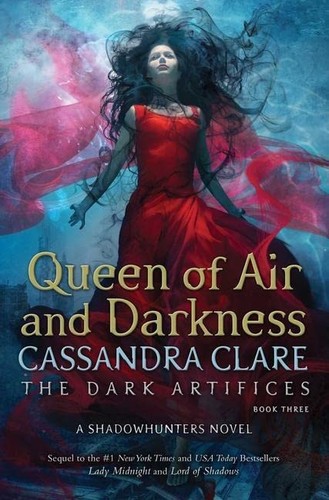

Tropes in this book
- Plot twists
- Romantasy
Themes
- urban fantasy
- trilogy finale
- Shadowhunters and faerie courts
- grief and necromancy
- alternate universe
- forbidden love
- parabatai curse
Read it if
- you finished Lord of Shadows and there's no way you're leaving the Blackthorns stuck in that last scene
- you love alternate versions of familiar worlds where your favorite characters lost their war
- you want fantasy about grief where the sadness doesn't clear up in a chapter and everyone carries it differently
Skip it if
- 900-plus pages and a dozen-odd points of view is more patience than you have for one story
- you want the climax decided by the characters' own wits, not by angelic fire in the darkest hour
- a finale that wraps up the trilogy and immediately cracks the door to the next series gets on your nerves
Why this rating
🧠 For connoisseurs
6/10- Thule. The world where Sebastian won is the strongest stretch of the whole trilogy. Clare builds it out of small, awful details: frozen bodies under a club floor, an execution on the beach, Livvy with a scar across one eye and a shotgun in her hands. Julian meeting a sister who survived but lost Ty instead hurts more than plenty of actual deaths.
- Julian on mute. Magnus's spell is a bold swing: a boy who has lived his entire life for other people suddenly just runs the numbers, manipulates Emma and brushes off the brother who came to him for help. Clare doesn't soften any of it, and getting his feelings back comes with a real price.
- Ty and grief. A fifteen-year-old who can't accept his twin's death and collects necromancy ingredients piece by piece is written with care and zero lecturing. The scene at Lake Lyn where Kit tries to stop him is one of the best in the whole Shadowhunter saga.
- Politics with no bow on top. The fight with the Cohort doesn't end in a clean, cheerful win. Victory costs the heroes something enormous, and that's a braver call than I expected.
- Cardboard Cohort. Horace, Zara and Manuel don't have a single doubt between them, and at the climax they practically announce their own crimes. Next to someone as morally gray as Julian, they fall flat.
- A curse solved in one stroke. Clare plants warnings all along, and the monsters of Thule show exactly what can happen to parabatai. Even so, the trilogy's central problem gets solved for the heroes by a blast of heavenly power instead of letting them work their own way out.
- Sheer bulk and an ending in installments. Over 900 pages means a lot of war councils and scenes where characters recap things we already know. After the battle, Clare ties off every couple's story one at a time, and the wrap-up runs longer than some action chapters.
💖 For comfort readers
7/10- Romances that pay off. Emma and Julian finally get to love each other without lies, and Clare gives them the scene readers have been waiting three books for. Alongside them, the sweet and funny relationship between Mark, Cristina and Kieran keeps growing.
- A battle worthy of a finale. On the Imperishable Fields you get werewolves, vampires, the Wild Hunt, the Riders of Mannan, the Cohort and a crowd of Shadowhunters, and every character gets their moment.
- Laughs when it's heaviest. A Black Volume of the Dead run off and bound at a copy shop, Magnus on lake water seeing seven Alecs, a celebration cake with a message too absurd to spoil. Clare knows exactly when to let you breathe.
- A send-off for the whole cast. A finale on the beach, reunions and goodbyes with characters from across the Shadowhunter world – a gift for anyone who loves this universe.
- Length. Even a die-hard fan will notice that a few war councils and battle prep scenes could go without anyone missing them.
The book's four layers
Plot and pacing
Faerie, Thule, Ty's necromancy and the war for the Clave braid together smoothly, and the Thule section is the best plotting in the trilogy. The pace sags with every new council before the battle, and the curse gets resolved from the outside.
Characters and relationships
Julian without feelings, Ty in mourning, Kit discovering where he really comes from and Kieran pushed into a role he never wanted all get their best moments here, and Dru finally gets a story of her own. The Cohort are caricatures, and Emma sometimes shrinks into a warrior on special assignment.
Writing style and atmosphere
The dialogue is lively, and Thule is vivid and genuinely scary. The metaphors and declarations are weaker: eyes like the sea, hearts like glass and love confessions come back so often they lose their punch.
Entertainment and value
The finale gives fans everything they've been waiting for: a massive battle, romances that pay off, tears and a family celebration. I'm docking points for the length, which buries you at times even when the pace is good.
The book in brief, spoiler-free
After Livvy's death, Julian has his own feelings switched off, the new Inquisitor sends him and Emma into Faerie on a mission they're not supposed to come back from, and in Los Angeles Ty quietly works out how to bring his twin back. The Dark Artifices finale drags you through the Unseelie Court and a ruined world called Thule all the way to a war over the future of the Clave.
Want the plot step by step?SummaryThemes it explores
Cassandra Clare closes the trilogy with a story about grief and the lengths people go to so they don't have to feel it. Julian has his emotions taken away, Ty tries to undo death, and Emma looks for a way to break the bond that could destroy them both. Running alongside is a political story about fear turning into law: the Cohort starts with a registry of Downworlders and ends up wanting to seal off Idris entirely. Thule, the world where evil won, works like a funhouse mirror that shows the heroes the worst versions of their own choices. Mercy matters here too – a lot comes down to the moment someone gives up on revenge.
The main threads: grief (Livvy's death and how differently each of the Blackthorns carries it); forbidden love (Emma and Julian as parabatai, and the curse that starts to kick in); Thule (an alternate world where Sebastian Morgenstern won); Faerie (the Unseelie Court, the Seelie Queen, Ash and the fight for a throne); necromancy (Ty's spell and its price); the Cohort (Horace Dearborn, Zara and the politics of fear); and found family (the alliance raised in Livvy's name, Mark, Cristina and Kieran, and a new home for Kit).
Questions and answers
Do I need to read Lady Midnight and Lord of Shadows first?
Yes. Queen of Air and Darkness is book 3 and the finale of The Dark Artifices, so the order is Lady Midnight, Lord of Shadows, then this one. It starts in the exact scene where Lord of Shadows ended and doesn't recap anything. The trilogy is set a few years after The Mortal Instruments, and characters from Clare's earlier series drop in – knowing them helps a lot once the story reaches Thule. If you want the full background, The Mortal Instruments has six books and starts with City of Bones.
Is Queen of Air and Darkness the last book in The Dark Artifices?
Yes, it closes the trilogy. Emma and Julian's story, the parabatai curse and the fight with the Cohort all get resolved, but the epilogue and a few loose threads, like Kit's heritage and Ash's fate, point toward more stories in the Shadowhunter world. The US hardcover also ends with a bonus story about Clary and Jace, “A Love That Never Tires.”
How spicy is Queen of Air and Darkness?
6/10 on my spice scale, the steamiest book of the trilogy. There are three sex scenes, and the last one is the most direct in the series, though Clare still skips anatomical detail. Add plenty of heated kissing and all the tension of a love that's against the law.
Is Queen of Air and Darkness appropriate for 12 year olds?
No. I rate it 16+, like the whole trilogy, and this book makes the strongest case for that line. Besides the sex scenes, the violence is heavier than before: a beheading, gruesome images from Thule, a bloody battle and suicide within the Cohort. There's also a family grieving a sister, necromancy and a boy who hurts himself in despair. If you're grieving or thinking about hurting yourself, in the US you can call or text 988 any time.
How many pages is Queen of Air and Darkness?
912 pages in the 2018 US hardcover from Margaret K. McElderry Books, though it depends on the edition. It's split into three parts with 34 chapters and an epilogue, and the chapter titles come from Edgar Allan Poe's poem “The City in the Sea.” It's the longest book in the trilogy.
Who is Queen of Air and Darkness for?
Anyone who has read the first two books and needs to know how the Blackthorns' story ends, plus fans of fantasy with faerie courts, alternate worlds and a big family at its heart. Comfort readers get romances that pay off, an epic battle and a warm family ending on the beach. Connoisseurs will love Thule and Ty's storyline, as long as they can handle 900-plus pages, paper-thin villains and a climax settled by angelic fire.
What about you? Have you read this book?
Reader ratings
Your rating might be totally different from mine. A lot depends on when you pick it up.
Your rating on a 1-10 scale
No login needed. One vote per browser – you can change it later.
Disagree? Rate the book above or message me on Instagram or TikTok.
What to read next
 Lord of Shadows
Cassandra Clare
The previous book, which ends in the Council Hall scene where this finale opens.
★ 7/10🧠 6💖 7🌶️ 516+
Read the review
 Lady Midnight
Cassandra Clare
Same series.
★ 7/10🧠 6💖 7🌶️ 416+
Read the review
 City of Glass
Cassandra Clare
The same Idris and the battle for Alicante from The Mortal Instruments, which echoes all through Thule.
★ 7/10🧠 6💖 7🌶️ 214+
Read the review