

 Compiled by T.O. Lyceum
Tropes in this book
- Plot twists
Themes
- fantasy fairy tales
- short story collection
- Grishaverse
- fairy tale retellings
- dark atmosphere
- twist endings
- illustrated edition
In brief
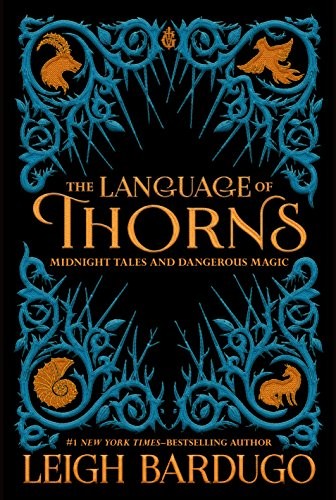
The Language of Thorns: Midnight Tales and Dangerous Magic by Leigh Bardugo is an illustrated collection of six fairy tales set in the Grishaverse, the same world as the Shadow and Bone trilogy and Six of Crows. It isn't a novel: each story has its own characters and comes from a different corner of the map – Novyi Zem, Ravka, Kerch or Fjerda. What ties them together is that they start out like fairy tales everyone knows and then turn down paths the classic versions preferred to avoid.
Ayama, a kitchen girl, is sent to the monster of the thorn wood and survives by telling stories. Koja the fox outwits hounds, a bear and his own mother, until he meets a hunter cleverer than he is. Nadya, from starving Duva, a village where girls keep disappearing, runs from her stepmother to a witch's hut. Beautiful Yeva of Velisyana watches her father stage three trials for her hand. Clara from Kerch confides in a nutcracker given to her by a suspicious clockmaker, and Ulla, a mermaid of the northern seas, comes ashore with her best friend and a prince who needs her song to win a throne.
In the background you can hear echoes of Beauty and the Beast, Hansel and Gretel, The Nutcracker and The Little Mermaid, but the endings belong to Bardugo alone. The book closes with an author's note about what unsettled her in the fairy tales of her childhood.
Read this book? Rate it
Reader ratings
Your rating on a 1-10 scale
No login needed. One vote per browser – you can change it later.
Spoilers ahead. The plot breakdown gives away the ending. If you don't want to know it, stop at the description above.
Plot breakdown
- 1
Ayama and the Thorn Wood
In a western valley, a queen of common birth gives the king a second son: more wolf than boy, with black fur, red eyes and the beginnings of horns. The king locks him in a labyrinth under the palace. Around the same time a poor family welcomes beautiful Kima, and a year later Ayama – clumsy, with a loud, grating voice, treated by her parents like a servant and sleeping on the stones of the kitchen hearth. When the monster escapes the labyrinth, he slaughters the herds, and the bones of the hundred soldiers sent after him turn up in the town square, stacked into a tower. The king promises three chests of gold and thirty bolts of silk to anyone willing to negotiate with him, and at dinner Grandmother Ma Zil tosses out the idea of sending Ayama. In the thorn wood, where stars shine in the middle of the day, there's only one rule: tell the truth. The monster knocks a cup of water out of Ayama's hand and offers her a deal – she has to tell him a story that makes him feel something more than anger. Ayama comes back three times, and each time she changes the ending of a well-known tale into a truer one: the boy who swallowed the sun still carries an emptiness inside him; a mother's new children are protected from her by the ghosts of her first children, the ones she poisoned; and the girl a bird prince carried off to his palace is taken back by her sisters, because there are better things in the world than princes. The monster spares the herds, then the fields, and Ayama's family grows rich, though she herself still sleeps in the kitchen. The third time, the king gives her a knife made from quince thorns, the only blade that can pierce the beast's hide, and promises her the prince's hand in exchange for the monster's heart. Ayama puts the knife away, drinks the water of the wood, leads the bound monster to the palace and accuses the king: he was the one who let his son out of the labyrinth and destroyed the herds and the crops himself, so his people would forget the lost wars and the taxes. The guards' daggers can't hurt her, because the water has turned her into a monster too, with a forked tongue and hair like fiery snakes. The queen confirms the truth, and Ayama shows the king mercy by having him locked in his own labyrinth. The monster forgives his mother and marries Ayama under a blood moon, Kima marries the prince and they hand the throne over to the monstrous couple, and from then on the women of the valley pray for red-eyed sons and horned daughters.
- 2
The Too-Clever Fox
In a Ravkan forest, the runt of a litter is born: a fox cub with yellow eyes. His mother eats two of his siblings but spares him after he convinces her that next to an ugly son she'll look even more beautiful. The other animals name him Koja – “handsome” – as a joke, and he talks his way out of one trap after another: he turns a pack of hounds against each other with the promise of a single wish, pays a swarm of fleas with a year in his own fur to bite Ivan Gostov, the bear who wanted to eat him, and later wins the bear's friendship with a hen and a bottle of kvass. In winter Ivan disappears, and Lula the nightingale brings news that Lev Jurek has come to Polvost – a hunter who leaves no tracks and whose rifle makes no sound. Ivan's hide lies on the floor of Jurek's house, and Jurek's sister, Sofiya, wears a ghoulish coat of furs with a collar made from the tails of seven white fox kits, the cubs of Koja's sister. Koja strikes up a conversation with Sofiya while she's crying in the woods, makes her laugh and promises to free her from her brother: he brings her sleep-inducing marsh leaves to knock Jurek out so she can steal his charm. Sofiya brings the pouch, treats the fox to cheese and wine, and he falls asleep in her lap. He wakes up with a knife in his belly: Sofiya is the hunter, and her brother, who is afraid of her, just collects the glory. Loneliness is the trap, she tells him as she skins him. Lula saves the dying Koja by pecking out Sofiya's eyes. Blind Sofiya ends up in the widows' house and is left alone in her coat, Jurek takes work as a woodcutter and finds a fiancée, and Koja, whose fur never sits right again, lives a quiet life beside Lula – who is not only clever, but wise.
- 3
The Witch of Duva
There is famine in the Ravkan village of Duva, and girls keep vanishing: one leaves behind nothing but a pile of clothespins, Lara Deniken a bloody shoe. Nadya, the daughter of Maxim Grushov, a carpenter, loses her mother, who before she died would eat nothing but the cakes of the widow Karina Stoyanova. The old women whisper about a forest spirit that likes to take the shape of a beautiful woman, and Karina spends more and more time around the widowed Maxim. Nadya begs her father not to marry her, but it does no good. At a dance before Nadya's brother, Havel, leaves for the army, Karina tells the girl to go with him and warns her there won't be a second warning. The next day the girl who'd been crowned queen of the thaw festival is gone. After the wedding Karina locks Nadya in her room and sends her into the woods to check the snares. The second time, Nadya loses the trail marked with white stones, smells burnt sugar and runs from something in the dark to a painted hut full of lights. It belongs to Magda, a witch with a bear cub in a gold collar. Magda feeds Nadya until she's full and asks her every morning what she wants. Nadya works over the pots and brews, and in winter she watches Magda bake a living gingerbread child for a mother dying of the same fever that killed her daughter. When the thaw comes, Nadya says what she wants: for her father to be free of Karina and for Duva to be safe. She pays with two fingers, which Magda grinds into flour. The dough becomes a gingerbread girl in Nadya's clothes, and through the eyes of a blind crow Nadya watches her double knock on the door of her house. Karina slips out with relief at the sight of it, while her father holds the gingerbread daughter in a way that leaves no doubt about what was threatening Nadya, sobs that he tried to stop, and eats her piece by piece. He was the one taking the girls: under the floorboards lie the missing girls' things, including the thaw queen's ribbons and Lara's apron. Maxim dies in the night, vomiting blood and sugar, and is buried without prayers. Karina, who married him to protect Nadya and to look for proof, moves away from Duva, Havel comes home from the northern campaign a hero, and Nadya stays with Magda and learns her magic.
- 4
Little Knife
Velisyana, now a dead town on the northern road, was once famous for its flour and for the beauty of Yeva, the duke's daughter. Yeva was so beautiful that the midwife locked herself in a linen closet with her, a portrait painter from Os Alta tried to kidnap her, and a glimpse of her ankle started a riot, so her father shut her away in his palace. When a rich man, Uri Levkin, comes to blows with his own son over her on her sixteenth birthday, the duke, hungry for fame and for profits from his flour, announces trials for her suitors. Each time Yeva asks whether this will get her a good husband, and each time nobody answers. The favorite is a golden-haired prince, the king's son, but the winner is Semyon – a poor, ragged Tidemaker from the days before the Second Army existed, helped by the river that runs past the mill. In a single night the water carries felled trees into a wooden tower, then carries Semyon into the Petrazoi mountains to an old Fabrikator woman for a mirror, and Semyon gives the river a name: Little Knife. For the third trial, fetching a magic coin hidden beneath Ravka, he breaks the dam with an axe so the divided water can get its strength back. The river brings up the coin, and when the duke, the prince and Semyon all reach for it at once, it rises over the bank as a woman made of waves. It was a spirit of the northern sea, trapped by the dam and the mill wheel. It asks Yeva whether she'll stay with the father who wanted to sell her, the prince who wanted to buy her or the man too weak to complete the tasks on his own. Yeva tears off her veil and leaps into the current. The water carries her to the sea and smashes the mill to splinters, and the wheel, torn loose, knocks down the prince and his retinue. Without its river Velisyana dies, the duke is left alone in the ruins of his palace, Semyon is driven out and withers away because he's afraid to drink water, and Yeva lives to old age by a shrine near the sea, alone but happy.
- 5
The Soldier Prince
Droessen, a clockmaker from Wijnstraat in Kerch, is famous for his automatons and for the strange things that seem to happen around him. He wants to marry well, so he sets his sights on Clara Zelverhaus, not yet twelve, from a family of wealthy tea merchants, and gives her a nutcracker in a blue uniform to whom she's supposed to confide all her secrets. Years go by, and Clara still sneaks up to the attic, puts a nut between the doll's jaws and asks whether he is her soldier, her prince and her love. Then the nutcracker grows into a handsome prince and takes her to a dream kingdom, but he always brings her back. Part of the story is told through his eyes: his memory keeps blurring, and the Rat King, who started out as a sugar mouse, tells him that real life begins with wanting things for yourself and warns him about Droessen – the doll has been a spy, passing Clara's dreams on to the clockmaker. During the winter holidays the nutcracker wants something for himself for the first time: to step out onto the road and see where it leads. Clara, now seventeen, wants him to take her to the dream kingdom forever, and her brother Frederik brings him to a party as a school friend named Josef. That night Droessen tries to break the doll by telling him he's nothing but a toy and wants to throw him into the fire, but the rats swarm the clockmaker. By imagining a father who loved him, the nutcracker turns the tables: it's Droessen who shrinks into a little wooden doll, which the young man sets in the display cabinet before he walks away down the road to the east. In the morning Clara's father finds her barefoot on the road. Rumors of a tryst with the vanished clockmaker ruin her reputation, so she moves to Ketterdam and becomes a writer, and someone in uniform leads a parade of automatons out of Droessen's workshop in the night. Frederik sails from port to port and never comes back to the family business, and one night their mother, Althea, takes the ugly doll in the little velvet coat out of the cabinet and whispers to it the same questions Clara used to ask.
- 6
When Water Sang Fire
The narrator speaks to someone sailing to the northern islands to strike a bargain with the witch of the black pools, and tells them to hear her story first. Ulla, a young sildroher from the days when the sea folk wielded song magic, has gray skin and black hair, and the others gossip that her father was human. Everything changes with a duet with red-haired Signy: together they raise a storm in the shell hall, and at the seventeenth birthday of Roffe, the youngest of six princes, they sing a living royal garden into being. Roffe takes them ashore for three months, to a palace on land, because the king will choose his successor by the gifts his sons bring him, and a sixth son needs powerful magic. Signy loves Roffe. Ulla, who feels no attraction to humans, meets the apprentice of the royal seer. With a bell, the boy squeezes her heart and reveals that they are siblings: Ulla was born on land to a witch mother, and her father, a sildroher, took her into the sea. He also tells her what a fire that could burn underwater requires: blood magic and a human sacrifice. Ulla refuses, but Roffe begins courting Signy and promises her a crown, so Ulla gives in for her friend's sake. On the night of the ball, a bound boy lies on her bed, supposedly a condemned murderer. Roffe kills him with Ulla's transformation knife, which Signy took from her trunk earlier, and throws the victim's lungs into the fire. The flame passes through Ulla and burns her from the inside, and Roffe takes the silver lantern with the fire and announces that Ulla killed an innocent page. Stained with human blood, the knife can never give her back her tail, and Signy chooses the prince, handing her friend the blade only after Roffe nods. Burned and voiceless, Ulla sings together with countless reflections in a magic mirror, cuts herself with the stained knife and grows a tail as black as an eel's. Her storm sinks the land palace along with the seer's tower, tears an island away from Fjerda and brings down the palace under the sea. Roffe becomes king, and Signy becomes his wife, who never sings again. Ulla lives in the icy pools of the north, waiting for the lonely, the ambitious and the weak who are ready to make a deal – Signy's six daughters among them.
Themes and message
- Fairy tales turned inside out
- Familiar patterns with endings that make you rethink who the real monster was.
- Truth and storytelling
- Ayama saves her own life by telling true endings instead of easy ones.
- Parents who fail
- Fathers and mothers who sell, abandon and even hurt their own children.
- Loneliness as a trap
- The fox, the nutcracker and the mermaid pay for finally finding someone who listens.
- Wanting things for yourself
- Yeva, Clara and the nutcracker walk away once they stop living out other people's dreams.
- The price of magic
- Gifts from witches, rivers and songs always come at a cost, often paid in blood.
This is a summary of “The Language of Thorns: Midnight Tales and Dangerous Magic” by Leigh Bardugo and its main events. It's not a review, but an overview of the novel's plot and themes.
Is this book for you?You'll find the rating and verdict in the review.
Read the review