
Tropes in this book
- College
- Enemies to lovers
- Fake dating
Themes
- romcom
- academic romance
- STEM heroine
- toxic mentor
- explicit spice
Read it if
- you loved The Love Hypothesis and want the same thing again, this time with physics instead of biology
- you like couples who go for each other's throats first and only slowly learn to trust each other
- you laugh at jokes about campus life: adjunct contracts, hiring committees and emails from students
Skip it if
- you're shopping for a teenager – the sex scenes here are long and extremely explicit
- you've had enough of huge, laconic heroes who always know better than the heroine what she needs
- you want a crisis that can't be fixed with one open letter and a confession in a hallway
Why this rating
🧠 For connoisseurs
3/10- Academia, no filter. Hazelwood knows exactly what she's writing about: a chronic illness and no health insurance, three adjunct contracts at once, a committee where two men at the urinals grade a candidate on her looks, and a mentor who keeps his protégée's career on a short leash. This thread is written seriously, and it's the best part of the book.
- Find and replace. Woman in science, enormous laconic scientist, fake relationship, campus politics, big public gesture at the end. Swap physics for biology and Jack for Adam, and I couldn't tell half the scenes apart. I don't think the author could either, since she let Adam into the party.
- Jack, the wish-fulfillment app. He knows her insulin routine, her favorite movie, her snacks and her fears, reads her like an open file and is never wrong once. He doesn't have a single flaw that isn't immediately explained away by a sad childhood.
- A villain from a Saturday-morning cartoon. The toxic-mentor theme is a serious one, but Laurendeau has all the subtlety of a fire alarm: he gets Elsie's name wrong, hides job offers from her and finishes with a speech about foolish, stubborn girls. The actual reckoning is handled for the author by a new dean, somewhere offstage.
- A plot that runs on coincidence. The department chair's son turns out to be Elsie's old client, a nurse happens to call both her and Jack, and the hostile committee members quietly drop out on their own. This story doesn't flow. It gets pushed.
- A crisis straight from the manual. The secret comes out, she tells him to leave, a week of silence, an open letter in a journal, a confession in front of the whole faculty. Every step showed up in exactly the order I'd predicted fifty pages in.
💖 For comfort readers
6/10- Humor. Student emails (a chinchilla with a gluten allergy, an essay on Lady Macbeth as the fourth witch), Volkov's physics puns and Greg high as a kite after the dentist. A few of those jokes landed perfectly for me.
- Chemistry and sparring. Elsie and Jack trade barbs across the committee table before they learn to talk to each other straight. If enemies to lovers is your thing, here it is, chalkboard edition.
- Friends and family. Cece and her hedgehog Hedgie, Millicent and her razor tongue, George and Greg make up the loudest, most lovable part of the book. The scene with the cheddar cubes is a small masterpiece.
- The inside joke. Adam and Olive drop by a party for a few pages, and Elsie privately decides that Olive couldn't possibly know anything about fake dating. Anyone who read The Love Hypothesis knows that's the best joke in this book.
- The bedroom eats the plot. From about two-thirds of the way in, the sex scenes run a dozen pages or more each, while the MIT storyline waits politely outside the door. If you came for a romcom with physics, you get an erotic romance with physics in the background.
The book's four layers
Plot and pacing
The setup is great: a fake girlfriend from an app goes to a job interview, and her client's brother is sitting on the committee. After that, the plot rolls along the rails Hazelwood already laid down in The Love Hypothesis: coincidences, an overheard conversation, a big secret, a week of sulking and a public gesture. The mentor storyline has real weight, but the author resolves it with someone else's hands.
Characters and relationships
Elsie, who plays a different version of herself for everyone she meets, is what really carries the book, and her learning to say what she wants has real consequences for her friendships, her family and her career. Jack is a flawless ideal, smitten since the first time he saw her near his grandmother's go board and as infallible as GPS. Cece, Greg and Millicent are written better than half the MIT physics faculty.
Writing style and atmosphere
Elsie narrates in first person, present tense, and lands plenty of sharp lines about adjunct life and student emails. But how many times can you compare a man to a refrigerator, a wardrobe and a skyscraper? Hazelwood tests it empirically and finds the answer is infinity. The sex scenes are tender but talky: rules, consent, more rules, at times like the minutes of a union negotiation.
Entertainment and value
It's funny, it's warm and there's a serious theme underneath, because type 1 diabetes without insurance and a career held on a leash by a mentor aren't decoration here. Still, it's the same recipe as last time, reheated and served with hotter seasoning. If you liked The Love Hypothesis, you'll leave full. If you were hoping for a new dish, you'll get a familiar plate.
The book in brief, spoiler-free
A theoretical physicist moonlights as a rent-a-girlfriend, walks into her MIT job interview and finds her client's older brother on the hiring committee – who also happens to be public enemy number one of her entire field. It's The Love Hypothesis with the biology lab coat swapped for a physics one, plus sharper jokes about academic poverty and much longer bedroom scenes.
Want the plot step by step?SummaryThemes it explores
Ali Hazelwood takes us back to campus and once again turns it into a minefield for women in science. This time it's physics and the feud between theorists and experimentalists, and under the romance there's a genuinely serious story about a woman who spent so long being convenient for everyone that she forgot what she wants herself. The problem is that all that seriousness lives inside a plot built from blocks the author already stacked once in The Love Hypothesis and has now just painted a different color.
The main threads: fake dating (Elsie earns money as a rent-a-girlfriend through the Faux app, and her favorite client, Greg, has his own reason to keep his family off his back); academic rivalry (an MIT job, a biased committee and a theorists-versus-experimentalists war whose symbol is Jack's hoax paper); a toxic mentor (Laurendeau controls Elsie's career, gets her name wrong and makes her decisions, and for years she mistakes it for care); masks and honesty (Elsie becomes whatever each person wants and slowly learns to say what she wants, in bed too); illness and adjunct life (type 1 diabetes, an insulin pump and the everyday fear of having no insurance); family (a mother and brothers who treat Elsie like an emergency service, and Jack, raised by a stepmother who never loved him); and friendship (Cece and her hedgehog, a friendship that survives even Elsie confessing she can't stand art-house cinema).
Questions and answers
Do I need to read The Love Hypothesis before Love, Theoretically?
No. It's a standalone with new main characters, and the publisher doesn't list it as part of a series. Adam and Olive from The Love Hypothesis make a cameo at one party for a few pages, and the dedication tells longtime readers that bit is for them. You won't miss anything without the earlier book, and with it you'll catch a few winks.
How spicy is Love, Theoretically?
8/10 on my spice scale. For the first two-thirds it's tension, banter and one very charged night on Jack's couch with no sex, and then from chapter 19 on come several long, very explicit sex scenes, with plenty of dirty talk and swearing. It's noticeably steamier than The Love Hypothesis.
Is Love, Theoretically appropriate for 12 year olds?
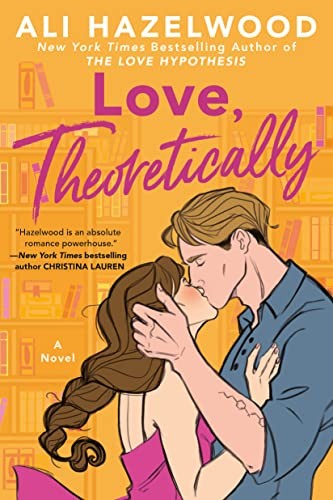
No. It's strictly 18+: there are several long, graphic sex scenes, constant swearing and characters in their late twenties and thirties dealing with adult problems like rent, health insurance and job contracts. The cartoon cover is cute, but this isn't a book for kids or younger teens.
How many pages is Love, Theoretically?
400 pages in the 2023 US paperback from Berkley, though it depends on the edition. There's a prologue, 26 chapters named after physics concepts and an epilogue.
Is Love, Theoretically YA or adult?
Adult romance with a new adult feel. Elsie is a 27-year-old physicist working as an adjunct in Boston, Jack is an MIT professor in his thirties, and the explicit sex puts it firmly at 18+. It sometimes gets shelved next to YA because of the cover and the author's fan base, but it isn't YA.
Who is Love, Theoretically for?
Comfort readers who loved The Love Hypothesis and want the same thing again in a different lab. Connoisseurs will enjoy the realistic academic detail and the mentor storyline, but the plot won't do anything they can't predict after a few chapters.
What about you? Have you read this book?
Reader ratings
Your rating might be totally different from mine. A lot depends on when you pick it up.
Your rating on a 1-10 scale
No login needed. One vote per browser – you can change it later.
Disagree? Rate the book above or message me on Instagram or TikTok.
What to read next
 The Love Hypothesis
Ali Hazelwood
Same author, same recipe, and the couple who crash the party in this book.
★ 5/10🧠 3💖 7🌶️ 718+
Read the review
 The Deal
Elle Kennedy
Fake dating, sharp banter and plenty of 18+ scenes, just on a college campus instead of in a lab.
★ 5/10🧠 2💖 7🌶️ 918+
Read the review
 Bride
Ali Hazelwood
Also by Ali Hazelwood.
★ 6/10🧠 4💖 7🌶️ 918+
Read the review