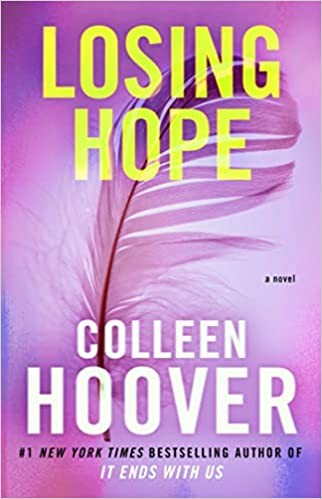

Tropes in this book
- High school
Themes
- new adult romance
- his POV retelling
- letters to a dead twin
- grief after suicide
- buried childhood secret
- explicit 18+ scenes
Read it if
- you've read Hopeless and want to know what was going on in Holder's head before he first climbed through Sky's window
- you're looking for a novel about losing a sibling where you're allowed to be furious at the person you lost
- you love books where letters and notes say more than the dialogue does
Skip it if
- you haven't read Hopeless yet – this one spoils all of it, ending included
- suicide, child sexual abuse and violence are too heavy for you right now
- you'd rather not sit through the same scenes and lines a second time, even from a different chair
Why this rating
🧠 For connoisseurs
4/10- Letters to Les. Most of the letters hide in chapters numbered with halves and three-quarters, written in a leather journal Les got for therapy and refused to touch. The best ones are a sentence or two long, like the string of sleepless late-night notes after the bracelet scene, and together they show grief without a filter: rage at his sister, guilt, and his theory that the word “devastated” should be reserved for mothers.
- Les's letter. Near the end Holder finally reads the letter his sister left in that journal. It's the strongest chapter in the book and the only one that makes you look at the whole duology differently: when Les's abuse started, why the family left Austin and what the adults knew about Hope. Hoover writes it plainly, with zero showing off.
- Rerun. From the grocery store all the way to Austin you get the same scenes and, for long stretches, the same lines as in Hopeless, word for word, just with Holder narrating over them. It felt like a second screening of a movie I'd already seen, this time with the director's commentary on, and the director mostly wants to talk about the lead actress's mouth.
- Obsession, romance edition. Now you know where Holder's staring, following and outbursts come from, but from the inside it looks even worse: he pins Sky to the mattress so she can't kick him out of her room, kisses her while she's asleep and admits himself that he never claimed he couldn't be cruel. The book serves all of this up as proof of a great love.
- Suicide as courage. Over dinner Holder tells Sky that Les was the bravest person he ever knew. The story walks that back later: he admits how angry he is at his sister, and her letter shows exhaustion and abuse, not heroism. But for long chapters that line goes unanswered, and in a novel plenty of teenagers pick up too, that's a risky shortcut.
- Convenient coincidences, squared. On top of the coincidences from book one comes a new one: years earlier, Holder's mother and Les recognized Hope in a restaurant and let the woman who took her drive away. Morally, it's an interesting choice. Plot-wise, it's one more back door the story uses to dodge consequences.
💖 For comfort readers
6/10- Daniel. Holder's best friend is a comedy genre of his own: he jumps across cafeteria tables, fires off nicknames in rapid bursts (his girlfriend Val isn't actually named Valerie) and tells the story of Cinderella in the janitor's closet. Without him the middle of the book would be a lot heavier.
- Holder from the inside. Holder fans get him with all the backstory: the year at his dad's, the blowup over his stepmom's couch, a pros-and-cons list about telling Sky the truth, and the weeks he avoids her but still shows up at school just to see her.
- Breckin and the bro friendship. The scene where tiny Breckin pokes Holder in the chest, and a few days later the two of them play Modern Warfare until midnight, is warm and funny.
- An ending that hurts. Les's letter and the conversation with his mom at her law office hit harder than solving the mystery in book one, because here you're crying over someone nobody can save anymore.
- Deja vu. If you read Hopeless recently, for long chapters you know exactly which line is coming next. The tension that Hope's mystery gave book one is gone, because Holder knows the answer almost from the start.
- No easy mode. A suicide in the first pages, a goodbye letter, child abuse and the death of Sky's father in front of the main characters. This is not a romance to unwind with after work.
The book's four layers
Plot and pacing
The first six chapters are a new story: the night with Grayson, Les's death, Amy, the fight, the arrest and the year in Austin. Then Hopeless starts again from the other seat, and until the road trip to Austin the plot adds little beyond commentary on familiar scenes and a few episodes with Daniel and Breckin. The ending with Les's letter saves it by laying a new, heavy foundation under the story, even if that foundation rests on yet another convenient coincidence.
Characters and relationships
Holder gains the most: grief, anger at his sister and shame after hitting his father make him a fuller person than in book one. Les, whom we only hear alive over the phone, turns out to be the most tragic character of the duology, Daniel and Breckin make a great buddy duo, and Holder's mom finally gets a face. Seen through his eyes, though, Sky shrinks into lips, countable smiles and comebacks, and Grayson, Amy and Val stay sketches.
Writing style and atmosphere
Hoover writes with a light hand, and the letter chapters are a good idea, especially the run of one-line notes from a sleepless night. What spoils it: dialogue copied over from book one, a narrator who returns to Sky's mouth every other paragraph, Daniel's nicknames fired off in volleys, and a self-plug when Sky reads Holder another Colleen Hoover novel out loud. One chapter is numbered thirty-nine, thirty-nine and a half and thirty-nine and three-quarters all at once, a joke that mainly amuses the author.
Entertainment and value
For a Hopeless fan it's a pleasant extra with a few strong chapters; for a new reader it's the wrong door in, because it gives everything away. The most value is in the letters and in how the book shows grief after suicide: rage, shame and longing sit side by side. I'm docking points for a middle that repeats book one and for sex once again being used as a bandage over trauma, this time for both of them.
The book in brief, spoiler-free
More than a year after his twin sister's suicide, Dean Holder is still writing her letters – and then, in a grocery store checkout line, he spots a girl with the eyes of Hope, his childhood best friend who vanished thirteen years ago. It's Hopeless told from the other side of the bed: scenes you already know, a handful of new ones, and one letter from Les that makes the trip back worth it.
Want the plot step by step?SummaryThemes it explores
Colleen Hoover tells the same story a second time, and its axis becomes Holder's guilt, which in book one we only saw from the outside. A boy who at six watched his best friend get into a stranger's car, and at seventeen found his twin sister dead, is convinced he fails every girl he loves, and he has it tattooed on his forearm. The letters to Les are his private therapy, and the last text in the journal, written in his sister's hand, answers the question Holder has been asking since chapter one.
The main threads: grief after suicide (rage, shame and missing a sister whose smile in every photo was a mask); guilt (Holder blames himself for Hope's kidnapping and Les's death until his sister's letter lifts that weight); abuse nobody talked about (what Hope's father did to Les, and the adults who knew more than they said); first love (Sky, who doesn't remember him, and Holder, who can't bring himself to tell her the truth); friendship (Daniel, Breckin and Amy, who each in their own way help him survive the year after the funeral); and family (a mother who, in her son's eyes, gave the word “devastated” a new meaning, and a father Holder hit and has to apologize to).
Questions and answers
Do I need to read Hopeless first?
Yes. Losing Hope is book two of the Hopeless duology, but it isn't a sequel in the usual sense: it retells the events of Hopeless from Dean Holder's point of view, opening more than a year earlier and adding a final chapter after the ending. Every secret from book one comes out early here, so start with Hopeless. If you've read it, you get new scenes (Les's death, the year in Austin, Daniel, the friendship with Breckin), the letters to his sister and her goodbye letter, which adds a new truth about Les and about what the adults knew. What you won't get is suspense, because you already know most of the scenes and the dialogue. There is also a short companion novella, Finding Cinderella, about Daniel and Six.
Is Losing Hope appropriate for 12 year olds?
No. It's 18+ on my scale, same as book one. There are several explicit sex scenes, including one with his dead sister's best friend a few days after the funeral, a sibling's suicide in the first pages, a goodbye letter in which Les writes about years of sexual abuse, and a suicide by Sky's father in front of the main characters. If you're thinking about ending your life or someone is hurting you, in the US you can call or text 988 any time.
How spicy is Losing Hope?
7/10 on my spice scale. For a good while it's flirting, kissing and Holder's thoughts about Sky's mouth, but the sex scenes are written out on the page, from the night with Amy to the hotel in Austin. What bothers me more than the heat is that sex keeps showing up as a painkiller for grief and trauma, and the book never really questions it.
How many pages is Losing Hope?
About 330 – the 2013 Atria paperback is listed at 336 pages, though it depends on the edition. Chapters are short, and many of the letters to Les take up a single page or less, so it reads fast.
Is Losing Hope YA or adult?
New adult, shelved with adult romance. Holder and Sky are high school seniors, but the content is firmly 18+: explicit sex, a lot of swearing, suicide and child sexual abuse. The teen characters shouldn't fool you into handing it to a teen.
Who is Losing Hope for?
Adult fans of Hopeless who want to get inside Holder's head and are fine knowing most of the story already. Readers moved by grief over a sibling, and by Les, will get the most out of it. If you're hoping for a new mystery, you'll be disappointed, because book one already solved it.
What about you? Have you read this book?
Reader ratings
Your rating might be totally different from mine. A lot depends on when you pick it up.
Your rating on a 1-10 scale
No login needed. One vote per browser – you can change it later.
Disagree? Rate the book above or message me on Instagram or TikTok.
What to read next
 Hopeless
Colleen Hoover
Book one, where you have to start, because there the same story still has its mystery.
★ 6/10🧠 4💖 7🌶️ 618+
Read the review
 It Ends with Us
Colleen Hoover
Hoover at her most serious, where the hardest part is not a buried secret but walking away from someone you love.
★ 6/10🧠 4💖 7🌶️ 718+
Read the review
 It Starts with Us
Colleen Hoover
Also by Colleen Hoover.
★ 5/10🧠 3💖 6🌶️ 718+
Read the review