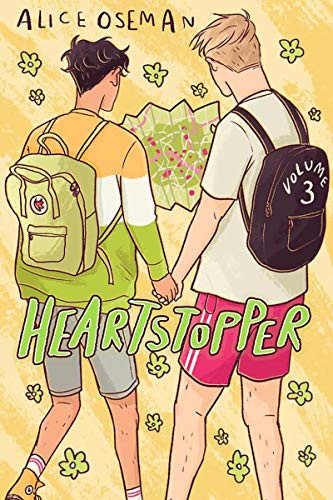

Tropes in this book
- Friends to lovers
- High school
Themes
- graphic novel
- LGBTQ+ romance
- school trip to Paris
- coming out
- mental health
- eating disorders
- boys' school
Read it if
- you want to see what happens when a couple is already a couple, but the world doesn't know it yet
- you're looking for a story about mental health that doesn't scare you, but shows what good support looks like
- you're dreaming of a school trip to Paris, with ice cream in Montmartre and a first kiss in view of the Louvre pyramid
Skip it if
- you want a comic with an actual plot, not a travel diary with sightseeing stops
- self-harm or eating disorders feel too close and too painful for you right now
- you can't stand endings that leave you uneasy and send you straight to the next volume
Why this rating
🧠 For connoisseurs
7/10- Charlie up close. Volumes 1 and 2 belonged to Nick, and this one finally gets inside Charlie's head. His confession on the beanbag in Nick's room, where he admits he used to self-harm, and the talk in the Louvre café about food being the one thing he can control are written quietly, precisely and without a trace of sensationalism. Oseman doesn't turn illness into a special effect, and she doesn't cure it with a kiss.
- A faint drawn from the inside. The Louvre sequence where the panels fall apart and Nick's words in the speech bubbles dissolve into unreadable scribbles is the best visual storytelling in the series. The same goes for “I love you” written across the background instead of in a speech bubble – a feeling nobody is saying out loud yet.
- A wider world. Tao gets a mistake from the past to carry, Tara explains how “lesbian” was used as an insult at her school, Aled has a secret of his own, and the two teachers running the trip get their own late-blooming story. Each of them brings a different answer to the question of when, and to whom, you tell people who you are.
- Sightseeing instead of plot. Seven days in Paris are half travel guide: Montmartre, ice cream, the Louvre, a bookshop, Notre-Dame, the Arc de Triomphe. It's pretty, but between the scenes that matter there's a lot of sightseeing that doesn't change a thing.
- Familiar tricks. Caught in the equipment cupboard, caught by the vending machines, nearly caught in the hotel room. Three volumes in, the near-miss routine no longer surprises me, and the cut-off ending with a search bar on a phone sets up Volume 4 more than it wraps up Volume 3.
💖 For comfort readers
7/10- Paris for two. Selfies at the Arc de Triomphe, pizza on stone steps, ice cream in Montmartre and a “Mon amour” dropped out of nowhere at the Louvre. If Volume 2 ended with a date by the sea, this one is a single weeklong date with the Eiffel Tower in the background.
- Humor. Charlie's dad and his strict no-sex-under-my-roof rule, Nick horrified that he's even capable of giving someone a hickey, Mr. Farouk bellowing for silence at a busload of teenagers, and Darcy with her vodka. For pure comebacks, this is the funniest volume in the series.
- Big moments. Charlie telling Harry he doesn't owe him forgiveness, and the whole room bursting into applause. Nick, in the middle of truth or dare, simply admitting the hickey is his. Those two scenes at Tara's birthday party are pure satisfaction.
- Bonus couples. Tao and Elle, Tara and Darcy, even the teachers – in this volume almost everyone who got on that bus falls for someone.
- Heavier than before. If you came only for the sweetness, you'll also get self-harm, a fainting spell and untouched plates. It's handled gently, but the mood gets heavy at times, and the volume ends on worry, not a smile.
The book's four layers
Plot and pacing
The first part is a string of short scenes from May and June: parents, the rugby team, the coach, a blowup with David. Then come seven days in Paris, each with its own small climax – the hickey, the fainting spell, Tara's birthday. One question holds it all together: when and how to tell people about the relationship, while the eating problem quietly builds underneath. Still, the structure is loose, a lot of pages are sightseeing, and the ending breaks off on a question saved for Volume 4.
Characters and relationships
Charlie finally gets the depth he was missing in the earlier volumes: anxiety, shame, anger at Harry and the feeling that he doesn't want to be anyone's fix-it project. Nick grows into a boyfriend who asks instead of deciding. Tao, Elle, Tara, Darcy and Aled get stories of their own, and the coach and the two teachers on the trip show that adults carry their own coming-out stories too. The weak spot is David, drawn with one thick line.
Writing style and atmosphere
Grays, falling leaves, little flowers around the kisses – the series' visual language is at its most mature here. Panels breaking apart during the faint, a dark, rippling mass around Charlie when he remembers the rumors, a background filled with words during the talk about boundaries, a phone search bar as the final panel. The dialogue sounds natural, with swearing exactly where a teenager would swear.
Entertainment and value
I read it grinning and with a lump in my throat by turns, and its value is huge: the book calmly tells teens that self-harm and eating disorders are worth telling someone close about, and that there's nothing shameful in that. I'm taking a point off for the slow stretches in Paris and an ending that leaves unfinished business.
The book in brief, spoiler-free
Nick and Charlie are officially together, so now they have to decide who else gets to know – and a school trip to Paris speeds everything up, including the problem Charlie doesn't want to talk about. It's the most serious and grown-up volume of the series so far, even if the plot reads more like a postcard from a trip than a novel.
Want the plot step by step?SummaryThemes it explores
Heartstopper: Volume 3 starts where most romances end – the boys are already together – and asks what comes next. Alice Oseman breaks coming out into dozens of small decisions: who to tell, when, whether you're allowed not to tell someone, and what to do when somebody else does it for you. Next to all the talk about who finds out, there's a quieter, more serious story: Charlie, who was a target at school a year earlier, still carries the fallout from that bullying, and it's starting to surface. Oseman shows that support in a relationship means listening, not rescuing, and that sometimes the bravest thing is eating a croissant while the person next to you doesn't make a big deal of it.
The main threads: coming out in installments (Charlie's parents, the rugby teammates, Aled, Tao and finally a whole room at Tara's party during truth or dare); self-harm (Charlie's confession about last year and his promise to tell Nick if he ever feels that bad again); eating disorders (skipped meals, the faint at the Louvre and Nick typing a search on the last page); homophobia and biphobia (last year's bullying, David's sneering, gossip about the hickey and Harry's apology, which Charlie doesn't have to accept); friendship (Tao wrestling with guilt, Aled with good advice and Tara, who knows what hiding feels like); love all around (Tao and Elle at the Louvre, Tara and Darcy at the birthday party, the teachers in the hotel hallway); boundaries (the talk about both of them needing to be ready for anything beyond kissing); and fathers and brothers (Nick's dad, who never has time for him, and a brother who can't accept that Nick is bisexual).
Questions and answers
Do I need to read Heartstopper Volumes 1 and 2 first?
Yes, read the volumes in number order. Volume 3 is a direct sequel: it opens with Nick's diary entry from the Sunday after he comes out to his mom, right where Volume 2 left off, and earlier events – the kiss at Harry's birthday party, the fight at the movies, Charlie's bullying the year before – only get quick reminders. This volume ends open, too, with a note that the story continues in Volume 4.
Is Heartstopper: Volume 3 appropriate for 12 year olds?
I rate it 13+, like the first two volumes, but this one is noticeably more serious. Charlie says outright that he self-harmed after being bullied at school, he restricts food and faints, there's vodka at a birthday party, and the arguments include some strong swearing. Nothing is shown graphically, but a younger reader should have an adult around to talk it through. If you recognize yourself in Charlie, in the US you can call or text 988 any time.
How spicy is Heartstopper: Volume 3?
2/10 on my spice scale. There's more kissing than before, a hickey that becomes the talk of the whole trip and one make-out session in bed that heats up – and then stops, because both boys say they aren't ready for more. No sex scenes, nothing beyond kissing on the page.
How many pages is Heartstopper: Volume 3?
The US paperback from Graphix (Scholastic) has 384 pages, though it depends on the edition. The story itself takes up about 350 of them, the rest is bonus material, and plenty of panels have no words at all, so it goes fast.
Is Heartstopper YA or adult?
YA. Charlie is 15, Nick is 16, and the story moves between a British boys' school, exams and a school trip. The heavy topics are handled with care for teen readers, and the content stays at kisses, swearing and homophobia. Adults who love the Netflix show read it too, and that's completely fine.
Who is Heartstopper: Volume 3 for?
Everyone who fell for Nick and Charlie in Volumes 1 and 2, comfort readers craving a warm story with Paris in the background, and teens looking for a coming-out story with no pressure and no rush. Connoisseurs will be won over by the mature, careful way it handles mental health and by the visual storytelling, though the plot is loose and the ending open. It's also a good pick for fans of the show, since the Paris trip is here in full.
What about you? Have you read this book?
Reader ratings
Your rating might be totally different from mine. A lot depends on when you pick it up.
Your rating on a 1-10 scale
No login needed. One vote per browser – you can change it later.
Disagree? Rate the book above or message me on Instagram or TikTok.
What to read next
 Heartstopper: Volume 2
Alice Oseman
The previous volume, without which this one loses half its meaning: a secret relationship, the fight at the movies and Nick coming out to his mom.
★ 7/10🧠 6💖 8🌶️ 213+
Read the review
 Heartstopper: Volume 1
Alice Oseman
Where it all began: a shared desk, the rugby team and a slow burn that leads to the first kiss.
★ 7/10🧠 6💖 8🌶️ 213+
Read the review
 The Fault in Our Stars
John Green
Another YA love story that takes hard topics seriously, though this one brings a lot more tears.
★ 7/10🧠 7💖 9🌶️ 113+
Read the review