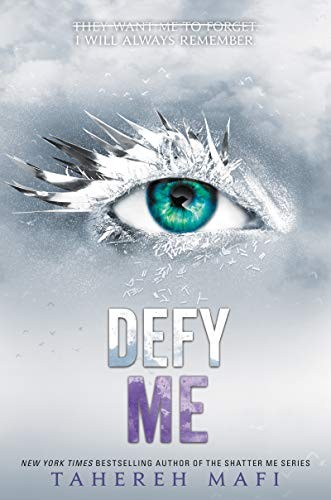

Tropes in this book
- Dystopia
- Found family
Themes
- dystopian YA
- Shatter Me book 5
- three narrators
- erased memories
- scientist parents
- steamy scenes 16+
- violence and torture
Read it if
- you've made it through four books and want to know, at long last, who was messing with Juliette's and Warner's heads, when and why
- you love Kenji enough to sit through a lot of suffering just for his chapters and his sparring with Nazeera
- you like dystopias where the characters realize someone has been wiping their memories for years, and the past comes back to them one piece at a time
Skip it if
- torture written in close-up, with a scalpel, needles and wires pushed into wounds, is a line you don't want a YA book to cross
- a steamy romance while the fate of the whole planet hangs in the balance feels like a wrong note to you, not a reward
- you expect a book to settle its main conflict, and here the biggest one gets announced, then shelved for book six
Why this rating
🧠 For connoisseurs
4/10- Memory as architecture. The best idea in this book is braiding the present with memories that are only now coming back to the characters. A scene where a sixteen-year-old Warner stands in a cell and asks a fourteen-year-old girl whether they've met before, and she tells him she would have remembered, gains real weight once you know how many times someone has made these two introduce themselves from scratch.
- Abuse at home, unsoftened. A little boy begging his friend not to tell anyone about the wounds on his back, and a father who threatens to kill a girl while his son watches, say more about what's done to children than a stack of parenting guides. Here Mafi hits the mark.
- Answers by lecture. Almost everything we learn arrives as a speech someone delivers in one long breath: Nazeera over a pile of photos, Delalieu from his chair, the mother standing over a lab chair, the father in a yellow sitting room. One of the speakers takes a bullet at the exact moment he reaches the important part, a trick older than the dystopian genre itself.
- Cartoon villains. The scientist mother wraps up her speech over her paralyzed daughter by admitting the whole thing is about her, and the villains walk everyone through their plans so eagerly you'd think they'd been rehearsing for four books. All that's missing is a white cat in someone's lap.
- A world on strings. When the book finally explains what actually keeps the Reestablishment in power, the explanation is so convoluted that you end up rereading four books' worth of dead birds and poisoned skies with fresh eyes, and not out of admiration.
- Violence with no echo. A heroine who spent half the series terrified of hurting anyone does something here that belongs in a horror movie, and not long after, on a plane, her main worry is how she left things with her boyfriend. The book doesn't give what she did a single serious thought.
💖 For comfort readers
6/10- Kenji. The brightest spot in the book. From his running commentary to his passionate defense of Tangled as a story about fighting for freedom, every scene he's in lets you breathe. A kiss with Nazeera, who right afterward makes it clear the two of them aren't happening, and his bickering with Warner in the cockpit, where Warner compares him to a plague, are the best moments here.
- The pace of the first part. A cell with poisoned bread rolls, the mother's lab, an escape through underground corridors and a jump out of a plane with no parachute. Until the landing the action barely lets you catch your breath, and the three narrators pass the ball without wasted moves.
- For the couple's fans. If you've been waiting for Juliette and Warner without fights or secrets, you get an apology on a plane, a shared tent and one very important evening.
- Frosting instead of a finale. After the landing the tension goes flat: talks in the tent, a shower and a party with cake. The biggest task in the book gets said out loud and immediately put off for later.
- Story-time stops. The action keeps pulling over so someone can sit down and tell a few pages of family history. Fans will read it with flushed cheeks, everyone else will notice the plot waiting in line the whole time.
The book's four layers
Plot and pacing
A fast, concrete book, at least until the escape: two cells, a lab, tunnels and a jump from a plane. After that the plot steps aside to make room for romance and a birthday, and it ends without a real climax. The Reestablishment's grand scheme sounds impressive, it just doesn't survive more than a minute of thinking about it.
Characters and relationships
Warner benefits most from his childhood memories, Kenji brings the humor and the most human emotions, and Nazeera finally stops being nothing but a riddle. Ella is tougher and surer of herself, though her transformation is announced more than shown. The scientist parents and Warner's father are villains with one facial expression, and Adam drops out of the book almost without a trace.
Writing style and atmosphere
Warner's and Kenji's chapters are calmer and better written, and Kenji's voice is the funniest in the whole book. Juliette's chapters bring back the familiar toolkit: a single sound effect spread over three separate lines, the name of the boy she loves repeated four times in one line and sentences chopped into staircases. The love scenes drown in endearments and flames running through veins.
Entertainment and value
Up to the landing I had a good time, and I read Kenji's chapters with a grin even while terrible things were happening around him. The trouble starts once everyone touches down safely: the tension drops and never comes back, and fans get mostly sweets in exchange.
The book in brief, spoiler-free
Juliette wakes up in her pink-and-purple childhood bedroom, where her long-lost parents greet her with three slaps and a syringe, while back in Sector 45 everyone who knows anything finally sits down and answers four books' worth of questions in one long speech. For about two-thirds it has the grip of a prison break, then the plot holsters its gun and turns into frosting.
Want the plot step by step?SummaryThemes it explores
Tahereh Mafi turns a series about a lethal touch into a story about memory that doesn't belong to the people carrying it. Every main character discovers that someone rewrote their past: Juliette learns she was born Ella, Warner learns his father spent years stealing his memories, and Nazeera learns her parents have been lying to her since she was a child. Under the dystopian plot sits a story about kids raised as an experiment by parents who see a daughter as a vessel and a son as material to be broken, and a question: is a love that comes back after every wipe fate, or just the stubbornness of two hurt people? Mafi knows how to write abuse at home so that it hurts, but she shrugs off the violence her own heroes commit and runs off into the romance.
The main threads: memory (erased memories return in fragments, and the characters learn to tell the truth from what was planted in them); parents (a mother who studies her daughter like a specimen and a father who controls his son's life even when everyone thinks he's out of the picture); sisters (Ella and Emmaline, one year and years of experiments apart); love (Ella and Warner, who fall for each other all over again after every reset); trust (Nazeera, who saves her friends without telling anyone anything); friendship (Kenji, who fights for Juliette to the very end, and his mouthy, reluctant friendship with Warner); and power (the Reestablishment, which rules through fear and the hope it has taken from people).
Questions and answers
Do I need to read Shatter Me first?
Yes – and the three books after it, too. Defy Me is book five and a direct sequel to Restore Me: it picks up right where book four cuts off and doesn't stop to re-explain who Kenji, Castle, Adam or Nazeera are, or how Juliette came to run Sector 45. The order is Shatter Me, Unravel Me, Ignite Me, Restore Me, Defy Me and Imagine Me, with optional novellas in between – Shadow Me fits just before this book and Reveal Me just after it.
Is Defy Me the last book in the Shatter Me series?
No. It's book five of six, and the main story wraps up in Imagine Me. The last scene of Defy Me is a quiet one, but the biggest conflict has only just been named, and the most important questions stay open, so keep book six within reach.
How many pages is Defy Me?
The 2019 US hardcover from HarperCollins has 368 pages, though it depends on the edition. The narration rotates between Juliette, Warner and Kenji, and some chapters are childhood memories the characters are only now getting back.
How spicy is Defy Me?
6/10 on my spice scale, the same as the two books before it. There's one sex scene in a shower that's written fairly directly, some heated kisses between Kenji and Nazeera and a lot of fire in the veins in Juliette's chapters. Outside that one scene, it's steam rather than anything explicit.
Is Defy Me appropriate for 12 year olds?
No. I rate it 16+, like every book in this YA series, and with this one I wouldn't go any lower. There's torture written in close-up (a scalpel, wires in open wounds, a needle in the temple), a shot to the head, a scene where a heart gets torn out, memories of a beaten child and of a little girl whose adoptive mother forced her hands into a fire. Add one fairly explicit shower scene, heated kisses and plenty of swearing. Suicidal thoughts and suicide attempts come up too. If you're struggling with thoughts of suicide, you can reach the Suicide & Crisis Lifeline any time by calling or texting 988 in the US.
Who is Defy Me for?
Readers 16 and older who have followed Juliette and Warner through four books, want the truth about their past at last and wouldn't mind a big helping of Kenji on the side. That's the comfort-reader crowd, and they'll mostly be happy. Connoisseurs will like the structure built on returning memories, but the lectures, the one-note villains and a plot that would rather throw a party than move forward by the end will wear them down.
What about you? Have you read this book?
Reader ratings
Your rating might be totally different from mine. A lot depends on when you pick it up.
Your rating on a 1-10 scale
No login needed. One vote per browser – you can change it later.
Disagree? Rate the book above or message me on Instagram or TikTok.
What to read next
 Restore Me
Tahereh Mafi
The previous book, and without it the opening of Defy Me makes no sense at all.
★ 5/10🧠 4💖 6🌶️ 616+
Read the review
 Ignite Me
Tahereh Mafi
Same series.
★ 5/10🧠 4💖 6🌶️ 616+
Read the review
 Unravel Me
Tahereh Mafi
Same series.
★ 5/10🧠 4💖 6🌶️ 416+
Read the review