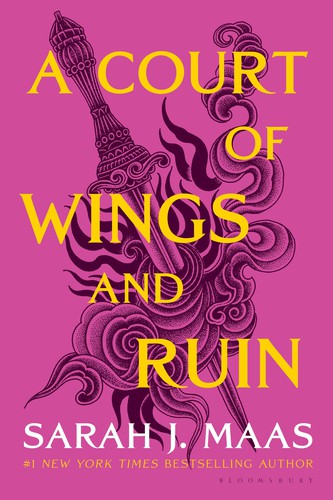

Tropes in this book
- Found family
- Romantasy
Themes
- book 3
- spy at the Spring Court
- war with Hybern
- Archeron sisters
- explicit spice
Read it if
- after the ending of A Court of Mist and Fury you have to see how Feyre, playing spy in the heart of the Spring Court, outmaneuvers Tamlin and Ianthe
- you care about Nesta, Elain, Amren and Mor as much as the main couple, because each of them gets a story of her own here
- you like your romantasy with an actual war in it: High Lord summits, alliances made through clenched teeth and a battle where ancient death-gods fight on your side
Skip it if
- after book two you're hoping for a finale with a real twist, and here the war gets decided by help pouring in from every corner of the world at once
- a Rhys without a single flaw and a Tamlin who spends a war council mostly on who slept with whom make you want to hurl the book across the room
- 700-plus pages of a war that, for chapters at a time, is mostly meetings and moving troops around sounds like too much
Why this rating
🧠 For connoisseurs
4/10- A spy in the house of spring. Part one is the best thing Maas has written in this series. Feyre dismantles the Spring Court from within: on the Summer Solstice she nudges Ianthe's marker stone with a breath of wind so the sunrise picks out Feyre instead, she stages a nightmare in Lucien's arms to set off Tamlin's jealousy, and she provokes an outburst the guards witness with their own eyes. She's a cool, calculating heroine who pays for her game, right down to an innocent guard getting flogged.
- The High Lords' summit. The meeting at the Dawn Court has the tension of a proper political drama: old grudges, threats, a secret of Rhys's from Under the Mountain, Nesta's speech about starving children and six of the seven High Lords ending up on their feet behind Feyre.
- Cavalry by appointment. In the finale, help arrives like a strategy game on easy mode: armies, ancient monsters and whole fleets roll in from every direction. Half of those aces are secret deals the reader hears about only at the moment they're slapped on the table.
- Low body count where it counts. The war costs thousands of nameless lives, but the core cast walks out of it practically untouched, and the book keeps staging huge sacrifices that it then quietly walks back. I won't say more, but the stakes turn out smaller than all the speeches promised.
- Exposition at the dinner table. The history of Miryam and Drakon, the human queens, the Weaver and Koschei is always narrated by someone sitting at a table. The king's winged hunters lay out his plan in the middle of a chase, and the Suriel conveniently tells Feyre exactly where the solution is waiting.
- Cardboard villains. Tamlin's contribution to the war council is mostly sexual jabs, Beron opens every line with an insult and Ianthe is evil from her first scene to her last. On the other side stands Rhys, whom Feyre tells point-blank that he's selfless, brave and good.
💖 For comfort readers
6/10- The Archeron sisters. Nesta and Elain finally stop being supporting characters. Nesta is tied to the Cauldron in a way nobody understands, and Elain, a ghost of a girl in a white room, turns out to see things no one else can. Their arc gives you the most emotionally powerful pages of the book, and the payoff in the finale is worth the wait.
- Found family at war. Bets on when a fistfight will break out at the council, Amren grumbling that every time she stays home somebody gets gutted, and Mor telling Feyre a secret she has kept for five hundred years. Rhys's inner circle is still the reason people keep coming back to this series.
- Big set pieces. A trap sprung in the Weaver's cottage, a heartbreaking scene with the Suriel, the Cauldron singing over a camp at night, a rescue inside the enemy camp with Feyre in disguise and a final battle with ancient death-gods on the field. Maas knows how to turn all of it into a spectacle.
- A couple with no obstacles. Feyre and Rhys are already together, so instead of misunderstandings you get rings, partnership and 18+ scenes. For fans of this pairing, it's dessert after two main courses.
- Page bloat. Between the good scenes sit dozens of pages of gowns, crowns from the treasury, flirting with Helion and camp meetings. 700-plus pages is a lot even for someone who adores Velaris, and the sex scenes tip over into kitsch once again.
The book's four layers
Plot and pacing
The opening at the Spring Court has speed and a clever setup, the High Lords' summit keeps the tension high and the night mission in Hybern's camp is a terrific sequence. In between, though, comes the logistics of war: meetings, troop movements and waiting for the king's next move. The finale resolves itself through a cascade of reinforcements, and the book's biggest sacrifices get undone almost as soon as they happen, so the great conflict ends without a real price for the main cast.
Characters and relationships
Feyre as spy and High Lady is the most interesting she's been in the whole series, and Nesta and Elain finally head down paths of their own. Mor gains a new dimension, and Jurian and Eris turn out to be less obvious than they looked. Rhys, on the other hand, stays a walking ideal, Tamlin is a caricature with claws until the very end, and Ianthe and Beron are villains without a single shade of gray.
Writing style and atmosphere
Maas writes dread and battle well: the Prison, the darkness under the library, the Cauldron singing at night above the camp. The tics from the earlier books are all present and accounted for, from ellipses in nearly every paragraph to arched brows, hard swallows and stars glittering in Rhys's eyes. A sex scene on a library table right after the story of a mutilated priestess grates like a knife on glass.
Entertainment and value
For fans of the series this is still required reading: a war, the sisters, Rhys's inner circle and a finale on a grand scale. It's less fun than book two, though, because the romance has lost its tension and the war spends too much time waiting. If you devoured book two with flushed cheeks, you'll get through this one too, just with more glances at the page number.
The book in brief, spoiler-free
Feyre goes back to the Spring Court as a spy and takes it apart from the inside, and then all of Prythian gears up for war with Hybern over the wall between fae and humans. The first ten chapters are the best thriller in the series – the rest is war councils, baths and reinforcements that never once show up late.
Want the plot step by step?SummaryThemes it explores
In book three, Sarah J. Maas delivers the war that A Court of Mist and Fury kept promising. Feyre is no longer a victim or a student: she's a spy, a High Lady and one of the most powerful beings in Prythian, and the book tests what she'll do with that kind of power and how much she's allowed to sacrifice along the way. Next to a romance that has no obstacles left, there are the stories of the Archeron sisters, the politics of the seven courts and the question of whether fae and humans can live side by side without a wall. The war costs thousands of nameless lives here, but the main cast comes out of it almost without losses.
The main threads: espionage (Feyre wrecking the Spring Court from within by manipulating Tamlin, Ianthe and the Hybern envoys); politics (the High Lords' meeting at the Dawn Court and alliances with Keir, Eris and Jurian made through clenched teeth); sisters (Nesta, bound to the Cauldron, and Elain, who becomes a Seer, both struggling with what being remade did to them); found family (Rhys's inner circle in wartime, with its fights, Mor's secret, Amren's lie and the loyalty of Cassian and Azriel); the wall and the Cauldron (a race to see who will tear down the border between the worlds and who will save it); sacrifice (Rhys, Amren and Feyre ready to pay for victory with their lives); and power (Feyre carrying pieces of seven High Lords' magic, and the High Lords starting to fear her).
Questions and answers
Do I need to read A Court of Thorns and Roses and A Court of Mist and Fury first?
Yes, both. A Court of Wings and Ruin is a direct sequel that picks up right after the ending in Hybern and assumes you know Tamlin, Rhysand, the inner circle in Velaris and the bargain made Under the Mountain. The reading order: A Court of Thorns and Roses, A Court of Mist and Fury, A Court of Wings and Ruin, A Court of Frost and Starlight (a short novella) and A Court of Silver Flames. I rated book one 6/10, book two 7/10, and this one comes in at 6/10.
Is A Court of Wings and Ruin the last book in the series?
No. It wraps up the war with Hybern and reads like the close of Feyre's main arc, but it leaves threads hanging for Nesta, Cassian, Lucien and Queen Vassa. Next comes A Court of Frost and Starlight, a short novella set in Velaris after the war, and then A Court of Silver Flames, which shifts the spotlight to Nesta and Cassian.
How spicy is A Court of Wings and Ruin?
8/10 on my spice scale, same as book two. Feyre and Rhys are already together, so there's no slow burn left to wait through, and the explicit sex scenes written out in full are even more frequent than last time. One of them lands right after the story of a mutilated priestess, which is a tonal swerve I could have done without.
How many pages is A Court of Wings and Ruin?
About 700 – the 2020 US paperback from Bloomsbury has 736 pages, though it depends on the edition. You get a prologue from Rhysand's point of view and 82 chapters in three parts, which makes it the longest of the first three books by a wide margin.
Is A Court of Wings and Ruin YA or adult? What age is it for?
It's new adult romantasy, and I'm keeping it at 18+, same as book two. There are more explicit sex scenes than before, and next to them you get beheadings, mutilated bodies, a flogging, Ianthe assaulting Lucien while he's tied up and references to sexual violence. Elain sinks into a depression and stops eating, and Nesta is carrying her trauma from the Cauldron. If something like that is part of your life or the life of someone close to you, in the US you can call or text 988 any time.
Who is A Court of Wings and Ruin for?
Adult fans of the series who fell for Rhys's inner circle and want to see the war with Hybern through to the end: the Archeron sisters, battles on a big scale and a couple with nothing left standing between them. Connoisseurs will love part one, with Feyre spying at the Spring Court, but reinforcements that arrive exactly on schedule and a finale that plays it safe with the main cast cool that excitement off fast.
What about you? Have you read this book?
Reader ratings
Your rating might be totally different from mine. A lot depends on when you pick it up.
Your rating on a 1-10 scale
No login needed. One vote per browser – you can change it later.
Disagree? Rate the book above or message me on Instagram or TikTok.
What to read next
 A Court of Mist and Fury
Sarah J. Maas
Book two, without which book three makes no sense, and still the best installment in the series.
★ 7/10🧠 5💖 8🌶️ 818+
Read the review
 A Court of Frost and Starlight
Sarah J. Maas
The short novella that comes next and shows Velaris catching its breath after the war.
★ 5/10🧠 3💖 5🌶️ 818+
Read the review
 A Court of Silver Flames
Sarah J. Maas
Same series.
★ 7/10🧠 5💖 7🌶️ 918+
Read the review