
Tropes in this book
- Academy and boarding school
- Mystery and crime
Themes
- fantasy for teens
- magic school
- tyrant teacher
- rebellion against authority
- secret student club
- anger and grief
- longest book in the series
Read it if
- you've finished the first four books and want to see what the wizarding world does when the truth is bad news for the people in charge
- you love stories about students secretly teaching themselves what their school has banned
- you're ready to forgive a hero for being a furious fifteen-year-old after trauma instead of a statue on a pedestal
Skip it if
- you expect the graveyard from book four to launch nonstop action, and instead you get a summer at the Dursleys', a house full of doxies and a hearing at the Ministry
- you can't stand heroes who yell at their friends in all caps and ignore every piece of good advice
- the book is for a ten-year-old who just finished the early volumes, because Umbridge's quill and the Ministry finale can be scarier than any dragon
Why this rating
🧠 For connoisseurs
7/10- Umbridge. A fluffy pink cardigan, kitten plates on the office wall, a little “hem, hem” before every sentence and a quill that makes a student write in his own blood. Rowling built an evil that doesn't need a Dark Mark – a rulebook and the Minister's signature do the job. Every new decree pinned to the notice board scares me more than all the Death Eaters put together.
- Power, the press and lies. The Ministry doesn't have to kill anyone, it owns a newspaper for that. Fudge would rather wreck a fifteen-year-old and an old headmaster than admit he got it wrong, and most of the wizarding world would rather believe him. It's the most grown-up theme in the series, and Rowling follows it all the way to a finale that leaves the Minister with nowhere to hide.
- Snape's memory. One trip into the Pensieve changes how you see two characters at once. Harry's father turns out to be a smug bully, and the teacher everyone loves to hate turns out to be a humiliated kid who still hits back with the ugliest word he knows. Rowling never tells you what to do with that, and it's her biggest strength in this book.
- The prophecy. Five books of wondering why Voldemort went after a baby finally get an answer, and the answer comes with a catch I'm not going to spoil. From that moment, the whole series reads differently.
- Way too long. 870 pages in the US paperback, and a big chunk of them goes to de-doxying a house, lessons, detentions and exams. You could cut two hundred pages and nobody would shed a tear over any of them.
- A plot that runs on silence. The finale only works because Dumbledore tells Harry nothing for a whole year, Harry blows off Occlumency and a little package from Sirius sits unopened at the bottom of his trunk. Dumbledore admits the mistake later, but it's still a story where one honest conversation in September would have spared everyone a tragedy.
💖 For comfort readers
8/10- Dumbledore's Army. Secret lessons in the Room of Requirement, fake Galleons that show the date of the next meeting and students from three houses taking things into their own hands. The most fun chapters in the book, because Harry finally gets to teach other people what he knows.
- The twins. Fireworks the day Umbridge tightens her grip on the school, and then Fred and George's goodbye to Hogwarts – a portable swamp in the corridor and Peeves saluting them on the way out – is the best comedy scene in the whole series. I waited most of the book for payback on Umbridge, and I got it with interest.
- New favorites. Luna, who talks about thestrals and her mother's death with disarming calm, and Neville, who finally gets a story and a courage of his own. Without the two of them, this book would be much heavier.
- The battle at the Ministry. A room full of brains, a room full of time, shelves of prophecies smashing to pieces and a wizard duel by a golden fountain. That last punch is worth the wait.
- Harry in all caps. For a good part of the year Harry yells at anyone who gets in his way: Ron and Hermione, Hagrid, Seamus. It's real and understandable after what he's been through, but somewhere around the tenth outburst in a row I wanted to send him for a long walk around the lake.
The book's four layers
Plot and pacing
The idea is brilliant: the enemy takes Hogwarts without a single attack, using nothing but decrees. Before the finale, though, you have to wade through a summer at the Dursleys', spring cleaning at Grimmauld Place and a school year recorded with the precision of an attendance book, where the plot stands still and the decrees keep piling up. The Department of Mysteries and the prophecy pay off the wait, even though the whole climax hangs on people not talking to each other for a year.
Characters and relationships
Umbridge is the most convincing villain in the series, because everybody has met someone like her in a teachers' lounge or a government office. Neville, Luna, Ginny and the twins get scenes of their own, and Sirius, locked up in a house he hates, is tragic before anything even happens. Harry is believably furious, which is exactly what makes him hard to like, and the only thing I really remember about Cho Chang is the crying.
Writing style and atmosphere
Rowling writes darker here: nightmares about a corridor and a locked door, the fear that something is living in Harry's head, grief with no sugarcoating and anger in capital letters. The humor is still there, mostly from the twins, Luna and Ron, but the tone of the series changes for good. The pacing is the weak spot, because lessons, detentions and exams take up more room than they need.
Entertainment and value
Even at this length it's still Harry Potter, the kind of book where hours disappear, and the Ministry finale and the talk in Dumbledore's office are among the strongest scenes in the series. It's also a great way into a conversation with a teenager about how people in power can lie, newspapers can repeat the lie and an adult at school can do real harm. After this book, the series is about a war.
The book in brief, spoiler-free
The Ministry of Magic brands fifteen-year-old Harry a liar and a lunatic, then sends Dolores Umbridge to Hogwarts to make sure nobody learns real Defense Against the Dark Arts ever again. The longest and angriest book in the series: baggy in places, but with a villain you'll hate more than Voldemort.
Want the plot step by step?SummaryThemes it explores
Book five is J.K. Rowling's story of what happens when the truth is inconvenient. Voldemort is back, but the Minister for Magic doesn't want to hear it, so the newspaper turns the only witness into a liar, and the school gets a teacher whose real job is to make sure the students learn nothing. The second theme is anger: after Cedric's death Harry is fifteen, with nightmares, a scar that burns and adults who keep him in the dark for his own good. The third is disappointment in grown-ups, from Dumbledore, who won't meet his eyes for a whole year, to his own father, who turns out to be a school bully in someone else's memory. At the end comes a loss nothing can reverse and a prophecy that changes how Harry sees his own future.
The main threads: Dolores Umbridge (the Ministry's teacher, Educational Decrees, a quill that writes in blood and the Inquisitorial Squad); Dumbledore's Army (secret Defense lessons in the Room of Requirement and the betrayal that ends them); the Order of the Phoenix (the adults at 12 Grimmauld Place who fight Voldemort and keep Harry out of the fight); the link with Voldemort (dreams of a door in the Department of Mysteries, the vision of the attack on Mr. Weasley and Occlumency lessons with Snape); media and politics (a Daily Prophet that works for the Minister and an interview in The Quibbler that tells the truth); friendship and first feelings (Ron on the Quidditch team, Hermione with a plan for everything, Cho Chang and a disastrous date); and loss and the prophecy (a death Harry can't undo and the answer to why Voldemort attacked him as a baby).
Questions and answers
Do I need to read Harry Potter and the Sorcerer's Stone and the other earlier books first?
Yes, all four of them. Order of the Phoenix opens a few weeks after the end of Goblet of Fire and expects you to know who Sirius, Lupin and Wormtail are, what happened in the graveyard, who Cedric was and why Harry can suddenly see things other students can't. The order is the publication order: Sorcerer's Stone, Chamber of Secrets, Prisoner of Azkaban, Goblet of Fire, Order of the Phoenix, Half-Blood Prince and Deathly Hallows. The story continues in Half-Blood Prince, book six.
How many pages is Order of the Phoenix?
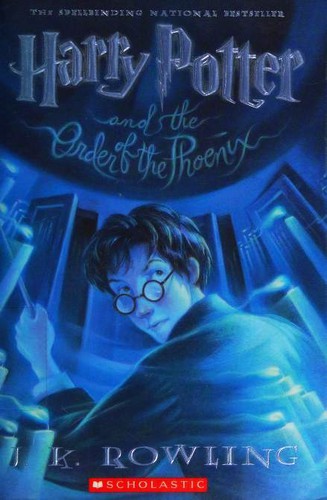
870 pages in the Scholastic paperback with Mary GrandPré's cover art, though it depends on the edition. It's the longest book in the series: 38 chapters and a healthy supply of patience required.
Is Order of the Phoenix appropriate for 12 year olds?
12+ is still my call, just like for book four, but the fear works differently here. There's less blood and fewer monsters and more adult cruelty toward kids: a teacher who makes a student cut words into the back of his own hand and later threatens him with a torture curse, torture curses in the finale and parents who no longer recognize their own son after what was done to them. Add a snake attack on Mr. Weasley, Harry's fear that Voldemort is inside his head and the death of someone close to him, right in front of him. Romance comes down to one kiss, and there's practically no swearing. If a younger kid reads it, plan a talk afterward about loss and about what to do when an adult at school crosses a line.
How spicy is Order of the Phoenix?
2/10 on my spice scale. Harry gets his first kiss under the mistletoe, there's one very awkward Valentine's Day date and a lot of confusion about what girls are thinking. No sex scenes, nothing beyond kissing.
Is Order of the Phoenix YA or middle grade?
It's where the series crosses the line. The early books are middle grade, but here Harry is fifteen, angry and grieving, the plot is about politics, propaganda and abuse of power, and the ending is heavy. Bookstores still file it under kids' books, but it reads like YA, and I put it at 12+.
Who is Order of the Phoenix for?
Everyone who's finished the first four books and needs to know what happens next, because this one can't be skipped. Comfort readers get a secret student club, the twins at the top of their game, Luna and a spectacular battle at the Ministry. Connoisseurs get the best-written villain in the series, politics without shortcuts and a prophecy that sets up the whole endgame. If the page count scares you, know that the middle drags, but the ending makes up for it.
What about you? Have you read this book?
Reader ratings
Your rating might be totally different from mine. A lot depends on when you pick it up.
Your rating on a 1-10 scale
No login needed. One vote per browser – you can change it later.
Disagree? Rate the book above or message me on Instagram or TikTok.
What to read next
 Harry Potter and the Goblet of Fire
J.K. Rowling
The previous book, without which this one makes no sense: the tournament, the graveyard and Voldemort's return.
★ 9/10🧠 8💖 9🌶️ 212+
Read the review
 Harry Potter and the Sorcerer's Stone
J.K. Rowling
Same series.
★ 8/10🧠 6💖 9🌶️ 110+
Read the review
 Harry Potter and the Chamber of Secrets
J.K. Rowling
Same series.
★ 8/10🧠 6💖 9🌶️ 110+
Read the review