
Tropes in this book
- Found family
- Zero to hero
Themes
- middle grade fantasy
- Greek and Roman mythology
- Roman demigod legion
- quest to Alaska
- amnesiac hero
- humor
Read it if
- you finished The Lost Hero and need to know where Percy has been this whole time
- you love a team of misfits who have to prove to an entire camp that they aren't bad luck
- you want a post-Percy adventure for a kid where war, family and grief sit right next to the monsters, told without the scare factor
Skip it if
- you haven't read Percy Jackson or The Lost Hero, because half the scenes and returning memories will fall flat
- a quest built from stop after stop with yet another god or monster already bored you in the earlier books
- it bugs you when gods show up in dreams and at bedsides to tell the heroes who they are and what to do next
Why this rating
🧠 For connoisseurs
7/10- Hazel Levesque. The most fully realized character Riordan had written in this universe up to this point. A thirteen-year-old from New Orleans in 1941, at St. Agnes Academy for Colored Children and Indians, where other kids throw rocks at her, with a mother who blames her for a curse and the guilt of having helped wake a giant. Her memories of Alaska and the scene before the judges of the dead carry a weight this series simply didn't have before.
- Frank and the stick. The idea that a hero's life depends on a piece of firewood one match could finish off puts real tension into every scene with a flame in it. Frank is clumsy, lactose intolerant and embarrassed by his dad, and behind him stand a mother killed in Afghanistan and a great-grandfather kicked out of the legion partly for being Chinese. His family gift is planted early and revealed at exactly the right moment.
- A finale won with brains. Rules about the world laid out in the first chapters come back at the end, and they, not muscle, decide the fights with the giants. Add the bet with Phineas, where Percy wagers that Gaea still needs him alive. Riordan rewards his heroes for thinking, not for flexing.
- Same itinerary, new state. The goddess of the rainbow, a blind seer, the Amazons, Grandma's house: once again the quest is a chain of pit stops where someone either helps or tries to kill them. And help tends to arrive on command: Arion appears when Hazel calls, the Amazons roll onto the battlefield right on cue, Tyson comes running at a whistle.
- Bedside lectures. The big information drops come in dreams and from gods who sit down and explain: Mars, at the bedside of a dying grandmother, walks Frank through his family history, and Juno lays out her entire plan for Percy in a dream. Percy's amnesia doesn't build much suspense, since anyone who read the earlier books knows everything about him, and Octavian with his knife and his stuffed animals is a villain with no second layer.
💖 For comfort readers
8/10- Humor. Terminus, the armless god of boundaries, who nitpicks a stone two inches out of place and the length of someone's pant legs; Mars writing a prophecy with a pen that used to be a grenade; Arion, who swears like a sailor while Percy censors the translation; Ella the harpy quoting farmers' almanacs. I laughed more often than I did in the previous book.
- The clock is ticking. Four days to get from California to Alaska and back, and every stop ends differently: a bet over poison, an escape in a shower of silver friendship bracelets, a potato cannon, or a giant whose legs you have to hide under.
- The team. Percy, Hazel and Frank click by the first battle, and they're a joy to watch. Hazel and Frank's shy crush is adorable without crowding out the adventure, and Percy works better as a big brother than as the confused new guy.
- The eagle battle. The finale at Camp Jupiter is everything at once: a golden eagle throwing lightning, Amazons on armored forklifts, a Cyclops in a Roman helmet with his cape tied on like a bib, a hellhound pulling a chariot. And the last scene has you reaching for the next book on the spot.
- Flashbacks hit the brakes. Hazel's trips into the past are the best scenes for a connoisseur, but for a comfort reader they can stall the action right when it picks up speed. At 560 pages in the US paperback, that's a lot of book for a race against the clock.
The book's four layers
Plot and pacing
Death in chains is a brilliant setup, because if the heroes win, the dead start dying again – Hazel included. A deadline set to the exact day keeps the pace up, and the finale cashes in rules introduced at the start. The route itself, though, is a familiar string of stops, and too often outside help shows up at the crucial moment.
Characters and relationships
Hazel and Frank are the best thing this whole cycle has gotten so far: each of them carries something heavy, and their stories hurt without wallowing. Until his memory comes back, Percy is a bit of a guest in his own novel, Reyna is intriguing, and Octavian and Polybotes are caricatures.
Writing style and atmosphere
Three points of view – Percy, Hazel and Frank – fit together well, and Riordan knows how to capture a place: prewar New Orleans, a shack on stilts in Seward, the northern lights over a gas station in Moose Pass and a glacier dropping icebergs with a roar. The humor never clashes with the serious scenes. Dreams and divine lectures sometimes stall the action.
Entertainment and value
It's fun, it's moving at times, and it ends with a solid battle. It's as thick as the previous book but drags less, because the clock is ticking and the team knows what it wants from day one. A ten-year-old who loves Percy gets the hero back plus two new friends.
The book in brief, spoiler-free
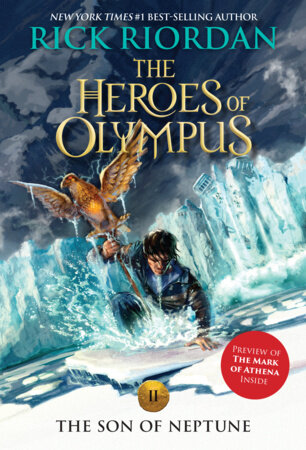
Percy Jackson wakes up with no memory, lands in a Roman camp for demigods and heads to Alaska with two outcasts from the legion's worst cohort to set Death free. We've traveled this kind of quest route before, but this time Riordan gives the team heroes whose pasts genuinely hurt.
Want the plot step by step?SummaryThemes it explores
This time Rick Riordan writes about kids someone has already written off. The legion mocks the Fifth Cohort, the Romans are scared of a son of Neptune, and a daughter of Pluto has a giant's awakening on her conscience. Hazel got a second life and doesn't know whether she's allowed to enjoy it, Frank carries his life in his pocket as a charred stick, and Percy has to make friends before he even remembers who he is. The most interesting twist on the formula is that the quest is meant to free Death, which means restoring the order in which the heroes could lose exactly what they've just gotten back. The gods once again prefer explaining to helping, and Mars, with his war and his duty, turns out to be a more complicated father than Frank would like.
The main threads: the quest to Alaska (four days to free Thanatos and make it back before the Feast of Fortuna); second chances (Hazel, from 1940s New Orleans, back from the Underworld to fix her mistake); legacy (Frank, a soldier mother, a strict grandmother and ancestors stretching from the Argonauts to a Chinese city founded by Roman prisoners); memory (Percy without his past in a camp that calls him a Greek); racism and rejection (a segregated school, a whites-only riding club and Frank's great-grandfather thrown out of the legion); Romans and Greeks (the legion, the augur, the senate and Juno's plan to unite two demigod camps); and Gaea (the sleeping Earth and her giants marching on Camp Jupiter).
Questions and answers
Do I need to read The Lost Hero first?
You can technically start here, since the Romans explain their world to Percy from scratch, but a lot of scenes lose half their punch. From Percy Jackson and the Olympians, you'll want to know Annabeth, Grover, Tyson, and Nico and his sister Bianca, remember where Percy met Reyna and Hylla (Circe's island in The Sea of Monsters) and remember the war with Kronos. From The Lost Hero, you need to know that Jason showed up at Camp Half-Blood when Percy vanished, that Leo is building a flying ship called the Argo II and who the Cyclops Ma Gasket is. The order: the five Percy Jackson and the Olympians books (The Lightning Thief, The Sea of Monsters, The Titan's Curse, The Battle of the Labyrinth, The Last Olympian), then The Heroes of Olympus: The Lost Hero, The Son of Neptune, The Mark of Athena, The House of Hades and The Blood of Olympus. The ending is open and leads straight into The Mark of Athena.
How many pages is The Son of Neptune?
560 pages in the 2013 Disney-Hyperion paperback, the one you'll see on most US shelves, though it depends on the edition. The first hardcover came out in 2011.
Is The Son of Neptune appropriate for 10 year olds?
I rate it 10+, like the rest of the series, but it's a more serious book than the earlier ones. There's nothing sexual in it: one kiss on the lips and a couple on the cheek. There's a lot of death, though: Frank's mother was killed in Afghanistan, his grandmother is dying, and in a flashback Hazel dies along with her mother and stands before the judges of the dead. In the background there's school bullying and racial segregation in 1940s New Orleans, a girl speared during war games who comes back to life, and cannibals who want to roast Frank. The descriptions are restrained, with no gore, but a younger reader will be glad to have an adult around to talk those scenes through.
How spicy is The Son of Neptune?
1/10 on my spice scale, which is basically zero. Hazel and Frank's crush stays at the blushing, hand-holding stage until one kiss, and Percy spends the whole book holding on to the one name he remembers: Annabeth.
Is The Son of Neptune YA or middle grade?
Middle grade, like Riordan's other Camp Half-Blood books: Hazel is 13, Percy is 16, and the publisher pitches it at ages 10 to 14. Full disclosure: YA ranked covers books for younger teens too, and with its heavier themes this one sits right on the line between the two shelves.
Who is The Son of Neptune for?
Readers roughly 10 to 14 who finished The Lost Hero and want Percy back, and adult comfort readers who love team adventures with humor and mythology. Connoisseurs will be won over by Hazel and Frank, their family histories and a finale decided by cleverness, even if the quest itself runs on familiar tracks.
What about you? Have you read this book?
Reader ratings
Your rating might be totally different from mine. A lot depends on when you pick it up.
Your rating on a 1-10 scale
No login needed. One vote per browser – you can change it later.
Disagree? Rate the book above or message me on Instagram or TikTok.
What to read next
 The Lost Hero
Rick Riordan
The previous book, without which the Percy and Jason swap and the ship in the final scene make no sense.
★ 7/10🧠 6💖 7🌶️ 110+
Read the review
 The Last Olympian
Rick Riordan
The war with Kronos that Percy starts remembering on the road to Alaska, in its full version.
★ 8/10🧠 7💖 9🌶️ 210+
Read the review
 The Sea of Monsters
Rick Riordan
Circe's island, where Percy first crossed paths with Reyna and Hylla, long before either of them had a title.
★ 7/10🧠 6💖 8🌶️ 110+
Read the review