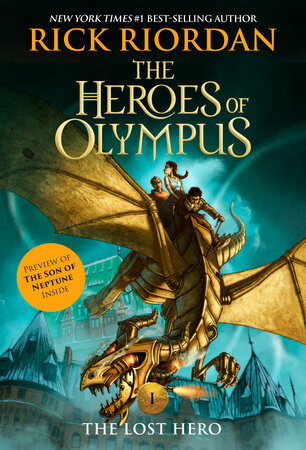

Tropes in this book
- Found family
Themes
- middle grade fantasy
- Greek and Roman mythology
- demigods
- hero with amnesia
- cross-country quest
- humor
Read it if
- you've finished all five Percy books and need to know what happens at Camp Half-Blood after the Titan war
- you like a crew where everyone is hiding something and the jokes don't stop even with a thirty-foot giant in the room
- you're looking for a big, fat adventure for an 11- to 13-year-old who has already devoured Percy and wants more
Skip it if
- you want a tight story, because for nearly 600 pages the heroes keep landing with yet another host who turns out to be the enemy
- you haven't read the Percy Jackson series yet and don't want its ending spoiled secondhand
- it bugs you when gods and villains stop the story to explain the plot in dreams and monologues
Why this rating
🧠 For connoisseurs
6/10- Greeks vs. Romans. The best idea in the book. Riordan takes the world we know from five books and bolts a second, Roman face onto it: gods who change their names along with their personalities, Latin that Jason has no business knowing, an SPQR tattoo and a she-wolf named Lupa. The clues are scattered from the first chapter, and the very last line resets the whole series.
- Three burdens instead of one. Each narrator is carrying something heavy. Jason doesn't know who he is, Piper has to choose between her dad and her friends, and Leo has blamed himself for his mom's death for years. It works best with Leo, who cracks jokes so he won't cry, and that mask breaks in exactly the right places.
- Myths with a second layer. Medea makes a pretty convincing case that she's the real victim, Midas admits he learned nothing at all, and Hera, the goddess of family, is the one who demanded that a two-year-old be handed over to the wolves. Once again the gods come off barely better than the monsters.
- Host, trap, getaway. Boreas, Medea, Midas, Aeolus: one after another, they welcome the heroes politely and then try to freeze them, turn them to gold or drop them off a cliff. By the third stop, I knew exactly how the fourth would end.
- Lectures instead of discoveries. Information mostly arrives in dreams and monologues. Hera, Lupa, Hephaestus, Aphrodite and Khione each explain a slice of the plot, and the myth of Gaea and Kronos's scythe gets told twice in a row. On top of that, rescue drops from the outside far too often: a lightning bolt right as Jason prays, the Hunters of Artemis showing up just as the last flame dies, a goddess's blast that wipes out every monster at once.
💖 For comfort readers
7/10- Humor. Coach Hedge, a satyr who wants to punch anything that moves and snacks on plastic cups; Leo pulling breath mints out of his magic tool belt instead of a weapon; a Cyclops who refuses to eat demigods without salsa; and the lord of the winds hosting a weather report while bickering gods bark orders at him. I laughed out loud more than once.
- Leo. The best-written of the three: a kid who bounced between foster homes, builds a dragon out of scrap and gets his big moments in the finale. His goodbye to Festus will get you right in the throat.
- Always on the move. Quebec, Detroit, Chicago, Omaha, Pikes Peak, California – every stop means new scenery and a new monster from the myths, and the ending stacks two battles: a giant on Mount Diablo and the king of the giants in the ruins of the Wolf House.
- Familiar faces. Annabeth, Chiron and Rachel are right where you left them, and the missing Percy hangs over the whole book. If you've read the first series, you'll feel at home.
- Too long. 592 pages in the US paperback is a good hundred too many. Each of the three keeps almost confessing a secret and then backing out, and Jason and Piper wonder endlessly whether their relationship was ever real.
The book's four layers
Plot and pacing
The setup is strong: a kidnapped goddess, a deadline on the winter solstice and a hero with no memory whose past turns out to be the key to the whole series. The middle, though, is a quest assembled from stops cut from the same template, and too many scenes get resolved by someone swooping in. The last line saves a lot, because it makes you look at everything before it differently.
Characters and relationships
Three narrators, each with a weight of their own: amnesia, blackmail, guilt. Leo and Piper are terrific, and Piper's talk with her dad after Mount Diablo is one of the warmest scenes in Riordan's whole universe. Jason is paler, because right up to the finale he doesn't know who he is, and Drew and Khione are mean girls without a shred of nuance.
Writing style and atmosphere
Light, funny and with a good sense of when a joke needs to cover up pain. The third-person narration, rotating between three points of view, gives the story more room to breathe than Percy's first-person monologue, but it loses his mouthy voice. The action keeps stalling for dreams and lectures in which gods explain what's going on.
Entertainment and value
It's fun, it pulls you in and it gives you a solid reason to pick up the next book. A ten-year-old who devoured Percy will be thrilled. For an adult, the middle drags: this book is noticeably thicker than any of the Percy books, and the story doesn't need that many stops.
The book in brief, spoiler-free
Jason wakes up on a school bus with no memory, holding hands with a girl he doesn't recognize, and he has four days to break the queen of the gods out of her prison. Riordan opens the new series with three narrators and a brilliant Greek-meets-Roman idea, then spends the middle of the book checking his heroes into one treacherous guesthouse after another.
Want the plot step by step?SummaryThemes it explores
Rick Riordan opens the new series with a story about kids who don't know who they are because adults decided it for them. A goddess took Jason's memory, Piper grew up with a father who played every role except his own, and Leo has spent his whole life running from a fire he blames himself for. Under the monster-fighting adventure sits a question: can you trust a friendship that started with fake memories, and can a kid fix what their parents broke? The gods are as fickle and self-absorbed as ever, and Zeus has shut Olympus and left the demigods to fend for themselves.
The main threads: the quest (four days to free Hera before the winter solstice); identity (Jason without his memory, and the signs that he comes from a completely different world); family (Piper's kidnapped father, the mother who gave Jason up, and gods who watch their kids from a distance); guilt (Leo and his mom's death, Piper and the blackmail meant to turn her into a traitor); friendship (a trio that starts as a random team and becomes a real one); Greeks and Romans (two faces of the same gods and two camps of demigods who don't know the other exists); and Gaea (the sleeping Earth, whose servants are trying to wake her up).
Questions and answers
Do I need to read Percy Jackson before The Lost Hero?
You can follow it without them, because the three narrators are newbies and everything gets explained from scratch: the Mist, the cabins, being claimed by a godly parent, even how the war with the Titans went. But the book gives away the ending of the Percy series, and Annabeth, Thalia, Rachel and the memory of the campers who died only hit with full force after all five books. My advice: start with The Lightning Thief, read Percy Jackson and the Olympians in order, and come here afterward.
What's the reading order for The Heroes of Olympus?
The Lost Hero is book 1 of 5: 1. The Lost Hero, 2. The Son of Neptune, 3. The Mark of Athena, 4. The House of Hades, 5. The Blood of Olympus. The series picks up after the five Percy Jackson and the Olympians books (The Lightning Thief, The Sea of Monsters, The Titan's Curse, The Battle of the Labyrinth, The Last Olympian). The ending leaves several threads open and leads straight into The Son of Neptune.
How many pages is The Lost Hero?
592 pages in the 2012 Disney-Hyperion paperback, the edition most US readers pick up, though it depends on the edition. Either way, it's thicker than any of the five Percy books.
Is The Lost Hero appropriate for 10 or 12 year olds?
Yes – I keep it at 10+, same as the Percy series. There are no sex scenes, and the monsters crumble into dust instead of bleeding. A few threads can still hit a younger reader hard: Leo blames himself for his mom dying in a fire, Piper's dad is held hostage by a giant, and Jason's mother gave up her two-year-old son because a goddess demanded it. Those are worth talking through with an adult nearby. Full disclosure: this is middle grade rather than YA, but YA ranked covers books for younger teens too.
How spicy is The Lost Hero?
1/10 on my spice scale, so basically nothing. Jason and Piper never actually kiss – the one kiss they “share” lives in a memory that may not be real – and the romance is mostly Piper wondering whether any of it ever happened.
Who is The Lost Hero for?
Readers roughly 10 to 14 who finished Percy and want to go back to Camp Half-Blood, plus adult comfort readers who don't mind an adventure spread across a lot of stops. Connoisseurs will enjoy the Greek-meets-Roman worldbuilding and how well Leo is written, but the quest itself rarely strays from the familiar route.
What about you? Have you read this book?
Reader ratings
Your rating might be totally different from mine. A lot depends on when you pick it up.
Your rating on a 1-10 scale
No login needed. One vote per browser – you can change it later.
Disagree? Rate the book above or message me on Instagram or TikTok.
What to read next
 The Son of Neptune
Rick Riordan
Book two of The Heroes of Olympus, the direct continuation of this one.
★ 8/10🧠 7💖 8🌶️ 110+
Read the review
 The Last Olympian
Rick Riordan
The book this story picks up from – without it, half the camp's cast are just names.
★ 8/10🧠 7💖 9🌶️ 210+
Read the review
 The Battle of the Labyrinth
Rick Riordan
Also by Rick Riordan.
★ 8/10🧠 6💖 9🌶️ 110+
Read the review