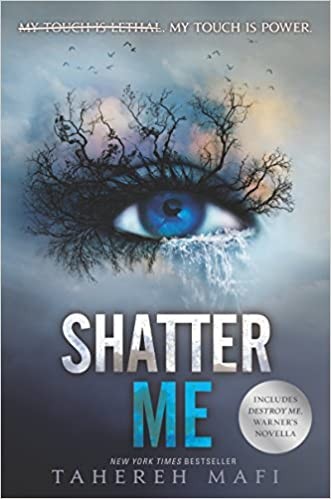

Tropes in this book
- Dystopia
- Zero to hero
Themes
- dystopian romance
- lethal touch
- strikethrough narration
- escape from military headquarters
- love triangle
- obsessive villain
- superpowers
Read it if
- you like dystopias where the heroine has a power the world hates her for and the people in charge want to use
- you want a romance where a hug through a blanket is a major event and every kiss costs something
- you're curious about a style full of strikethroughs, numbers and repetitions that shows you exactly what the heroine refuses to admit
Skip it if
- metaphors about eyes shattering like broken windows make you laugh instead of shiver
- you expect a dystopia with a thought-through world, not a backdrop of ruins, posters and loudspeakers
- you'd rather have a love interest with flaws than a guy who's perfect in every scene and remembers your good deeds from elementary school
Why this rating
🧠 For connoisseurs
4/10- A voice from the cell. The opening chapters are the best part of the book. Juliette counts days, hours, cracks in the walls and breaths, and the thoughts she won't admit to get crossed out right in front of us: that she's desperate for someone's touch, that her parents threw her away, that she believes she's a monster. One chapter opens with sixteen struck-through lines of her insisting she isn't insane, and it says more about isolation than pages of description could.
- Warner. A nineteen-year-old in white gloves who shoots the roast in the middle of the dinner table to win an argument, executes a private in front of the whole sector and goes pale like a kid caught lying when she throws out a crack about his poor mother. He's the most interesting and the most unsettling character in the book. His “care” is obsession and control, from the dresses he picks for her to the cameras in her room, and the scene in the empty classroom is an assault. Mafi still has Juliette feel a spark between them right then, and that one paragraph leaves a nasty aftertaste.
- A world made of posters. The Reestablishment has slogans, loudspeakers on poles and a ban on holidays, but no logic. Adam explains the climate collapse in one monologue, and near the end Castle announces in another that almost all of it is a lie. It's not even clear why the regime needs a girl for torture when Warner himself brags that he handles killing just fine without her.
- Plot on autopilot. The escape gets a helping hand from a drill alarm, keys left in the ignition and soldiers conveniently called back to base, and Kenji's story about a stranger who dropped him at the door gets swapped for a different one a few chapters later. The best idea – that Warner can touch Juliette too – is shelved for the next book, and in the final stretch an underground hideout, psychokinesis, electric sparks and invisibility all show up at once, as if an X-Men crew had wandered onto the wrong set.
- Flawless Adam. Adam remembers every good deed Juliette did in elementary school, shielded her from kids throwing rocks, has the bird from her dreams tattooed on his chest and never once does anything dumb. He's a beautiful answer to her loneliness, but he isn't a person. When he tells her she's the only good thing left in this world, it reads like the dedication on page one, not like something a teenage boy would actually say.
💖 For comfort readers
6/10- Forbidden touch. The whole romance rests on one idea, and that idea works. After 264 days alone, someone hugs Juliette through a blanket, and that scene lands harder than plenty of kisses in other romances. The morning when Adam, under the noise of the shower, tells her he can touch her carries a charge the author has honestly earned.
- Action after the escape. A rope lowered from the fifteenth floor, a chase through abandoned warehouses, Juliette punching through a steel door and the first drive of her life, announced with the confession that she has no idea how to drive. From the escape onward the book picks up speed and never lets off.
- Kenji and James. A ten-year-old who takes one look at Juliette in a shredded dress and asks if she always dresses like that, and Kenji, who insists through a swollen, beat-up face that he has a gorgeous face, let a little air into this gloomy book.
- The hook at the end. Warner survived and knows he can touch Juliette, Adam might have a gift of his own, and she gets a superhero suit. You reach for book two out of pure curiosity.
- Interrupted mid-kiss. Juliette and Adam get cut off by, in order, an intercom, an alarm, his little brother, his little brother again and Kenji. By round three I'd stopped caring, and the weeks at Warner's headquarters, made of breakfasts, dresses and the same conversations on repeat, drag on longer than they should.
The book's four layers
Plot and pacing
The cell section grabs you by the throat, and the moment her cellmate turns out to be one of Warner's soldiers is a well-played betrayal. The stay at Sector 45 headquarters still has the tension of the cat-and-mouse game with Warner, even if it circles the same breakfasts and dresses. After the escape the plot turns into a sprint from one hiding place to the next, the explanations arrive as monologues, and the ending opens Omega Point like the pilot of a new TV show. The best idea, Warner's touch, is only a promise here.
Characters and relationships
Juliette is convincing where it's hardest: the loneliness, the guilt and the shy process of learning she can mean something to someone. Warner is an antagonist you keep thinking about after you close the book, because under the cruelty there's a boy desperate for someone to choose him. Adam, on the other hand, is perfect to the point of boring, Castle, Winston and Brendan get one scene each to introduce themselves, and the humor comes almost entirely from Kenji and James.
Writing style and atmosphere
Strikethroughs, numbers written as digits and the same word repeated three times in a row nail the head of a girl who hasn't spoken to anyone in 264 days. The trouble is that Mafi never takes her foot off the gas: every emotion gets three metaphors, eyes shatter like broken windows, and Adam's smiles get measured on a planetary scale. The gray world of ruins, posters and loudspeakers has atmosphere, but it's mostly set dressing.
Entertainment and value
A strong concept, plenty of tension, a romance where touch actually means something and an ending that sets up the whole series. Points for taking loneliness and self-hatred seriously. What wears you down: the overloaded metaphors, a predictable romance and a finale that promises more than it resolves.
The book in brief, spoiler-free
Juliette has spent 264 days in a cell because her touch drains the life out of people, and a nineteen-year-old commander named Warner wants to turn her into a weapon. Tahereh Mafi has a brilliant idea for a narrator whose buried thoughts show up on the page as strikethroughs – and a much weaker one for a world that ends up as a hideout full of superpowered people straight out of X-Men.
Want the plot step by step?SummaryThemes it explores
Tahereh Mafi writes about touch hunger. Juliette has been told her whole life that she's a monster: her parents locked her in her room, at school she ate alone behind the fence, and after a little boy died at the grocery store she was sent to an asylum where she didn't say a word to anyone for 264 days. The book asks whether someone everyone calls a monster can decide for herself who she's going to be, and it offers two answers in the shape of two boys: Warner, who wants to turn her skin into a weapon, and Adam, who saw the good in her long before anyone started to fear her. In the background runs a dystopia about a regime that burns books, wipes out languages and rules through fear.
The main threads: touch and loneliness (a girl nobody has touched in 264 days, in a world where a hug through a blanket feels like a miracle); guilt and self-hatred (the death of a three-year-old Juliette never meant to cause, and years of hearing that she's a danger to everyone); the body as a weapon (a power Juliette is terrified of and Warner wants to use to torture rebels); obsession and control (Warner picks her dresses, forbids her to talk to soldiers, records her every move and calls it care); first love (Adam, the one boy at school who ever stood up for her); brothers and a new home (Adam, who joined the army to support ten-year-old James, and the people of Omega Point, where for the first time Juliette doesn't feel like a freak); and power and fear (the Reestablishment, a public execution and lies about a world that supposedly can't be saved anymore).
Questions and answers
Is Shatter Me a series? What's the reading order?
Yes, it's book 1 of Tahereh Mafi's series, so start here. The main novels go Shatter Me, Unravel Me, Ignite Me (the original trilogy), then Restore Me, Defy Me and Imagine Me. There are also novellas: Destroy Me, told by Warner, fits right after Shatter Me (the current US paperback actually includes it), and Fracture Me, told by Adam, fits between Unravel Me and Ignite Me. The later novellas slot in between the later novels. You can skip the novellas and still follow the story, but Destroy Me is worth it if Warner got under your skin.
How many pages is Shatter Me?
The current US paperback from HarperCollins has 368 pages, though it depends on the edition – that paperback also packs in Warner's novella Destroy Me, and the original 2011 hardcover is shorter. The chapters are short and the strikethrough style makes it read faster than the page count suggests.
Is Shatter Me appropriate for 12 year olds?
I rate it 16+, the same as the rest of the series. There's no sex, but there are bold kisses with hands under clothes and a scene where Warner pins Juliette against a wall and kisses her against her will. The violence isn't graphic, but there's a lot of it: beatings, a public execution, torture, a small child put in a room with spikes rising from the floor, and the death of a three-year-old in Juliette's past. Juliette hates herself and, at her lowest, thinks about dying. For most 12-year-olds I'd wait a few years. If thoughts of suicide or self-hatred are something you're dealing with, you can call or text 988 (the Suicide & Crisis Lifeline) in the US.
How spicy is Shatter Me?
3/10 on my spice scale. Lots of longing, kisses that get heated, hands under clothes and nights spent sleeping in Adam's arms, but no sex scenes. The one moment to know about ahead of time is Warner's forced kiss in the classroom, which is an assault, not romance.
Is Shatter Me YA or adult?
YA: Juliette is 17, the book first came out from HarperTeen, HarperCollins' teen imprint, and it rode the same dystopian wave as The Hunger Games and Divergent. It's on the darker, more intense end of YA, which is why I put it at 16+.
Who is Shatter Me for?
Comfort readers 16 and up who like dystopias with romance, a dark mood and a heroine with a dangerous power, and who don't mind metaphors stacked three deep. Connoisseurs get the excellent cell chapters, the strikethroughs and a genuinely unsettling Warner, but the world and the plot won't surprise them. If you liked Shadow and Bone, you'll recognize the setup: a childhood friend on one side and a dark commander who wants to own the heroine on the other.
What about you? Have you read this book?
Reader ratings
Your rating might be totally different from mine. A lot depends on when you pick it up.
Your rating on a 1-10 scale
No login needed. One vote per browser – you can change it later.
Disagree? Rate the book above or message me on Instagram or TikTok.
What to read next
 Unravel Me
Tahereh Mafi
Book two, where Omega Point stops being a promise and Juliette has to figure out what to do with her power and with Warner.
★ 5/10🧠 4💖 6🌶️ 416+
Read the review
 Ignite Me
Tahereh Mafi
Same series.
★ 5/10🧠 4💖 6🌶️ 616+
Read the review
 Divergent
Veronica Roth
A dystopia where the heroine has to hide what makes her different, because the people in power want to use it or destroy it.
★ 6/10🧠 6💖 7🌶️ 214+
Read the review