

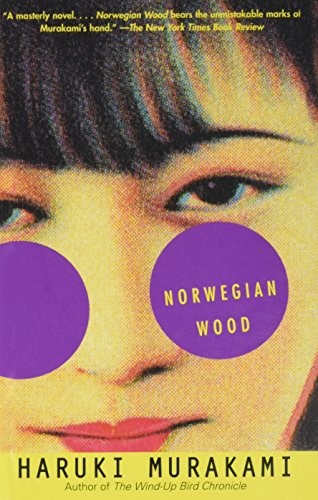

Tropes in this book
- College
Themes
- Japanese literary fiction
- coming of age
- college in 1960s Tokyo
- love triangle
- grief and mental illness
- melancholy
- explicit sex scenes
Read it if
- you like novels where the mood matters more than the plot and sadness keeps bumping into humor
- you loved Looking for Alaska or The Perks of Being a Wallflower and want something more grown-up
- you're curious about Tokyo at the end of the '60s: dorms, student strikes, jazz bars and Beatles records
Skip it if
- you need a plot that races, because here the hero spends hundreds of pages walking, writing letters and drinking whiskey
- suicide and mental illness hit too close to home for you right now
- you're expecting YA where sex is hinted at, at most, and the characters get a happy ending
Why this rating
🧠 For connoisseurs
8/10- Midori. The most alive character in the novel and proof that Murakami can write people, not just moods. She says whatever pops into her head, takes care of her dying father, cooks like a pro and hides, under all that nerve, a girl who has never once been allowed to be selfish. Her scenes are the funniest in the book and the most heartbreaking, often at the same time.
- A gallery of characters. Reiko with her cigarette and her guitar; Nagasawa, who once swallowed three slugs so nobody would mess with him and treats the girlfriend who loves him like a part of his system; Storm Trooper and his radio calisthenics; Midori's dying father and his cucumber. Everyone has a story and a weight of their own, and the hospital visit works as a short story all by itself.
- Grief without consolation. Kizuki is dead from the first pages, but his death sets up the entire book. Murakami writes about loss without melodrama and without ready-made answers: no wisdom about death can cure the sadness, and part of growing up is learning to live with it.
- The frame and the ending. The 37-year-old narrator in Hamburg lets you know from the start that this won't end well, and the last phone call still leaves you with a question that has no easy answer. The chapter about Watanabe's first visit to the Ami Hostel is writing of the highest order.
- A passive narrator. Watanabe mostly reacts: he goes where he's taken, listens and waits for letters. Women confide in him, undress in front of him and invite him into bed without him having to do much of anything. Some of that is deliberate, but it gets tiring.
- Sex where it isn't needed. Sex scenes turn up even where they add nothing. The worst is Reiko's story about her 13-year-old piano student, told in the language of erotica even though it's a story of manipulation in which the seducer is a child. An adult and a 13-year-old written like a love scene: it's the most disturbing passage in the book, and it's very hard to defend.
💖 For comfort readers
5/10- Midori's humor. Every conversation with Midori is a treat: watching a neighborhood fire from the laundry deck with beer and a guitar, the bear in springtime, the strawberry shortcake tossed out the window. I laughed out loud at those scenes.
- Romance with real tension. The question of who Watanabe will choose keeps you reading to the last page, and the scene on a department store roof in the pouring rain is pure, old-fashioned romance.
- Sadness on every page. Suicides, hospitals, cancer, funerals. Even the lighter scenes have someone's death in the background, and the ending doesn't give you the relief you're hoping for after a book like this.
- A slow pace. Walks around Tokyo, letters, whiskey, one Sunday after another of laundry and ironing. If you're used to YA where every chapter ends on a hook, you may nod off here.
- Sex out of nowhere. The sex scenes are explicit and show up in places that give no hint anything erotic is coming. If you wanted a tender love story, that can catch you off guard, and not in a good way.
The book's four layers
Plot and pacing
The plot is simple and episodic: walks, letters, two visits to the sanatorium, a hospital, the seasons changing. The tension comes from two questions – will Naoko get better, and what will Watanabe do about his feelings for Midori – while very little actually happens. The frame with the grown-up narrator gives a lot away up front, but the final scene stays with you for a long time anyway.
Characters and relationships
Midori, Reiko, Nagasawa, Storm Trooper and Midori's father are characters you remember. Naoko is more an image than a person, which makes sense, since we see her through the eyes of a boy in love. The weakest link is Watanabe himself: passive, and a little too desired by everyone around him.
Writing style and atmosphere
Murakami writes in plain words, and every sentence carries a mood: rain, moonlight, Bill Evans records, the smell of dry grass. Melancholy mixes with absurd humor, and Midori's dialogue sounds like real speech. The sex scenes are written without metaphors and without hesitation, which some readers will love and others will find jarring.
Entertainment and value
This is no easy bedtime read: it takes its time, it's sad and it's full of death. Its value is high, though, because it's hard to find a better novel about how to keep living after someone close to you takes their own life, and about adulthood being a choice. I'm taking points off for too much sex and for one scene you can't read without feeling sick.
The book in brief, spoiler-free
Toru Watanabe starts college in Tokyo less than a year after his best friend's suicide and ends up torn between Naoko, who can't find her way out of the past, and Midori, who wants to live right here, right now. It's melancholy, sex-heavy fiction for adults – not YA – that plenty of older teens and twentysomethings reach for anyway.
Want the plot step by step?SummaryThemes it explores
Haruki Murakami writes about growing up in the shadow of death. Watanabe is 18 when he arrives in Tokyo determined to keep his distance and not take anything too seriously, but Kizuki's death comes along with him. Someone in this book is always leaving or being left alone with their illness, and Watanabe learns that no wisdom about death can heal the sadness. Right next to all that darkness stands Midori, who laughs in a hospital, eats for two and never apologizes for wanting to live.
The main threads: grief (Kizuki, who will be seventeen forever, and a wound that refuses to close); mental illness (Naoko and Reiko at the Ami Hostel, where patients and staff learn to live with their own quirks and cracks); a divided heart (a quiet, guilt-heavy love for Naoko and a vivid, pulsing love for Midori); sexuality (sex as closeness, as an escape from loneliness and as the place where the body stops listening to the head); friendship (Kizuki, Nagasawa, Reiko and Storm Trooper, who each shape Watanabe in their own way); caregiving and family (Midori, who has spent years looking after dying parents and has never been allowed to be selfish); growing up (deciding to stop feeling sorry for yourself and to own your choices); and late-'60s Tokyo (student strikes, a dorm with a flag on the pole, jazz bars and Beatles records).
Questions and answers
Is Norwegian Wood YA or adult?
Adult. It's literary fiction written for grown-ups, not young adult, even though plenty of older teens and twentysomethings pick it up. The characters are college students, the narrator looks back at them from eighteen years later, and neither the sex nor the deaths are softened in any way. If you're coming from YA, expect less plot, more mood and an ending that doesn't tie itself up with a bow.
Is Norwegian Wood appropriate for 12 year olds?
No. I rate it 18+, and there isn't much to negotiate. The sex scenes are explicit, including Reiko's story of a sexual encounter between an adult woman and a 13-year-old girl, and in the background there are several suicides, two of them by 17-year-olds, plus a suicide attempt. Add alcohol, casual sex and serious mental illness. If this book stirs up something painful, or thoughts of death feel close right now, you can call or text 988, the Suicide & Crisis Lifeline in the US, any time.
How spicy is Norwegian Wood?
8/10 on my spice scale. There are several explicit sex scenes written without metaphors, one-night stands with girls picked up in Shinjuku bars and a trip to an adult movie theater. It isn't romance-novel spice, though: sex here is about closeness, loneliness and grief, and the most disturbing passage, Reiko's story about her 13-year-old student, isn't spice at all.
Is Norwegian Wood part of a series?
No, it's a standalone novel with no plot ties to Murakami's other books. It makes a good first Murakami, because it's one of his most realistic: instead of talking cats and parallel worlds, you get late-'60s Tokyo and people. In 2010 it was adapted into a Japanese film directed by Tran Anh Hung, with Kenichi Matsuyama as Watanabe, Rinko Kikuchi as Naoko and Kiko Mizuhara as Midori.
How many pages is Norwegian Wood?
298 pages in the 2000 Vintage International paperback translated by Jay Rubin, though it depends on the edition. That's the translation you'll find in US stores; an earlier one by Alfred Birnbaum came out only in Japan, in 1989. It's eleven chapters of prose you're better off not rushing.
Who is Norwegian Wood for?
Adults and older teens who have outgrown typical YA and want a coming-of-age novel that doesn't go easy on them. Connoisseurs get Midori, a whole gallery of side characters and grief without cheap comfort; comfort readers looking for a page-turner may find it slow and heavy. If you're going through a crisis right now, save it for later, and if you need someone to talk to, call or text 988.
What about you? Have you read this book?
Reader ratings
Your rating might be totally different from mine. A lot depends on when you pick it up.
Your rating on a 1-10 scale
No login needed. One vote per browser – you can change it later.
Disagree? Rate the book above or message me on Instagram or TikTok.
What to read next
 South of the Border, West of the Sun
Haruki Murakami
Murakami in a realistic key again: a first love who walks back into a grown man's settled life.
★ 7/10🧠 7💖 4🌶️ 718+
Read the review
 Normal People
Sally Rooney
Also: literary fiction, small-town Ireland to Trinity College.
★ 8/10🧠 8💖 6🌶️ 616+
Read the review
 Kafka on the Shore
Haruki Murakami
Also by Haruki Murakami.
★ 8/10🧠 8💖 5🌶️ 718+
Read the review