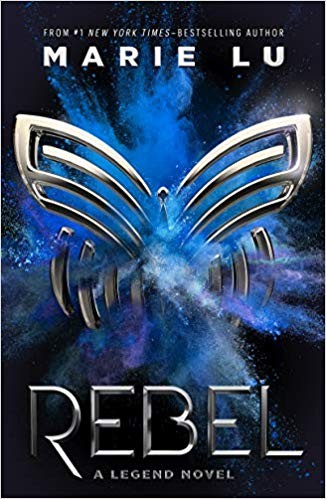

Tropes in this book
- Dystopia
- Friends to lovers
Themes
- dystopian YA
- sequel a decade later
- gamified city
- drone racing
- brothers and war trauma
- Day and June
- on-page violence
Read it if
- you've read the Legend trilogy and want to see what ten years did to Day, June and Eden
- you like dystopias where a whole city runs like a game, with points, levels and an augmented-reality overlay
- you want a YA book about brothers learning to talk about the war instead of pretending it doesn't hurt
Skip it if
- the ending of Champion was all the closure you needed and you don't want a nearly 400-page epilogue
- you want a villain who surprises you at least once instead of giving speeches about a broken system
- you can't stand a romance where the hero spends a good chunk of the book rehearsing on his balcony what to say to a girl
Why this rating
🧠 For connoisseurs
4/10- Eden as narrator. The most interesting thing Marie Lu does here is hand the mic to the little brother. A nerd in glasses who keeps pressed flowers in his physics textbook and jolts out of bed at fireworks because he hears gunfire thinks at a different rhythm than Day and is scared of different things. His nightmares about a glass cylinder rocking in a train car say more about experiments on children than plenty of the trilogy's action scenes ever did.
- The talk by the lake. A night run over the rooftops of Lake, the hole in a wall where Day slept as a kid, and two brothers who each spent years shielding the other from his own nightmares. When Daniel finally admits he sees them too, this book has a weight its plot never manages to carry.
- A villain with a lecture. Dominic Hann gets a tragic backstory and a few sharp lines about a system that grinds down the poor. His best moment is telling Eden that Day was once exactly like him – a loser, a rebel, a wanted criminal. Lu never follows that idea anywhere, though, and the rest is a villain starter kit: a rattling cough, an immaculate suit, a snap of the fingers and guards who leave the room without a word.
- A plot on a string. Hann kidnaps the heroes and lets them go whenever the plot needs it, and his reasoning boils down to: you'll be back anyway. He sees through the brothers' double game from the start, yet he still lets them in, lets them walk right up to the control platform and explains his plans before he ever pulls a gun. What he really wants to do with the system is easy to guess long before anyone says it out loud.
- Politics in one hearing. The big dystopian question – can you fix a system from the inside? – gets solved by a chip the size of a fingernail and one speech in front of the president. Ross City burns, tanks roll through the Undercity, and then the city ends up keeping the patches of a college kid the authorities themselves hauled in front of the council. For a book about how slowly change comes, it comes suspiciously smoothly.
- June as a guest star. In the trilogy June was half the story; here she doesn't get a single chapter. She has one great move with a decoy team in a building that blows up, but otherwise she mostly blushes, reads Daniel in one glance and wears crimson gowns.
💖 For comfort readers
7/10- Back with old friends. Day, June, Tess, Anden and the paper-clip ring still on Daniel's finger. If you lived through the trilogy with them, the reunion ten years later is a reward in itself, and the finale gives fans what they've been waiting for since the series closed.
- Drone races. Illegal races in the Undercity, with cash bets, sponsors and a hummingbird-size drone weaving past heavy machines through narrow alleys – the most cinematic scenes in the book.
- Ross City. A city under a dome, with a virtual whale gliding between skyscrapers and the aurora over the rooftops, makes a gorgeous set. One floating icon over a potted plant in a university hallway, promising a point for watering it, tells you everything about how this society works.
- Eden and Pressa. The second couple is sweeter than the first: a shy nerd from the top floors of the city and a mouthy Undercity girl who runs the cleaning bots and bets on races to buy medicine for her dad. Pressa has fast reflexes, a pharmacist's know-how and the best comebacks in the book.
- The warm-up. Daniel's first chapters are mostly pining for June: he rehearses opening lines on his balcony, counts her blushes and keeps wondering whether she still feels anything for him. If you're not here for the romance, you'll be turning those pages with your foot tapping.
The book's four layers
Plot and pacing
The setup has potential: a gamified city, an Undercity gangster and a boy whose engine could tip the balance of power. Then the plot rides on rails laid down for the heroes: kidnappings end in releases, a double game works even though the enemy saw through it, and the political knot gets untied by a chip and a speech. The quiet scenes work best: Lake at night, Eden's memories replayed at intelligence headquarters and the brothers' talk by the water.
Characters and relationships
Eden is the best idea in this book, and his relationship with a brother who still treats him like a twelve-year-old is written with real care. Pressa has personality, and agency chief Min Gheren gets a few great exchanges with Daniel, capped by her flatly telling him she hates him. The rest is weaker: June is reduced to a guest star, Hann wobbles between grieving father and poster villain, and the campus bullies are a faceless trio.
Writing style and atmosphere
Alternating between Eden and Daniel makes sense, but the two voices sound too alike, and hearts pound wildly so often that I stopped counting. Ross City, with its dome, its aurora and its virtual murals, is vivid, though, and the contrast between the gleaming top floors and the smoky Undercity builds atmosphere better than a lot of the dialogue does.
Entertainment and value
As an epilogue for fans, it does the job: races, a kidnapping, riots, a fight on a catwalk and the finale series readers have waited years for. Bonus points for taking both brothers' war trauma seriously and for showing that shiny Ross City is just as unfair as the Republic was. As a standalone dystopia, though, it adds little to the story the series already told, and the stakes are clearly lower than in the trilogy.
The book in brief, spoiler-free
Ten years after Champion, Marie Lu brings back Day and Eden, drops them into a gamified Antarctic city and hands half the narration to the little brother. The talk about the nightmares both of them carried for years is the best thing here; the gangster plot runs on tracks so straight you can call every stop before the train gets there.
Want the plot step by step?SummaryThemes it explores
Marie Lu returns to the Legend characters a decade later and asks what war leaves inside people once it's over. Daniel ran from his past all the way to Antarctica, to a city where everything glows and every good deed earns points. Eden keeps going back to that past obsessively, because otherwise he can't understand why he wakes up screaming every night. Ross City turns out to be closer to the Republic than its residents would like to admit: from the top floors you can't see the Undercity, and a system built to reward goodness ends up punishing poverty and illness.
What the book keeps circling back to: the level system (a chip behind your ear, plus points and floors that decide where you live, what you eat and whether you can afford treatment); brothers (Daniel, who wants to protect Eden at any cost, and Eden, who is tired of always being the national hero's kid brother); war trauma (the nightmares both brothers have carried since childhood and the night they finally admit it to each other); the Undercity and Dominic Hann (a gangster who speaks for the wronged and hurts them more than anyone); memory and love (Daniel getting his memories of June back piece by piece and learning to be with her again); friendship from the Undercity (Pressa, her father's pharmacy and the question of who pays for other people's revolutions); and patriotism (Eden's belief that loving your country also means speaking up about what's rotting in it).
Questions and answers
Do I need to read Legend before Rebel?
You can follow it without the trilogy – Marie Lu reminds you who John, Metias, Kaede and Tess were – but you'll lose a lot. Rebel is a fourth book added years later, and its emotional stakes (the gaps in Daniel's memory, the paper-clip ring, ten years apart from June) only land if you know the first three. The opening chapters also give away how the war ended and what happened to the main characters. The reading order is Legend, Prodigy, Champion, Rebel; this one picks up about ten years after Champion. A graphic novel adaptation of Rebel came out from Roaring Brook Press in September 2026.
How spicy is Rebel?
4/10 on my spice scale. There are kisses, a slow, sweet build between Eden and Pressa, and one night Daniel and June spend together, written tenderly and without anything explicit. Nothing graphic on the page.
Is Rebel appropriate for 12 year olds?
The publisher lists it as 12 and up; I'd say 14+, like the rest of the series. The romance stays mild, but the violence doesn't: a woman takes poison during an arrest, a murdered politician is left mutilated in the street, there's a kidnapping and a beating, someone close to the characters is stabbed during riots, and there's a shootout. Both brothers also live with war nightmares. If violence, losing someone you love or bad memories that keep coming back hit close to home, you can call or text 988 in the US.
How many pages is Rebel?
384 pages in the 2019 US hardcover from Roaring Brook Press, though it depends on the edition – the Square Fish paperback runs 400. Chapters alternate between Eden and Daniel, so it moves fast.
Is Rebel YA or adult?
YA. It was published for teen readers by Roaring Brook Press, an imprint of Macmillan, and at its heart is Eden figuring out who he is outside his famous brother's shadow. Daniel and June are adults now, which gives their storyline a slightly older feel, but the content stays within YA limits.
Who is Rebel for?
Legend fans who want to see Day and June one more time and find out how Eden grew up. Comfort readers get drone races, a kidnapping, riots and a romance that ends the way series readers have wanted for years. Connoisseurs are left with Eden and his war trauma, because the gangster plot won't surprise them once. If you don't know the series and just want a city that runs like a game, Marie Lu's Warcross is the better pick.
What about you? Have you read this book?
Reader ratings
Your rating might be totally different from mine. A lot depends on when you pick it up.
Your rating on a 1-10 scale
No login needed. One vote per browser – you can change it later.
Disagree? Rate the book above or message me on Instagram or TikTok.
What to read next
 Champion
Marie Lu
The previous book, without which the finale of Rebel loses half its weight.
★ 6/10🧠 5💖 7🌶️ 414+
Read the review
 Legend
Marie Lu
Where it all starts: if Rebel would be your first Legend book, go back here instead.
★ 6/10🧠 5💖 8🌶️ 214+
Read the review
 Prodigy
Marie Lu
Same series.
★ 7/10🧠 6💖 8🌶️ 214+
Read the review