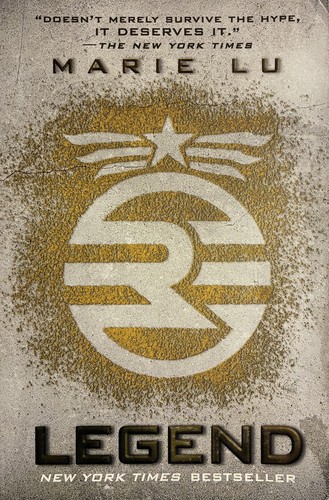

Tropes in this book
- Dystopia
- Enemies to lovers
Themes
- YA dystopia
- cat-and-mouse chase
- the plague and the Trial
- two teen geniuses
- dual POV
- Legend book 1
Read it if
- you love dystopias where teenagers outsmart the entire machinery of the state and the action never takes a chapter off
- you want a story told in turns by the hunter and the hunted, with feelings that start on the wrong side of the barricade
- you finished The Hunger Games and want something shorter, with a hero who steals, sabotages and never kills
Skip it if
- you want a world built down to the details, not a Republic and Colonies you mostly know from slogans on JumboTrons
- characters who are the best at everything, from exams to jumping out of third-floor windows, get on your nerves
- you have a hard time with books where the heroes' loved ones die and soldiers fire into a crowd
Why this rating
🧠 For connoisseurs
5/10- Manhunt in two voices. The alternating chapters from June and Day are the best idea in this book. She builds his profile out of an accent, a limp and a knot on a coat, while he scrapes together money for his little brother's medicine with no clue who's sleeping next to him in the alley. That irony builds more tension than plenty of shootouts.
- The Trial. An exam every ten-year-old takes, one that decides their entire life, is the most interesting piece of this world, and what June digs out of the score archive knocks over her faith in a state that supposedly rewards talent in one move. Metias's coded journals are a fun puzzle too, if you like cracking things right alongside the heroine.
- Mysteries visible from a mile away. Who killed Metias, if not Day, and why the plague only ever hits the poor sectors – Lu hands over the answers so early and so clearly that I spent a good hundred pages waiting for genius June to catch up. From a girl who counts ceiling tiles to pass the time, I expected faster reflexes.
- Villains without a single shade of gray. Commander Jameson smiles while she orders a civilian shot, and the Republic poisons its own citizens, kills kids after the exam and fires into crowds. The evil here is so complete that it leaves room for exactly one question: when is somebody finally going to bring it down?
- Geniuses on fast-forward. June and Day are the best at everything: they fight, climb, count seconds and read people like detectives in a crime novel. June goes from loyal soldier to rebel in a matter of days, and the feelings show up even faster, before these two get to properly enjoy being enemies.
💖 For comfort readers
8/10- Pace. A hospital break-in, a leap from a third-floor window, an escape through the sewers, an underground fight ring, a dust bomb and a finale where the seconds get counted out loud. This book doesn't have a warm-up chapter.
- Day. A street Robin Hood with a slingshot who robs the military, hands the money to his family and neighbors and can still fire off a sharp comeback while chained to a rooftop. Good luck not rooting for him.
- Hunter and prey. The girl who's supposed to catch him and the boy who saves her life without knowing who she is. The kiss in the alley and the cell scene with the pendant work, even when your brain keeps saying it's all happening way too fast.
- John. The big brother who spent his whole life standing between Day and the world gets the strongest scene in the book. I won't say which one, but it stayed with me longer than all the chases put together.
- No easy ride. This is not a light adventure: the hero's mother dies right in front of him, soldiers shoot at protesters and the ending leaves a lump in your throat. If all you want is to unwind, expect to take a few hits along the way.
The book's four layers
Plot and pacing
The structure is very efficient: two narratives closing in on each other like trains on the same track, then a role swap once the hunter starts looking for the real killer, and a finale with a countdown. The problem is that the main mysteries are visible long before the heroine, who supposedly notices everything, spots them. The Republic and the Colonies are a sketch: floods, JumboTrons and a war you know only as much about as the propaganda tells you.
Characters and relationships
Day has charm, pride and his heart on his sleeve, June has a cool head and a habit of counting everything she sees, but they're both too perfect to really fear for. The side characters land harder: John, Metias seen through memories and journals, and even Thomas in the scene where he shouts that he grew up poor too and got where he is by following the rules. Jameson and Chian, on the other hand, are cartoon villains, and Tess spends the whole book as a sweet kid who needs looking after.
Writing style and atmosphere
Present tense, Day and June taking turns, and chapter headers that read like a field report: time, sector, indoor temperature. June's chapters are tiny Sherlock-style investigations – an accent, a limp, a Canto knot, a smudge on a forehead – and that part is a blast. The prose is simple and cinematic, sometimes a little too cinematic: a soaked boy gets compared to an angel, and a girl's eyes flicker gold in a flash of lightning.
Entertainment and value
A little over three hundred pages with no dead stretches, heroes you root for and an ending that hurts, even though you can watch it being set up. Along the way, the book asks some smart questions: what does a state do with the people who lost at the starting line, what does obedience cost, and when should a soldier refuse an order? I'm docking points for predictability and for the fact that all this fun is paid for with a hefty body count.
The book in brief, spoiler-free
A fifteen-year-old prodigy in the Republic's army gets her first assignment: catch the most wanted criminal in the country, the boy she's told killed her brother. A slick, breakneck dystopia in two voices – you'll call a lot of it early, and the ending hurts anyway.
Want the plot step by step?SummaryThemes it explores
Marie Lu writes about a state that sorts people like merchandise. The Trial at age ten splits kids into a future elite, laborers and the ones who get sent to so-called labor camps, and the plague keeps coming back to the poor sectors and only the poor sectors. June believes in the system because it gave her everything, Day hates it because it took everything from him, and only when the two of them collide on the streets of Lake does each start to see what the other refused to see. It's a story about truth buried under propaganda, about the price of obedience and about siblings who carry more than they should.
The main threads: the Republic and propaganda (JumboTrons, the pledge to the Elector and a war with the Colonies you know only as much about as the government says); the Trial (an exam that decides the lives of ten-year-olds, and a score someone in an office can rewrite with a single keystroke); the plague (crossed-out X's on doors, numbers on underground pipes and the question of why the government always has a vaccine ready); siblings (Metias, who raised June, John, who always shielded Day, and Eden, for whom Day risks everything); enemies and trust (a hunter and a fugitive who save each other's lives before they even know each other's names); obedience (Thomas, who will carry out any order, and June, who learns that an order doesn't let your conscience off the hook); and rebellion (Day working alone, the Patriots with their own list of targets and Metias's advice to rebel from the inside).
Questions and answers
Is Legend a series? What's the reading order?
Yes, it's book 1 of Marie Lu's Legend series. The trilogy goes Legend, Prodigy, Champion, and Lu later added a fourth novel, Rebel, set years after the trilogy, so read them in that order. Legend wraps up the mystery of Metias's death, but Day and June end the book on the run, and what happens to Eden and Tess is left wide open.
How many pages is Legend?
352 pages in the US paperback from Speak (2013), though it depends on the edition – the original 2011 hardcover from G.P. Putnam's Sons is listed at 320. Short chapters and a constant pace make it a quick read.
Is Legend appropriate for 12 year olds?
I rate it 14+. There's no sexual content – just two kisses – but there's a lot of violence, written briefly and without gory close-ups: soldiers shoot a sick woman in the street, the hero's mother is shot in the head, troops open fire on protesters, a spy is tortured, a chained prisoner is beaten and an execution plays on screens across the city. For most 12-year-olds I'd wait a couple of years or read it together. If any of these scenes stays with a younger reader longer than it should, you can call or text 988 (USA).
How spicy is Legend?
2/10 on my spice scale. There are two kisses and a lot of charged looks, and that's it – no sex scenes, nothing fades to black. The heat in this book comes from rooftop chases, not from the bedroom.
Is Legend YA or adult?
Straight-up YA. Day and June are both fifteen, the book was published for teen readers by Penguin's young readers division, and it sits on the same dystopian shelf as The Hunger Games and Divergent. Adults who like fast action will get through it in a weekend, too.
Who is Legend for?
Comfort readers who love fast dystopias with action and a romance across enemy lines, and fans of The Hunger Games and Divergent who want something shorter. Connoisseurs will enjoy the two-voice structure and what comes out about the Trial, but they'll crack the main mysteries before June does, and the Republic never gets past the sketch stage.
What about you? Have you read this book?
Reader ratings
Your rating might be totally different from mine. A lot depends on when you pick it up.
Your rating on a 1-10 scale
No login needed. One vote per browser – you can change it later.
Disagree? Rate the book above or message me on Instagram or TikTok.
What to read next
 Prodigy
Marie Lu
Book 2, which picks up Day and June's story after their escape from Los Angeles.
★ 7/10🧠 6💖 8🌶️ 214+
Read the review
 Champion
Marie Lu
Same series.
★ 6/10🧠 5💖 7🌶️ 414+
Read the review
 Rebel
Marie Lu
Same series.
★ 5/10🧠 4💖 7🌶️ 414+
Read the review