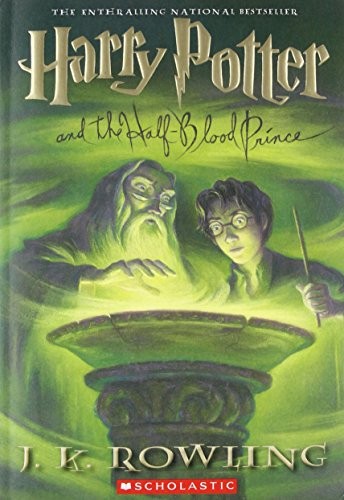

Tropes in this book
- Academy and boarding school
- Mystery and crime
Themes
- YA fantasy
- magic school
- Voldemort's backstory
- the Half-Blood Prince mystery
- first crushes and jealousy
- the series heads for its endgame
Read it if
- you finally want to know who Tom Riddle was before he became Lord Voldemort
- you like a school comedy of jealousy and love potions running alongside a war that keeps getting darker
- you've finished book five and you're ready for an ending after which Hogwarts never feels the same
Skip it if
- you're just starting the series – without the first five books, half the scenes lose their meaning
- you'd rather have action than lectures, and a good chunk of this year is spent watching other people's memories in the Pensieve
- you want a self-contained story, because this one ends as a running start into book seven
Why this rating
🧠 For connoisseurs
8/10- A villain's case file. The Pensieve lessons are a clever device: Voldemort's history gets pieced together from other people's memories, like evidence in an investigation. Marvolo Gaunt yanking his daughter forward by the chain of a locket, Merope slipping a love potion to the Muggle she adores, an eleven-year-old hiding a box of things he took from other kids, a yo-yo and a harmonica among them. Voldemort stops being the monster from the graveyard and becomes a boy who could still have been stopped back at the orphanage – nobody got there in time.
- Snape, right to the end. All year Rowling plants evidence on both sides: the Unbreakable Vow, an argument with Dumbledore that Hagrid overhears, the prophecy Snape once listened in on. Dumbledore keeps insisting he trusts him completely, and the finale puts that trust to the cruelest possible test. Whose side Snape is really on stays open until book seven, and that's the best cliffhanger in the whole series.
- Draco gets a second dimension. For five books he was a one-note bully. Here he gets paler and more hollow week after week and ends up crying over a sink in Moaning Myrtle's bathroom because someone has threatened to kill him. By the end he's a scared kid in way over his head. I felt sorry for him, and I never expected to say that about a Malfoy.
- The cave. The chapter with the potion in the stone basin is pure horror. Harry has to keep a promise that is unbearable to keep, and a black lake hiding things you'd rather not know about does more than plenty of horror novels for adults. Nothing in the series had gone this dark before.
- The Prince mystery at half power. The title thread resolves surprisingly flatly. Hermione digs a name out of an old newspaper, Harry waves it off, and the answer finally gets yelled mid-chase by the person in question. On top of that, a textbook works as Harry's potions cheat sheet for half a year, and nobody in the castle except Hermione sees a problem with it.
- Harry was right, and that's it. From the visit to Borgin and Burkes on, the Malfoy plot heads exactly where Harry has been pointing all along. Ron and Hermione refuse to believe him for the entire year, the reader believes him from page one, so there's not much mystery left – just the question of when and how.
💖 For comfort readers
8/10- A Hogwarts rom-com. Ron and Lavender making out in every corner, Hermione taking Cormac McLaggen to a party purely to spite Ron, a flock of conjured canaries going for Ron's head and a love potion hidden in Romilda Vane's chocolates. Rowling finally writes sixteen-year-olds the way sixteen-year-olds actually behave: dumb, jealous and blushing.
- Slughorn. A teacher who hides from the world by disguising himself as an armchair, collects famous students like stamps and gets drunk with Hagrid at a giant spider's funeral. One of the funniest characters in all of Hogwarts, and by the end a surprisingly human one.
- Humor in wartime. A spell-checking quill that signs Ron's essay “Roonil Wazlib,” Luna doing the commentary at a Quidditch match, Ron waking up dangling by one ankle and Fred and George's joke shop lighting up a half-empty Diagon Alley. With the news getting grimmer by the week, the jokes land even harder.
- Harry and Ginny. The feelings fans have been waiting on since Chamber of Secrets finally burst into a kiss after a big win, in front of the whole Gryffindor common room. Sweet, short and refreshingly drama-free.
- A lot of Pensieve time. The lessons with Dumbledore are mostly lectures: you watch someone else's memories and then talk them over at length. There's less Quidditch and less adventure than usual, and the middle of the year moves slower than in Goblet of Fire.
- A finale that isn't for everyone. If you read Harry Potter for the warm, safe Hogwarts of the early books, this ending will flatten you. It's sad, it's open, and it leaves the characters in a worse place than where they started.
The book's four layers
Plot and pacing
The book stands on two legs, and one is clearly stronger. The Pensieve lessons build, memory by memory, toward the answer to how Voldemort made himself immortal, and the cave and the final chapters have you by the throat. The school year in between, though, is mostly Harry tailing Malfoy, whose plan you see coming right along with Harry, plus a textbook that does Harry's potions for him and then gets stashed away without ceremony. The ending is deliberately left open to clear the ground for book seven.
Characters and relationships
The best-written cast in the series. A young Tom Riddle assembled from other people's memories, Slughorn as ridiculous as he is pitiful, Draco cracking under the weight of his task, a Dumbledore who admits his own mistakes, and Snape, whose every line can be read two ways. Ginny is the weak spot: we mostly learn about her through what Harry feels for her.
Writing style and atmosphere
Rowling switches from comedy to horror without a single grinding gear: one morning Ron is hanging upside down in the dormitory, a few hundred pages later there are bodies drifting in a black lake. The cave is damp, airless and genuinely creepy, and the closing chapters are the quietest and most moving thing Rowling had written up to that point.
Entertainment and value
Laughs, jealousy, a mystery and loss in one book, and plenty of fans call it their favorite. I take a point off for the slower middle and for the fact that it sets up the series finale more than it wraps up its own story. It's also a good excuse to talk with a younger reader about grief, trust and the fact that adults get things wrong too.
The book in brief, spoiler-free
Sixth year at Hogwarts is two books in one: a school comedy of love potions, jealousy and a secondhand textbook full of someone else's notes, and private lessons in the Pensieve where Harry traces how a boy from a London orphanage became Lord Voldemort. Snape, Draco and Slughorn get more nuance than the series has ever given anyone, and the ending sends you straight to book seven.
Want the plot step by step?SummaryThemes it explores
In book six, J.K. Rowling writes about where evil comes from and what can stand up to it. All year Harry watches Tom Riddle's childhood and youth in the Pensieve: the Gaunt family locked inside its pure-blood obsession, a mother who died an hour after giving birth, an orphan who at eleven already knew how to hurt people, and a polite, charming student quizzing a teacher about the darkest magic there is. Next to that runs a second story, about choices. Snape and Draco each stand in the shadows for their own reasons, Slughorn has spent years ashamed of a single conversation with a student, and Harry comes to see that being dragged into a fight to the death and walking into it with your head held high are two completely different things. The third theme is love: silly, jealous, sometimes faked with a potion, and the kind Dumbledore keeps telling Harry is his greatest protection.
The main threads: Voldemort's past (memories in the Pensieve, and the secret of his immortality, which Harry has to pry out of Slughorn); the Half-Blood Prince (an old textbook full of brilliant notes and dangerous spells, and a year of guessing who wrote them); Draco's task (a mysterious plan that leaves Malfoy pale, in tears and missing from the Marauder's Map); trust (Dumbledore trusts Snape without reservation and won't say why); first love (Ron and Lavender, Hermione's jealousy, Harry and Ginny); war in the background (disappearances, innocent people arrested and a Minister for Magic who'd rather have a mascot than the truth); and loss (a year that leaves Harry more alone than he has ever been).
Questions and answers
Do I need to read Harry Potter and the Sorcerer's Stone and the other earlier books first?
Yes, all five, in publication order: Harry Potter and the Sorcerer's Stone, Chamber of Secrets, Prisoner of Azkaban, Goblet of Fire and Order of the Phoenix. Half-Blood Prince picks up a few weeks after the battle at the Ministry of Magic and assumes you know who Sirius was, where the prophecy came from and who Tonks, Lupin and Wormtail are. It's also the second-to-last book of seven, so the ending is open and leads straight into Harry Potter and the Deathly Hallows.
How many pages is Harry Potter and the Half-Blood Prince?
652 pages in the US Scholastic edition – the 2006 paperback has the same page count as the 2005 hardcover – though it depends on the edition. There are 30 chapters.
Is Harry Potter and the Half-Blood Prince appropriate for 12 year olds?
I rate it 12+, same as Goblet of Fire, but it sits at the very top of that twelve. A major death happens right in front of Harry, a lake full of reanimated corpses attacks, an adult under a potion's effect begs to be allowed to stop, and a student hit by a slashing curse ends up lying in his own blood. Add a werewolf who bites children on purpose, the Cruciatus Curse during the final fight and a teacher pouring mead for his students. The romance is kissing and jealousy, nothing more. With younger readers, it's worth being around for the ending and talking about grief.
How spicy is Half-Blood Prince?
2/10 on my spice scale. Ron and Lavender kiss very publicly, Harry and Ginny get together, and love potions are mostly played for laughs. There are no sex scenes. The one darker note is Voldemort's backstory, where a love potion is used to trap a man – worth a conversation with younger readers.
Is Harry Potter and the Half-Blood Prince YA or middle grade?
The series starts as middle grade with an eleven-year-old hero and ages along with him. In book six Harry is sixteen, and the tone is full YA: first relationships, war, murder and moral gray zones. Stores usually shelve it with children's books, but this one reads older than the early volumes.
Who is Half-Blood Prince for?
Readers growing up alongside Harry who want to finally learn Voldemort's past, and adults coming back to the series. Comfort readers get a school rom-com, Slughorn and plenty of humor; connoisseurs get characters with several layers and an ending that makes you rethink every earlier scene with Snape. If stories about the youth of a future tyrant hook you, read The Ballad of Songbirds and Snakes next.
What about you? Have you read this book?
Reader ratings
Your rating might be totally different from mine. A lot depends on when you pick it up.
Your rating on a 1-10 scale
No login needed. One vote per browser – you can change it later.
Disagree? Rate the book above or message me on Instagram or TikTok.
What to read next
 Harry Potter and the Order of the Phoenix
J.K. Rowling
The previous book: Umbridge, a Ministry in denial and the battle that sets up everything in book six.
★ 8/10🧠 7💖 8🌶️ 212+
Read the review
 Harry Potter and the Chamber of Secrets
J.K. Rowling
Same series.
★ 8/10🧠 6💖 9🌶️ 110+
Read the review
 Harry Potter and the Prisoner of Azkaban
J.K. Rowling
Same series.
★ 9/10🧠 8💖 9🌶️ 110+
Read the review