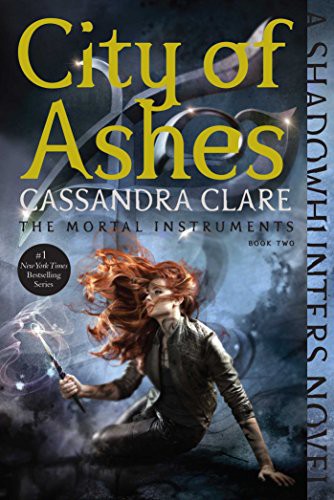

Tropes in this book
- Found family
- Romantasy
Themes
- urban fantasy
- Shadowhunters in New York
- demons and Downworlders
- forbidden love
- YA fantasy
- series sequel
Read it if
- book one left you desperate to know what Valentine will do with the Mortal Cup
- you like urban fantasy where demons, vampires and faeries hang around a perfectly ordinary Brooklyn
- second-string characters like Simon, Magnus and Alec win you over faster than the main couple
Skip it if
- a romance between two people who believe they're siblings makes you cringe more than it makes you swoon
- you like your fantasy lean, and long villain monologues knock you out faster than a lullaby
- you want a self-contained story – this one needs book one and ends with several threads still dangling
Why this rating
🧠 For connoisseurs
5/10- Simon steps up. The most ordinary guy in the cast gets an arc I didn't see coming: from jealous best friend to someone who has to rebuild his whole life from scratch. The scene with the coming-out pamphlet is funny and sad at the same time.
- Characters with motives. The Inquisitor with her son's story behind her, Maryse torn between fear and love, Alec hiding what's going on with Magnus. Clare gives them real reasons, not just a job as roadblocks in the heroes' way.
- Deus ex stele. Clary discovers she can create new runes, and from that moment almost every problem comes with a ready-made fix: a locked cell, a ship's bulkhead, the whole ship. The biggest showdown is won by a drawing, not by a well-thought-out decision.
- Villain at the podium. Valentine gets several long speeches about degenerate races and demons. Now and then he's convincing, but more often I felt like the author was using him to explain the plot to the reader.
- Melodrama instead of tension. In this book, what Clary and Jace feel mostly comes down to longing looks, confessions in doorways and grand declarations that he'll be nothing but her brother – which change exactly nothing. The conflict is blown way out of proportion, and its resolution still has to wait for the next book.
💖 For comfort readers
7/10- Pace and scale. A dungeon under the Silent City, the Seelie Court beneath a pond in Central Park, a midnight burial in Queens, a pickup truck driving across the East River and a battle on a ship crawling with demons. There's no room for boredom here.
- Banter. Jace asks the Inquisitor whether she's implying he's fat, Magnus offers to kick an unconscious guy to check if he's still alive, and Simon narrates everything like a D&D player. Without those comebacks the book would be as heavy as a suit of armor.
- Uphill romance. The kiss at the Seelie Court and the endless we-want-to-but-we-can't are pure fuel for anyone who loves tension with no payoff.
- The crew. Isabelle with her whip, Alec with his guisarme, Luke as werewolf and stand-in dad in one, and Magnus covered in glitter. You end up rooting for all of them at once.
- Reruns. Every few dozen pages Clary and Jace circle back to the same conversation about why they can't be together, and Simon to the same one about trust. With action this good, those loops knock you right out of the rhythm.
The book's four layers
Plot and pacing
A ritual that needs the blood of four Downworlder children gives the plot a clear spine, and every new victim and kidnapping cranks up the stakes. The individual stops are great: the Seelie Court, the cemetery in Queens, the ship on the river. It's weaker on the logic of the finale, which a single rune wraps up, and plenty of mysteries get shelved for the next book.
Characters and relationships
Simon, Magnus and Alec are more interesting than the leads, and the Inquisitor and Maryse get more than one shade. Jace can be exhausting with all that irony, but here you finally see what rejecting his father costs him. Clary has bursts of courage, though more often someone explains things to her than she figures them out herself.
Writing style and atmosphere
New York with demons in its alleys has atmosphere, and the fights are vivid. The prose is weaker: simile chases simile, eyes keep blazing gold, and Valentine preaches like he's behind a pulpit. The dialogue rescues it – quick and often funny.
Entertainment and value
As a sequel, it gives fans of book one exactly what they came for: more action, more surprises and more feelings. I enjoyed it, even if the melodrama had me rolling my eyes now and then. The downside is the open ending, which pretty much forces you to pick up book three.
The book in brief, spoiler-free
Book two of The Mortal Instruments picks up a few days after City of Bones: Valentine has the Mortal Cup, the Inquisitor has Jace in her sights, and someone in New York is killing young Downworlders for their blood. You get more action, more demons and sharper comebacks than in book one – and just as much melodrama around a love that isn't supposed to happen.
Want the plot step by step?SummaryThemes it explores
Cassandra Clare asks whether blood decides who we are. Jace is afraid he's a copy of his father, Clary learns that Valentine changed something in her before she was even born, Simon has to come to terms with what he's become, and Maia can't forget who turned her into a werewolf. Each of them has to decide whether to let what they got through their genes – or through a bite – make their choices for them. In the background, the Clave and the Inquisitor show that the Law can be just as merciless as the villain, while friendship and found family turn out to be sturdier than blood ties.
The main threads: the Mortal Instruments (the Cup and the Sword, which Valentine wants to use to summon an army of demons); the Ritual of Infernal Conversion (the blood of four Downworlder children needed to turn the Sword); forbidden feelings (Clary and Jace, in love even though they believe they're brother and sister); Simon's transformation (a best friend whose life gets turned upside down); Downworlders and Shadowhunters (the prejudices werewolves, vampires, faeries and the Clave hold against each other); family (the Lightwoods, Luke and Jocelyn, and the question of who your real parent is); and new runes (Clary's talent, which changes the rules of the game).
Questions and answers
Do I need to read City of Bones before City of Ashes?
Yes, don't start here. City of Ashes picks up a few days after the end of City of Bones and assumes you know about the fight at Renwick's, Hodge's betrayal and the truth about Valentine. Without book one, most of the emotional punches simply won't land.
What's the reading order of The Mortal Instruments?
City of Bones, City of Ashes and City of Glass make up the Valentine arc, followed by City of Fallen Angels, City of Lost Souls and City of Heavenly Fire, six books in all. Clare also wrote a prequel trilogy, The Infernal Devices, set in Victorian London; it comes first chronologically but was published after the first three Mortal Instruments books, and most fans read in publication order starting with City of Bones. City of Ashes ends with a few open threads, so keep City of Glass within reach.
How many pages is City of Ashes?
About 500 – the current Margaret K. McElderry paperback has 512 pages, though it depends on the edition (the original 2008 hardcover has 453). Inside you get a prologue, three parts with nineteen chapters and an epilogue.
Is City of Ashes appropriate for 12 year olds?
I rate it 14+, so for most 12-year-olds I'd wait a bit. There's nothing sexual, but there's plenty of violence: slit throats, murdered Silent Brothers and bloody fights with demons. There are heavy themes too – a romance between two characters convinced they're siblings, an abusive ex-boyfriend in one character's past and a suicide in another character's backstory. If any of that hits close to home, you can call or text 988 (in the US).
How spicy is City of Ashes?
2/10 on my spice scale. Kisses, longing looks and one night when Clary and Simon fall asleep in the same bed after making out – nothing more. The tension between Clary and Jace runs on what they can't have, not on heat.
Is City of Ashes YA, and who is it for?
It's YA, written for teens like the rest of the series. It's for fans of City of Bones and for comfort readers who like urban fantasy with demons, sharp dialogue and a romance that keeps running into walls. Connoisseurs will find a more interesting supporting cast than in book one, but they'll have to swallow the melodrama and a finale solved with a single rune.
What about you? Have you read this book?
Reader ratings
Your rating might be totally different from mine. A lot depends on when you pick it up.
Your rating on a 1-10 scale
No login needed. One vote per browser – you can change it later.
Disagree? Rate the book above or message me on Instagram or TikTok.
What to read next
 City of Glass
Cassandra Clare
Book three picks up the threads this one leaves dangling and closes Valentine's storyline.
★ 7/10🧠 6💖 7🌶️ 214+
Read the review
 City of Bones
Cassandra Clare
Where it all starts: Clary, the Mortal Cup and the night at Pandemonium that pulls her into the Shadow World.
★ 6/10🧠 5💖 7🌶️ 214+
Read the review
 Lady Midnight
Cassandra Clare
Also by Cassandra Clare.
★ 7/10🧠 6💖 7🌶️ 416+
Read the review