
Tropes in this book
- Mystery and crime
- Plot twists
Themes
- YA thriller
- trilogy finale
- serial killer
- stalker
- PTSD
- morally gray heroine
Read it if
- you've been through two books with Pip and want to see what's left of the good girl
- you love thrillers where an investigation slowly turns into a fight for your life
- you want a book that doesn't hand its heroine an easy pardon and makes you judge her choices yourself
Skip it if
- you need a heroine you can root for with zero reservations
- violence, prescription pill dependence and painstakingly erasing evidence are too heavy a mix for you right now
- you can't buy true-crime-podcast forensics where the plan works down to the minute
Why this rating
🧠 For connoisseurs
7/10- A knot three books long. Jackson goes back to Andie Bell and shows that the story from book one had a false bottom. The clues were lying around for ages: a hairbrush on a desk, two letters scribbled in a planner, a gold necklace around a mother's neck. Finding out who the DT Killer really is caught me off guard, and once I knew, every piece slid into place.
- A heroine coming apart. This Pip has nothing left of the confident senior with a school project. She buys pills from a dealer, lies to her therapist and her boyfriend, and kills Max in her head on every run. Her post-traumatic stress is written from the inside, with no easy exit.
- Dread made of small things. A dead pigeon, chalk on the driveway, a question in an email. Each one on its own can be waved away, and the police and her mom wave them away one by one. The chapters about how isolated a stalking victim becomes are the best-written part of the book.
- Nerve. YA mysteries rarely let their heroine cross a line she can't come back from. Holly Jackson doesn't pull her punch here, and she makes Pip pay for that step.
- A loaded scale. For three books the series has asked who gets to hand out justice, and the finale takes a shortcut by putting nothing but monsters on the other side. Once the mask comes off, the killer talks like a poster about misogyny – women should be seen and not heard, more or less in those words – so Pip's choice is easy to forgive. Billy Karras's story is practically begging to be held up as a mirror, and the book only glances into it for a moment.
- Podcast forensics. The second half turns into a manual for making evidence disappear, and every step works down to the minute: an SUV's air conditioning used as a fridge, a cell tower, the cameras at a gas station. The police swallow almost every lead they're fed, and the only slip turns out to be a tiny detail Pip had no way of knowing about.
- Refrains. Stanley's blood on her hands, the six gunshots, the dark place she keeps sliding back into, the Ravi-and-Pip duet, the ending that's really a beginning. Over almost 500 pages these motifs come back so often that instead of building tension, they start to soften it.
💖 For comfort readers
6/10- Tension. The first half is a solid stalker thriller, and the scenes in the trunk and in the warehouse had me reading with my jaw clenched.
- Ravi. Jokes, nicknames, coded love notes and his voice in Pip's head when things are at their worst. Without him this book would be unbearable.
- The crew. Cara, Naomi, Nat and the Reynolds brothers help without asking a single question. These are the warmest scenes in the whole book.
- Racing the clock. A night planned out minute by minute plays like a movie heist run in reverse: nobody steals anything, everybody's busy erasing.
- The weight. This is not a feel-good read: pills, violence, a dead body and an ending that keeps people apart for a long time. A comfort reader who fell for book one because of the duo and the puzzle gets something closer to a psychological drama here.
- Slow stretches. Vacuuming a warehouse, siphoning gas out of lawn mowers, hours of flushing evidence down the toilet. All that detail helps you believe the plan, but in places it reads like a police report.
The book's four layers
Plot and pacing
The first half is a classic investigation with dread that keeps climbing and a terrific solution that ties all three books into one knot. The second half flips the genre: instead of hunting for a murderer, the heroine is covering her tracks. It's a gutsy move, except the plan runs too smoothly and a few sequences drag on for no reason. The ending is bitter and doesn't pretend everything has gone back to normal.
Characters and relationships
Pip gets a fuller psychological portrait here than in book one: trauma, addiction, rage and guilt that don't vanish after one heart-to-heart. Ravi is tender and funny, and her friends each get small scenes that matter. The villains are weaker: once the mask is off, the killer turns into a cardboard misogynist, and Max has exactly one trait and a water bottle.
Writing style and atmosphere
The documents woven into the text – the incident log, the interview transcript, the email that never got sent – work brilliantly and build the mood. On the other hand, refrain phrases come back every few paragraphs, the metaphors pile up, and some chapters stretch out while Pip talks herself through the same reasoning one more time.
Entertainment and value
It keeps you on edge until the last line and asks questions YA usually dodges: about coerced confessions, about police who don't listen to victims and about what revenge costs. The answers can be oversimplified, but they stayed with me longer than the solution to the mystery.
The book in brief, spoiler-free
Pip Fitz-Amobi promised herself she was done with investigations, but someone keeps leaving dead pigeons and headless chalk figures on her driveway, and the trail leads to a serial killer who's supposedly been behind bars for six years. The trilogy's finale is far darker than book one, and halfway through it swerves somewhere YA mysteries rarely dare to go.
Want the plot step by step?SummaryThemes it explores
Holly Jackson closes the trilogy with the question she's been asking since book one: what's left of right and wrong when the institutions that are supposed to protect you fail. After last year, Pip is no longer a high schooler who believes the truth is enough. She's eighteen, with trauma, a stash of pills in her desk drawer and the conviction that one black-and-white case will fix her. She gets one, just not in the shape she asked for, and in the second half of the book she becomes someone she would once have hunted. The author never tells you to condemn her, but she also doesn't pretend that road comes free.
The main threads: stalking (dead pigeons, headless chalk figures and the same question again and again – violence that looks like an accident, which is exactly why nobody takes it seriously); post-traumatic stress and pills (blood on her hands, imaginary gunshots and benzodiazepines bought from a dealer, shown without any gloss); an old crime (a serial killer from six years ago and an innocent man convicted on a coerced confession); Andie Bell (a girl whose secrets turn out to be even heavier than Pip thought, and whose fear set the whole avalanche in motion); the line (self-defense, choice and revenge, and then the question of whether you can frame a guilty man for a crime he didn't commit); loyalty (friends who help without asking and Ravi, who chooses Pip every single time); and loneliness (the price Pip pays for keeping the people she loves safe).
Questions and answers
Do I need to read A Good Girl's Guide to Murder first?
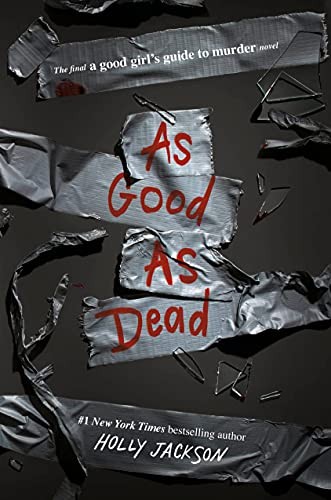
Yes, and Good Girl, Bad Blood too. This is the finale of Pip Fitz-Amobi's trilogy, and it only works in order: A Good Girl's Guide to Murder, then Good Girl, Bad Blood, then As Good as Dead (the prequel novella Kill Joy is a bonus). The book recaps the big events, but in doing so it gives away the solutions to both earlier mysteries, and its main twist only makes sense if you know Andie Bell's story.
Is As Good as Dead the last book in the series?
Yes. It's the third and final book of the A Good Girl's Guide to Murder trilogy, and the US paperback even calls itself the finale. Pip's story ends here, and the ending is a lot darker than the start of the series suggested.
Is As Good as Dead appropriate for 12 year olds?
I'd say 15+, same as the rest of the series, but this book is clearly heavier than book one, so for most 12-year-olds it's too early. There are no sex scenes, but there's a brutal killing, a kidnapping with duct tape, someone being drugged, prescription pill abuse, post-traumatic stress, rape as the subject of an earlier trial and plenty of swearing. The publisher lists it as 14 and up. If any of these topics hit close to home, in the US you can call or text 988 any time.
How spicy is As Good as Dead?
1/10 on my spice scale, so basically none. Pip and Ravi are together, and the romance comes down to kisses, nicknames and a lot of tenderness. Everything heavy in this book comes from the violence and the trauma, not from the romance.
How many pages is As Good as Dead?
480 pages in the US paperback from Delacorte Press (2023); the 2021 hardcover has 464, and it depends on the edition. It's split into two parts and 55 chapters, broken up by incident logs, interview transcripts and bits of the podcast, so it's the longest book in the trilogy but not a slow one to get through.
Who is As Good as Dead for?
Readers who've been through the first two books with Pip and are ready for an ending much darker than the series' beginning promised. It's YA with an eighteen-year-old heroine, but adult thriller fans will get plenty out of it. Connoisseurs get a gutsy twist and a solution that ties the whole trilogy together; comfort readers get tension and a duo worth rooting for. If you want a light mystery with a likable girl detective, stay with book one.
What about you? Have you read this book?
Reader ratings
Your rating might be totally different from mine. A lot depends on when you pick it up.
Your rating on a 1-10 scale
No login needed. One vote per browser – you can change it later.
Disagree? Rate the book above or message me on Instagram or TikTok.
What to read next
 Good Girl, Bad Blood
Holly Jackson
Book two, which leaves Pip with the trauma and the unfinished business this finale is built on.
★ 7/10🧠 7💖 7🌶️ 115+
Read the review
 A Good Girl's Guide to Murder
Holly Jackson
Where it all starts – Andie Bell's case, which this book reopens from a completely new angle.
★ 7/10🧠 7💖 8🌶️ 115+
Read the review
 One of Us Is Lying
Karen M. McManus
Also: mystery and crime, plot twists.
★ 7/10🧠 6💖 7🌶️ 215+
Read the review