 Compiled by T.O. Lyceum
Tropes in this book
- Found family
Themes
- historical YA
- World War II
- Death as narrator
- Jewish man hidden in the basement
- childhood friendship
- the power of words
- heavy read
In brief
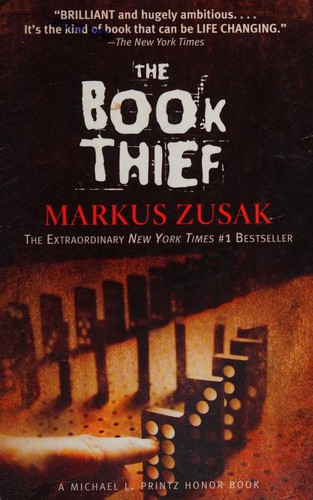
The Book Thief by Markus Zusak is a novel about World War II as seen from a poor German street, and it's narrated by Death. In January 1939, nine-year-old Liesel Meminger travels with her mother and her little brother Werner to a foster family near Munich. The boy dies on the train, and at the cemetery where he's buried, Liesel picks up a book that a young gravedigger dropped in the snow. She can't read yet, but it's the first of her thefts.
In the town of Molching, at 33 Himmel Street, Liesel moves in with Hans Hubermann, a house painter who plays the accordion and teaches her the alphabet in the middle of the night, and his wife Rosa, who calls everyone she loves a pig. She becomes friends with Rudy Steiner from next door, pulls a book out of a Nazi bonfire and reads in the library of the mayor's wife. In November 1940, Max Vandenburg, a young Jewish man from Stuttgart, starts hiding in the Hubermanns' basement. He's the son of the soldier who saved Hans's life during World War I.
From the first pages, Death says he met the book thief three times, and he makes no secret of the fact that he'll also be coming for other people on this street.
Read this book? Rate it
Reader ratings
Your rating on a 1-10 scale
No login needed. One vote per browser – you can change it later.
Spoilers ahead. The plot breakdown gives away the ending. If you don't want to know it, stop at the description above.
Plot breakdown
- 1
The train, the snow and the first book
January 1939. Liesel Meminger, who will turn ten in February, is on a train to Munich with her mother and her six-year-old brother Werner. Her mother is sick and has no money, so she's taking the children to a foster family; all Liesel knows about her father is that people called him a Communist. Werner dies in the carriage after a coughing fit, and Death, who has come for his soul, notices that the girl can see him. The boy is buried in a snowed-in town whose name Liesel doesn't know. A fourteen-year-old gravedigger's apprentice drops a black book with silver lettering by the grave, and Liesel picks it up out of the snow and takes it with her. In Munich her mother hands her over to the authorities and leaves, and Frau Heinrich drives the girl to Molching, to 33 Himmel Street. For almost a quarter of an hour Liesel refuses to get out of the car, then she clings to the gate, while her new mother, Rosa Hubermann, swears at the neighbors who stop to stare.
- 2
Midnight lessons
Every night Liesel wakes up screaming from nightmares about her brother, and her foster father Hans Hubermann, a house painter and accordion player, sits with her until morning. When she wets the bed at the end of May, Hans finds her treasure under the sheet, The Grave Digger's Handbook, and starts their reading lessons: at two in the morning, with a carpenter's pencil on the back of a sheet of sandpaper, and later with paint on the basement wall. At school, Liesel can't read, so she's put with the little kids, and when she's called up for a reading test and recites a passage about digging graves in the snow from memory instead of the assigned text, the class laughs at her and she beats up Ludwig Schmeikl in the schoolyard. Her best friend is Rudy Steiner from next door, a boy with hair the color of lemons who, back in 1936, smeared himself with charcoal and ran around the local track at night as Jesse Owens, and who now keeps asking her for a kiss. In September the war begins. For Christmas the Hubermanns give Liesel two books bought with cigarettes Hans rolled and sold at the market, and she writes letters to her mother that nobody answers. Eventually Frau Heinrich admits that the office has lost contact with Paula Meminger.
- 3
The bonfire and the mayor's library
On April 20, 1940, Molching celebrates Hitler's birthday by burning books and flags in the town square. That day the Hubermanns' son, Hans Junior, calls his father a coward for not belonging to the Party and walks out of the house for good. During the speech, Liesel hears the word Communists and puts it all together – her mother's interrogations, her disappearance and her brother's death: whoever took her mama away, it was the Führer. When she tells Hans she hates the Führer, he slaps her across the face and teaches her that such words must never be said outside the house. That evening Liesel pulls The Shoulder Shrug, a book with a Jewish hero, out of the smoking ashes and hides it under her uniform, and Ilsa Hermann, the mayor's wife, whose washing Rosa does, sees her do it. Hans promises to keep quiet, and a few days later he buys a copy of Mein Kampf at the Nazi Party office. Liesel dreads delivering the laundry to 8 Grande Strasse, but the silent woman in the bathrobe lets her in and shows her a room full of books. From then on the girl reads on the library floor and learns that the Hermanns' son, Johann, was killed in 1918. That summer, hungry, Liesel and Rudy join fifteen-year-old Arthur Berg's gang of fruit thieves, and for a penny they find in the street the shopkeeper Frau Diller gives them a single piece of candy, which they take turns sucking.
- 4
The Jew in the basement
One night in November 1940, an exhausted twenty-four-year-old walks into the Hubermanns' kitchen with a key taped inside a copy of Mein Kampf and asks if Hans still plays the accordion. He is Max Vandenburg, son of Erik, who during World War I volunteered Hans to write letters for the captain and in doing so saved his life, because none of the men who went into battle that day came back. Hans promised the widow his help back then, and after Kristallnacht it was his address that Max's mother pressed into her son's pocket. Max's friend Walter Kugler got him papers and a ticket. Hans takes Liesel down to the basement and explains that if she tells anyone about their guest, he'll burn her books, she'll be taken away, and he and Rosa will be taken away forever. Max sleeps for three days in Liesel's room, in the bed once meant for her brother, then moves under the basement stairs, behind a wall of drop sheets and paint cans, and on winter nights he warms himself by the fire. Liesel and Max discover that they both have nightmares, and they trade them. For Liesel's twelfth birthday, Max paints over the pages of Mein Kampf with white paint and paints an illustrated story for her on them, The Standover Man. The girl fishes newspapers with crosswords out of the trash for him and describes the weather to him every day, and he paints a cloud like a tightrope on the wall, with two figures walking along it toward the sun. In the dark of the basement he does push-ups and imagines fighting Hitler in a boxing ring.
- 5
The Whistler and the freezing river
In June 1941, the mayor stops using Rosa's services. Ilsa Hermann presses The Whistler on Liesel as a goodbye, and the girl goes back to her door, shouts that her son is dead and that she's pathetic for sitting in the cold to atone for it, and throws the book at her feet. Rosa doesn't believe it's Liesel's fault that they lost their last job. In October, Liesel and Rudy go back to Grande Strasse and she steals The Whistler through the open library window. She leaves her shoes by the wall, Rudy runs back for them, and for the first time he calls her the book thief. Rudy is going through hell in the Hitler Youth: the leader, Franz Deutscher, makes him drop into the mud and drill on a field spread with manure, and when Rudy throws a stone at him and, asked for the Führer's birthday, answers that it's Easter Monday, Deutscher beats him and hacks off his hair with a knife. Rudy transfers to a flying unit of the Hitler Youth. In December, Viktor Chemmel, the new leader of the gang of thieves, snatches The Whistler from Liesel and throws it into the Amper River. Rudy jumps into the freezing water, fishes the book out and asks for a kiss, but Liesel doesn't kiss him. Death reveals that the boy will never ask again, and he'll never get that kiss while he's alive.
- 6
The snowman and thirteen presents
On Christmas Eve 1941, Liesel carries buckets of snow down to the basement, all four of them have a snowball fight and they build a snowman. That same night Max's health starts to slip, and in mid-February 1942, just before Liesel's thirteenth birthday, he collapses by the fire and is carried unconscious to her bed. Liesel brings him thirteen presents: a crushed soccer ball, a ribbon, a pinecone, a button, a stone, a feather, two newspapers, a candy wrapper, a cloud described in words, a toy soldier, a maple leaf, The Whistler read to the very end and a piece of sadness. She steals The Dream Carrier from the library and reads it to Max out loud, while the Hubermanns quietly wonder what they'll do with the body of a Jew if he dies. Max wakes up, and Rosa comes to the school, makes a scene about a hairbrush Liesel supposedly took and whispers the good news to her, along with the toy soldier. When the Party inspects the basements on Himmel Street as possible air raid shelters, Liesel deliberately crashes into another player during a soccer game and cuts her knee so she can get Hans to come home. The inspector decides the basement is too shallow and leaves, while Max, hidden under the stairs, clutches a pair of rusty scissors.
- 7
The dictionary, the shelter and the bread
In the summer of 1942, Liesel helps Hans paint window blinds black, drinks a glass of champagne with him that clients give him instead of money, and listens to the accordion during their breakfast breaks. Rudy wins three races at the Hitler Youth carnival, and in the fourth, the 100 meters, he deliberately false-starts twice. On the last day of August, Ilsa Hermann leaves The Duden Dictionary and Thesaurus on the window with a letter: she has known about the thefts from the start and is waiting for Liesel to knock on the front door. The air raids come. In the Fiedlers' basement, Liesel reads The Whistler out loud and calms the whole shelter, while Max, alone in the house, sees the stars through the window for the first time in twenty-two months. Frau Holtzapfel, the neighbor who spat on the Hubermanns' door for years, pays Liesel in ration coffee to read to her twice a week. In October, Jews are marched through Molching to Dachau. Hans gives a piece of bread to an old man who keeps falling, and he's whipped in front of the whole street. Afraid of a search, he sends Max away that same night, and all he brings back from the agreed meeting place by the river is a note saying they have done enough for him. Three weeks later, two men in long coats knock, but at the Steiners' door: they want to take Rudy to an elite school, and his parents refuse. The punishment is the draft. The Party suddenly accepts Hans's membership application and sends him to a unit that puts out fires and pulls people out of the rubble during air raids, while Alex Steiner ends up at a hospital near Vienna.
- 8
The Word Shaker and 1943
In December, Liesel and Rudy scatter bread along the road ahead of another march to Dachau, and before Christmas Rosa pulls the sketchbook Max left behind out of her mattress. It's called The Word Shaker, and it's full of his drawings, his memories and a fable about a Führer who conquered the world with words and a girl who grew a tree that couldn't be cut down from a tear made of the word friendship. On Christmas Eve, Liesel and Rudy let themselves into Rudy's father's closed tailor shop for a suit, and after the holidays Ilsa leaves a plate of cookies for Liesel in the library. In January, Michael Holtzapfel comes back from Stalingrad missing three fingers, while his brother Robert has died there in a hospital. Hans breaks his leg when a truck rolls over near Essen; Reinhold Zucker, who forced Hans to swap seats with him, is killed. In March, after an air raid, Rudy places a teddy bear on the chest of the dying pilot of a downed plane, and in April Hans comes home. In July, Michael Holtzapfel, tormented by the guilt of having survived, takes his own life. In August, Liesel recognizes Max in a column of prisoners, walks in among them, says the words from his fable to him, and they're both whipped before Rudy drags her off the road. Liesel tells him the secret of the basement. Hurt and angry, she tears up a book in the mayor's wife's library, and in response Ilsa Hermann brings her a blank notebook and tells her not to punish herself. Liesel starts writing her own story in the basement at night and calls it The Book Thief.
- 9
The end of Himmel Street
On the rainy night of October 7, 1943, bombs fall on Molching before the sirens go off. Himmel Street is wiped out: the sleeping Hans and Rosa die, as do Rudy and his whole family except his father, Frau Holtzapfel, Frau Diller, Tommy Müller and the Fiedlers. Only Liesel survives, because she was sitting in the basement over her manuscript. Soldiers pull her out of the rubble; she finds Rudy's body and kisses him on the lips, the way he always wanted, then says goodbye to her mama and lays his accordion beside her papa. The black notebook ends up on a garbage truck with the rubble, and Death takes it. Liesel goes to live with the mayor and Ilsa Hermann, helps Alex Steiner in his shop after he returns, and in October 1945 Max, who has survived, walks into the shop. In the epilogue, Liesel dies at a great age in a suburb of Sydney, and before she dies she sees her husband, her three children, her grandchildren and the people she lost. Death gives her back the notebook she lost in the rubble, and the story ends with the line: “I am haunted by humans.”
Themes and message
- Words and books
- Hitler won Germany over with them, and a girl from a poor street got through the war with them.
- A foster family
- Hans, Rosa and Liesel, and later Max too, bound together by choice, not by blood.
- Hiding a Jewish man
- Everyday fear and a smile for the neighbors in a house with Max living in the basement.
- Friendship
- Liesel and Rudy, apple and book thieves, and Liesel and Max, who trade nightmares.
- Ordinary people in bad times
- The courage of small gestures, like a piece of bread for a prisoner or an open library window.
- Survivor's guilt
- Max, who left his family behind, Michael Holtzapfel after Stalingrad and Ilsa Hermann after losing her son.
- Death as a witness
- A narrator worn out by the war who tries to understand humans through their stories.
This is a summary of “The Book Thief” by Markus Zusak and its main events. It's not a review, but an overview of the novel's plot and themes.
Is this book for you?You'll find the rating and verdict in the review.
Read the review