 Compiled by T.O. Lyceum
Tropes in this book
- High school
- Mystery and crime
- Plot twists
Themes
- missing girl mystery
- clue hunt
- road trip
- senior year
- unrequited crush
- friendship
- coming of age
In brief
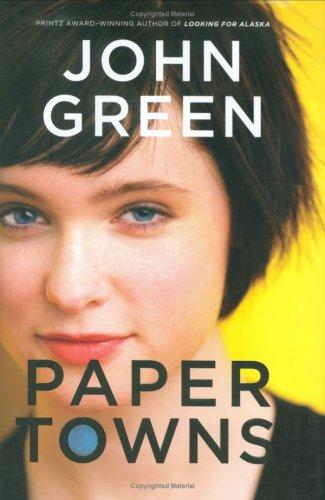
Paper Towns by John Green is a young adult novel about growing up, friendship and how easy it is to confuse a person with your idea of them. Quentin Jacobsen, known as Q, has lived in a subdivision in Orlando, Florida, since he was a toddler, right next door to Margo Roth Spiegelman, the school legend he has been in love with for as long as he can remember. With three and a half weeks of high school left, Margo turns up at his window in the middle of the night with her face painted black: she needs a car, a driver and an accomplice for eleven acts of revenge.
For Q, that night feels like the start of something new, but the next day Margo doesn't come to school. Her parents shrug it off, because she has run away before, and Q finds clues that seem to have been left just for him: a poster in her window, highlighted lines from Walt Whitman and a strange sentence about paper towns. Together with Ben, Radar and Lacey, Margo's friend, he tries to put the puzzle together, less and less sure whether he's looking for a runaway or for a girl who is no longer alive.
The novel has three parts: The Strings, The Grass and The Vessel. The first is one wild night, the second is the search around Orlando and the end of senior year, and the third is a race against the clock, told hour by hour.
Read this book? Rate it
Reader ratings
Your rating on a 1-10 scale
No login needed. One vote per browser – you can change it later.
Spoilers ahead. The plot breakdown gives away the ending. If you don't want to know it, stop at the description above.
Plot breakdown
- 1
The dead man in the park
Quentin and Margo are two when their parents move into neighboring houses in the Jefferson Park subdivision in Orlando. When they're nine, a bike ride to the park ends with them finding a dead man in a gray suit slumped against an oak tree. Q wants to go home right away; Margo steps closer. That night she appears at his window with a notebook: she has done her own investigation and knows the man was Robert Joyner, thirty-six, a lawyer going through a divorce, who took his own life. She adds her own explanation – maybe all the strings inside him broke. Then she tells Q to close the window, and they stare at each other through the glass for a long time. What Q remembers most from that night is that Margo always loved mysteries.
- 2
Eleven parts of one night
Nine years later Q is a senior at Winter Park High School, already accepted to Duke, and he likes his predictable routine: video games with Ben Starling and Radar, mornings outside the band room, dinners with his therapist parents. Margo has long lived in a different world. On May 5, just before midnight, she opens his window, face painted black, and announces that she has eleven things to take care of and needs a car and a driver. Her boyfriend Jase has been cheating on her with Becca Arrington, one of her closest friends, and plenty of people knew and kept quiet. With her bat mitzvah money they buy whole catfish, Veet hair remover, Vaseline, Mountain Dew, tulips and blue spray paint at Publix, and at Wal-Mart a steering wheel lock, which Margo puts on Jase's Lexus. Q calls Becca's father to tell him his daughter is in the basement with Jason Worthington, then photographs Jase sprinting across the lawn in nothing but his boxers. One catfish ends up in Becca's closet, another goes through a window of Jase's house, and a third gets crushed under the back seat of Lacey's SUV, on whose roof Q paints a giant M. Karin, who was the one to tell Margo about the cheating, gets flowers and an apology.
- 3
A paper town from the twenty-fifth floor
Around three in the morning a security guard named Gus, an old acquaintance of Margo's, lets them into the SunTrust Building. From a conference room on the twenty-fifth floor Margo looks down at the cul-de-sacs and subdivisions and calls Orlando a paper town, full of paper people who don't care about anything that matters. She admits that her friends' betrayal broke the last string she had left. Part ten belongs to Q: he gets to pick the target, and he chooses Chuck Parson, who bullied him and his friends for years and in sixth grade talked the girls at dance school into turning Q down. First they climb through the window of a random old man's house; then Ben, using Radar's login, gets them the right address. Margo smears Veet over the sleeping Chuck's right eyebrow, Q wipes it off along with every hair, and the doorknobs all over the house get coated in Vaseline. The eleventh and final part is SeaWorld: they wade through a moat, a garter snake bites Margo on the ankle, and a night guard lets them walk away for a hundred dollars. By the empty seal tank “Stars Fell on Alabama” drifts out of the speakers and they dance a foxtrot. At dawn, back in front of their houses, Margo whispers in Q's ear, word by word, that she is going to miss him.
- 4
The disappearance and the poster in the window
The next day Margo doesn't show up at school, and her car is gone from the driveway. Without her the school's tough guys go back to their old habits: Chuck and his friends run over twelve bikes belonging to younger students, and Jasper Hanson soaks freshmen with urine from a water gun. Q blackmails Jase with the photo, every kid who lost a bike gets two hundred dollars, and Chuck shows up at Q's front door to apologize. On Saturday Margo's parents and Detective Otis Warren are sitting in the Jacobsens' dining room: it's the fifth runaway report, Margo is eighteen, and the Spiegelmans are fed up and changing the locks. The detective compares kids like her to balloons on a string that eventually float away. On the outside of Margo's window shade, visible only from Q's room, a poster appears: Woody Guthrie with a guitar that says THIS MACHINE KILLS FASCISTS. For five dollars to Ruthie, Margo's little sister, Q, Ben and Radar get into her room. Among hundreds of records they find Mermaid Avenue with the song “Walt Whitman's Niece” circled, and on a shelf a copy of Leaves of Grass with passages from “Song of Myself” marked. Two lines are highlighted in green: “Unscrew the locks from the doors! Unscrew the doors themselves from their jambs!”
- 5
The strip mall and the paper towns
On Monday Lacey Pemberton seeks Q out: she knew nothing about Jase's cheating and believes Margo is in New York City, where her cousin is putting up flyers in record stores, and Ben asks Lacey to prom. Q takes Whitman literally and finds a scrap of newspaper in the doorjamb of his own bedroom, which leads him to an abandoned strip mall. He goes in with Ben and Radar on a school day instead of sitting in class. The office of a mortgage company, with desk calendars stuck in February 1986, a room full of shelves and a souvenir shop are connected by holes in the walls – troll holes. Under fresh white paint, letters in Margo's handwriting show through: YOU WILL GO TO THE PAPER TOWNS AND YOU WILL NEVER COME BACK. Over the phone, the detective reminds him that Margo is an adult and has every right to leave. Then, online, Q learns that “paper towns” can also mean subdivisions that were planned but never built, and he becomes convinced that Margo has killed herself and wants him to find her body, because he has found a dead man once before. Q drives out to the empty lots: at Grovepoint Acres there's nothing, at a second phantom subdivision a lone oak reminds him of Robert Joyner's tree, and only then does Q cry for Margo. His English teacher, Dr. Holden, explains that “Song of Myself” is a poem about what connects people, not a suicide note.
- 6
Prom night in Margo's hideout
On prom day Q tells his parents he's going to prom without a date, but instead he checks another phantom subdivision, Quail Hollow, and goes back to the strip mall. This time he notices that the back door opens inward and that one of the desk calendars has been flipped to June. In a drawer there's a bottle of nail polish in the same almost-black shade of red Margo painted her nails with on the revenge night, with a smudge of blue paint on it. Inside a rolled-up carpet Q finds a blanket that smells like her shampoo and an empty box of energy bars; in the wall there are pinholes, and on the shelves a pile of travel guides, including a dog-eared one about roadside America. He stays the night, finally manages to read Whitman's poem and understands that the question of who Margo is has as many answers as the question of what grass is. After three in the morning a drunk Ben calls: Q has to be his designated driver. At the party at Becca's house Ben sets the school record for the keg stand, drinking beer from the keg upside down, Q comforts Lacey, humiliated by Becca and hiding in a bathtub, and near dawn he drives his friend home with an empty beer can superglued to his hand. The day after the party Q fights with Ben, who blows him off on the phone, and Radar advises him to stop expecting people to be anything other than who they are.
- 7
The map with the pinholes
At dinner Q's parents talk about how people lack good mirrors, and Q realizes that Margo was not a miracle or an adventure – she was a girl. At the strip mall, together with Ben, Radar and Lacey, he runs into Gus and two of his friends, who are into urban exploring. They say that Margo had been coming with them to abandoned buildings since she was thirteen, but never took pictures: she sat in a corner and wrote in a black notebook. When one of Gus's friends insults Lacey, Ben goes at him with his fists. Thanks to brochures from the office, Q checks the last two phantom subdivisions on his list and again finds nothing. After a party at Radar's he tears his maps off his wall and sees the same pattern of pinholes as in the strip mall. Together with Radar he finds, in the souvenir shop, a 1972 Esso map of the US with marks near Los Angeles, Chicago, New York City, the Catskills and Washington, D.C. Ben calculates that a loop through those places would take exactly twenty-three days and is sure Margo will be back for graduation. On the last day of school Q throws almost everything in his locker into the trash, walks home and understands that once you leave, you don't want to come back.
- 8
The race to Agloe
On graduation morning his parents hand Q the keys to his very own car – to his disappointment, a Ford minivan. In the shower it hits him that Margo has holed up in one place instead of setting off on an endless trip. Radar's program for searching the Omnictionary turns up an entry on Agloe, New York, a village invented by Esso as a trap for map copiers – a paper town where someone later built a real store. On the talk page, an anonymous comment, written with the same random capital letters as Margo's shopping list, says that until noon on May 29 the population of Agloe will be one. That leaves less than a day. Q tells his parents in the bleachers that he won't be picking up his diploma, and Ben, Radar and Lacey pile into the minivan, the boys in their graduation gowns with nothing underneath. They drive straight through, with Lacey's BP card, six-minute gas station stops and Ben peeing into beer bottles. At night two cows appear on the highway, Q lets go of the wheel, and Ben grabs it and spins the van so that everyone walks away unhurt. The minivan, now christened the Dreidel, keeps going with a gouge in its side. North of Roscoe, next to a collapsing barn, Lacey spots a silver Honda. Inside, Margo, her hair chopped short, is writing in a notebook and only asks them to give her five minutes. Then she mocks Ben and needles Lacey, so the three friends walk out and drive to a motel in Catskill Park.
- 9
Goodbye in Agloe
Q and Margo yell at each other until Margo apologizes: they scared her. She explains that she didn't want to be found, and the Omnictionary comment was meant as a joke for whoever stumbled on it later. At ten she started a story in her black notebook in which Q was a fearless hero, and later she wrote her plans for new escapades across those same pages. The revenge night was meant to make Q braver, and the clues were meant to leave him the strip mall, which she called the Osprey, as a gift; she spent two nights there before heading north. She chose Agloe because it was a paper town for a paper girl: here a dot on a map turned into a real place. She calls her mother, who brings up the changed locks right away, and promises Ruthie a phone call every Tuesday. Q and Margo talk about strings, grass and a cracking vessel, they kiss, and they bury her notebook in the field, saying goodbye to little Margo, little Quentin, Myrna Mountweazel and Robert Joyner. Margo invites Q to New York, but he knows his life is back home. In the motel parking lot they promise to email and to meet up at the end of the summer, Margo cries, they kiss one last time, and Q, even though he loves her, doesn't follow her.
Themes and message
- Your idea of someone vs. the real person
- For years Q loved a vision of Margo, not the flesh-and-blood girl.
- Paper towns
- Orlando as a city made of paper, subdivisions that were never built and Agloe, a village invented on a map.
- Friendship
- Ben, Radar and Lacey fight with Q, but they still drive halfway across the country with him.
- Leaving and growing up
- The end of high school and saying goodbye to the place you grew up in.
- Clues and poetry
- Whitman, Woody Guthrie, maps and abandoned buildings as a path to another person.
- Strings, grass and the vessel
- Three metaphors for pain and connection that the characters argue about.
- Family
- Margo's cold parents versus Q's warm, slightly overeager ones.
This is a summary of “Paper Towns” by John Green and its main events. It's not a review, but an overview of the novel's plot and themes.
Is this book for you?You'll find the rating and verdict in the review.
Read the review