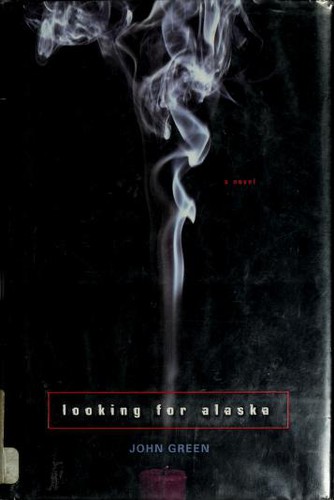

Tropes in this book
- High school
- Mystery and crime
Themes
- boarding school
- prank wars
- found family
- grief and guilt
- mysterious death
- famous last words
- coming of age
Read it if
- you want a coming-of-age story where the jokes and the grief share the same dorm room
- you want a book about friendship and loss that doesn't pretend to have every answer
- you liked Paper Towns or The Fault in Our Stars and want John Green at his most serious
Skip it if
- you're looking for a romance with a happy ending, because you won't get one here
- you're grieving right now or thoughts of death feel close – talk to someone you trust first, the book can wait
- a narrator who sees the girl he loves mostly through her neckline gets on your nerves
Why this rating
🧠 For connoisseurs
9/10- Before and after. Until the turning point, this looks like a familiar boarding school story: smoking by the creek, a prank war, a first crush. Then one scene in the gym kicks its legs out from under it. You can't read the second half the way you read the first, and that's the point: the twist isn't there for shock value, it changes what kind of book you're holding.
- Grief without an instruction manual. Anger at the girl who died, guilt, telling yourself it's just one more prank, even a flash of relief the characters are ashamed to admit. Green doesn't pick only the photogenic tears out of grief, and that's exactly why I believe him.
- The Colonel. A short genius from a trailer park who memorizes capitals and populations whenever he can't deal with his feelings. My favorite character in the book, and Thanksgiving at his mom's place is a small masterpiece squeezed into a few pages.
- The novel argues with its narrator. Miles idealizes Alaska, and the book lets the Colonel tell him to his face that he's mourning a girl he made up for his own use. YA rarely takes apart its own mysterious-girl fantasy this openly.
- A sixteen-year-old's gaze. Miles describes Alaska through her curves and her cleavage far too often, and Lara mostly gets an accent and one awkward scene. The perspective is deliberate, but at times it's exhausting.
💖 For comfort readers
7/10- Humor. The countdown half is a festival of pranks: firecrackers behind the principal's house, blue dye in hair gel, fake progress reports and a swan that bites Miles on the butt at the worst possible moment. I laughed out loud.
- The crew. The Colonel, Takumi with his freestyle rhymes, Lara and Alaska are a group you want to pull up a chair to, and their banter has the rhythm of a good TV show.
- The mystery in the second half. Digging into that night gives the later chapters an engine: a phone call at 3 a.m., white tulips, a note scribbled in the margin of a book. The pages turn themselves.
- The weight. From the midpoint on, the lightness is gone, and nobody hands out a romantic reward for your patience. When you close it, you won't want to start anything else for a while.
- No answer is coming. If you expect the mystery to be solved like a whodunit, you'll be left holding a question the characters have to learn to carry too.
The book's four layers
Plot and pacing
Counting down to one night and then living after it is one of the boldest structural ideas I know in YA. The countdown can feel episodic (a prank, a cigarette, a class, another prank), but every episode tucks something away for later: the secret of who ratted out Marya, the talk about the labyrinth, the Best Day/Worst Day game. The after section is an investigation brave enough not to end in a verdict.
Characters and relationships
The Colonel, Takumi, the Colonel's mom and Dr. Hyde feel fully alive, even when they only get a few pages. Alaska is deliberately hard to pin down – witty, cruel, tender and terrified all at once – and her past explains more than it seems to at first. Miles can be as passive as a piece of furniture, and Lara and the rich kids from Birmingham are drawn with a thick marker.
Writing style and atmosphere
Green writes lightly and with a sharp sense of humor, and the famous last words and the religion classes give the story a second layer without hammering it in. Miles's final essay could have sounded like a sermon, but it lands, because the whole book earned it.
Entertainment and value
First I laughed, then I sat for a long time with the book closed. It's a good one to talk through with a teenager: grief, guilt and the idea that you don't have to understand everything to keep going. Important: the possible suicide is never made romantic or mysteriously beautiful, and the ending chooses forgiveness and hope.
The book in brief, spoiler-free
Miles Halter leaves Florida for an Alabama boarding school to seek a Great Perhaps and finds friends, cigarettes by the creek and Alaska Young, a girl who talks faster than he can think. The book is split into before and after, and whatever sits in the middle turns a charming boarding school story into one of the strongest novels about grief I've read in YA.
Want the plot step by step?SummaryThemes it explores
Looking for Alaska is about what happens when someone you love disappears in a single night and leaves no explanation. Miles comes to Culver Creek for a big adventure and gets friendship, first love and his first real loss. The book borrows a question from religion class – how do you get out of the labyrinth of suffering? – and never pretends there's one answer. It shows grief not just as sadness but as anger, shame, relief and an obsessive hunt for causes, and it shows how idealizing someone who died can hide who she really was. Death here is neither beautiful nor romantic: the characters pay for it with guilt, and the ending chooses forgiveness and hope.
The main threads: the labyrinth (the question from The General in His Labyrinth that Alaska asks Miles on his first night, and that Dr. Hyde later leaves on the board for the rest of the year); friendship (the Colonel, Takumi, Lara and Alaska as the first group where Miles isn't standing against the wall); first love (a crush on a girl who has a boyfriend, and a kiss that promises more); guilt and loyalty (the school's code against ratting, a betrayal Alaska is ashamed of and a night when nobody stopped her); Alaska's past (her mother's death, which she witnessed at eight, and the weight she has carried ever since); grief and investigation (a phone call in the middle of the night, white tulips and an attempt to figure out whether it was an accident); and the Great Perhaps (Miles's collection of famous last words and the question of what we're looking for before we die).
Questions and answers
Is Looking for Alaska a series?
No, it's a standalone with no sequel, so there's no reading order and nothing to read first. John Green's other novels, like Paper Towns and The Fault in Our Stars, are standalones too. The book was adapted into an eight-episode Hulu limited series in 2019, starring Charlie Plummer and Kristine Froseth.
How many pages is Looking for Alaska?
The 2005 US hardcover from Dutton Books has 221 pages, though it depends on the edition. It's split into two parts, before and after, with short chapters headed by a countdown of days, so it reads fast.
Is Looking for Alaska appropriate for 12 year olds?
My rating is 15+. There are no full sex scenes, but there's one fairly direct oral sex scene and plenty of sex talk, plus cigarettes, a lot of drinking, drunk driving, the death of someone close and the question of whether it was suicide. A younger reader should have someone to talk it through with. If you or someone you know is struggling or thinking about suicide, call or text 988 (Suicide & Crisis Lifeline, US).
How spicy is Looking for Alaska?
4/10 on my spice scale. There's making out, a lot of frank talk about sex, a scene where Miles and Alaska watch a porn tape while she picks it apart, and one awkward, fairly direct oral sex scene that plays more for comedy than heat. Nothing goes further than that on the page.
Is Looking for Alaska YA or adult?
It's young adult: Miles is sixteen, it's set at a boarding school, and it won the Michael L. Printz Award for excellence in young adult literature. The themes are heavy enough that plenty of adults read it as a novel about grief rather than a school story.
Who is Looking for Alaska for?
Teens and adults who like coming-of-age stories that are funny and heavy at the same time, John Green fans, and anyone who has lost someone and wants a book that doesn't tell them how to feel. Connoisseurs (9/10) get the structure and the refusal of easy answers; comfort readers (7/10) get the pranks and the mystery of that night, as long as they're ready for sadness. If you're grieving or in crisis right now, talk to someone close first and read it later.
What about you? Have you read this book?
Reader ratings
Your rating might be totally different from mine. A lot depends on when you pick it up.
Your rating on a 1-10 scale
No login needed. One vote per browser – you can change it later.
Disagree? Rate the book above or message me on Instagram or TikTok.
What to read next
 Paper Towns
John Green
Same author: a boy, an elusive girl and the clues she leaves behind, in a much lighter key.
★ 8/10🧠 8💖 8🌶️ 113+
Read the review
 Turtles All the Way Down
John Green
Also by John Green.
★ 8/10🧠 8💖 6🌶️ 214+
Read the review
 The Fault in Our Stars
John Green
Green on death and first love, more openly heartbreaking and far less ambiguous.
★ 7/10🧠 7💖 9🌶️ 113+
Read the review